
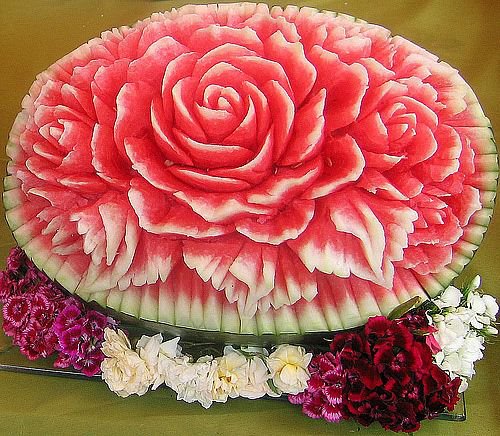



I am always in awe at what people can create from simple things that most of us just look at and don’t think much about. Here are some great examples of watermelon art to add to the others I have posted in the past.

I am always in awe at what people can create from simple things that most of us just look at and don’t think much about. Here are some great examples of watermelon art to add to the others I have posted in the past.
 What a great mix of real life images being blended together to make a unique piece of art! Not my favorite subject (the snake) but it is beautiful and I thought I would like to share it with you. Hope you like it!
•Most perennials stay in bloom for about three to six weeks. So, the secret to enjoying them to their fullest is to select plants with staggered bloom times for a bed full of color throughout the season.
•Carefully choose your color scheme. Red makes a flowerbed seem larger and closer, while blues will make it appear smaller and more distant. Pinks combine well with purple, and red with violet. White is a good complement for any color.
•Prepare planting beds by digging the soil to a depth of 12-18″. Work in plenty of peat moss, leaf mulch or compost to ensure good drainage. Space plants properly, as crowded plants grow less vigorously.
•Get your perennials off to a good start by fertilizing lightly when planting.
• Some easy-to-grow perennials for any area of the South include: phlox, candytuft, dianthus, daylily, rudbeckia, salvia, hosta, purple coneflower and verbena.
•Now is also a good time for harvesting a variety of vegetables. For that “homegrown” quality and taste, be sure to harvest at the best stage of maturity and carefully handle vegetables that will be eaten at any time later than the same day harvested.
• Weeds—Pull as many invaders out of your flower and shrub beds as you can before they produce seeds (and therefore more weeds). You’ll find that they are easier to pull after a rain. If your forecast is dry, use a sprinkler the day before you plan to work in the garden. If you have a lot of weeds to pull, try using a long-handled scuffle or stirrup hoe to save your back and knees.
• Slugs—These pests can be especially damaging to hosta foliage, leaving it marred for the entire growing season. To be sure the problem is slugs, look for the dried slime trail on the leaves. Slugs feed at night, so you rarely see them during the day. Although effective, slug bait pellets can be poisonous to children, pets, and birds. You might find a saucer of beer or a sprinkling of fireplace ashes in the mulch around the plants just as effective, cheaper, and safer than commercial baits.
• Water—As the weather gets hot, remember that new additions to your garden will need watering more often than established plants.
• Lawns—This is a good time to patch warm-season lawns such as Zoysia, St. Augustine, improved Bermuda, and centipede with sod of the same type grass. You can also sow seeds of turf-type fescues or cool-season blends to thicken bare or thin areas of your lawn.
• Shade—Protect new transplants from direct sun for about a week until the roots get
settled in their new location. A light layer of pine needles or hay will help, or you can construct a small shelter from a mesh plant tray supported by sticks or dowels.
• Petunias—Pinch back plants several inches to prevent long, stringy stems and to encourage repeated bloom through the summer. You may need to pinch a couple more times during the season. Fertilize with timed-release granules, such as 17-17-17, or water with liquid 20-20-20 every other week.
Fall Leaf Bars
1 3/4 cups all-purpose flour
1 1/2 cups sugar
1 1/2 teaspoons ground cinnamon
1 teaspoon baking soda
1/2 teaspoon each baking powder and ground nutmeg
r, 1
2 large eggs
1 cup canned pumpkin
6 tablespoons butter or margarine, melted
1/3 cup water
Cheese leaf rilling (recipe follows)
In a large bowl, mix flour, sugar, cinnamon, soda, baking powder, and nutmeg. Add eggs, pumpkin, butter, and
water; beat well. Spread batter in a buttered and floured 10- by 15-inch pan. Drop cheese filling in 24 equal portions (each about 1 tablespoon) equally over surface of batter. With a knife tip, pull edges of cheese into leaf shapes.
Bake in a 350° oven until center of cake (not cheese) springs back when lightly touched, about 30 minutes; let cool. Cut pieces so cheese is in center of each. Serve warm or cool, or cover and chill up to 3 days. Makes 24.
Cheese leaf filling. Smoothly mix 1 large package (8 oz.) cream cheese, 1 large egg, and 1/4 cup sugar.
Per piece: 161 cal. (39 percent from fat); 2.6 g protein; 6.9 g tat (4.1 g sat.); 23 g carbo.; 109 mg sodium; 45 mg chol.
 Country & Victorian Times