Victorian Hats

Throughout the half century, bonnets and hats, apart from sporting styles, were lavishly trimmed, and hair was invariably decorated with flowers, jewels or feathers for evening. Indoor caps were gradually discontinued, by the 1870s worn only, perhaps, with a tea-gown or breakfast jacket and by elderly ladies; servants and country folk wore them well into the 20th century. The variety of millinery styles throughout this period was enormous, and it is only possible to indicate the main shapes, which were dictated by the hairstyles. During the 1850s bonnets became shallower and set further back on the head, developing in the early 1860s into the spoon bonnet, which had a narrow brim close to the ears, rising vertically above the forehead in a spoon-shaped curve and sloping down behind to a very small crown, edged with a bavolet at the back. Bonnet strings (or ribbons) were wide, and often not tied but held by a brooch or pin under the chin, occasionally with a tiny bunch of artificial flowers. A curious addition to the bonnet between 1848 and 1864, appropriately called an ugly, was an extra brim resembling the front of a calash, made of half hoops of cane covered with silk and worn round the front as a protection against the sun; when not in use it could be folded flat. The most romantic-looking hat of the 1850s was a leghorn straw with a very wide brim dipping down at the back and slightly at the front and a high or low crown, trimmed with a lace or tulle veil, ribbons orflowers, or possibly all three; it appears to have been more popular in France and Germany, but was certainly adopted with slight variations in England and America for children’s wear.

With the massive arrangement of hair at the back of the head in the late 1860s and early 1870s, bonnets had to be worn further forward, the front curving fronijust above the hair-line to behind the ears where the ribbons were attached, the back cut away to allow the hair to flow freely. At this time hats were also perched on the forehead; a pillbox shape is sometimes referred to as a casquette, a name also applied to a hat following the lines of the Scotch glengarry cap. The Lamballe bonnet or plateau (named after the Princesse de Lamballe) might be classified as a bonnet or hat – worn in the same way as the pill-box, it closely resembled it but was more oval in shape and tied on by strings under the back hair or chignon or, when curved down slightly at the sides, would have ribbons tied in a large bow under the chin.

Small-brimmed hats, slightly wider in summer, toques and tiny bonnets set on top of the head above the close, high-dressed hair and fringe, helped to increase height in the late 1870s and 1880s; crowns rose, with a flower-pot shape appearing in the late 1880s. Trimmings, arranged to give a vertical line, could be elaborate and even bizarre: small birds, feathers, feather wings, aigrettes, beetles, flowers, fruit and vegetables intermingled with loops of fancy ribbon, velvet and/or tulle. Fur decorated some winter hats, and toques made of sealskin became very popular. At the same time, for country and sporting activities, plainer and rather masculine hats were in vogue. Boaters, introduced as early as the 1860s, continued to be worn, straight or tilted, into the 20th century. The Fedora felt hat, similar to a Homburg, was named after the heroine in a play by Sardou in which Sarah Bernhardt scored a success. Yachting caps were worn for sailing or at the sea-side. The tam-o’-shanter, for country wear, was a soft, round, flat cap or hat with no brim and a bobble in the centre of the crown; in the 1880s it might be made of velvet, plush, cloth or crochet; a knitted version became usual later.

During the 1890s, bonnets lost favour with the fashionable although still worn by some elderly ladies, even after 1900, and for mourning with a long crape veil. Hats became wider-brimmed, worn high on the head over the fuller hairstyle; even toques were often quite large, draped or ruched in velvet, silk or tulle. Trimmings, ribbons, flowers and feathers still emphasized a vertical line

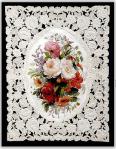
Valentines Day Card History

Valentine greetings have been popular since the Middle Ages, a time when prospective lovers said or sang their romantic verses. Written valentines began to appear after 1400. Paper valentines originated in the 1500s, being exchanged in Europe and being given in place of valentine gifts and oral or musical valentine greetings. They were particularly popular in England. The first written valentine (formerly known as “poetical or amorous addresses”) is traditionally attributed to the imprisoned Charles, Duke of Orleans, in 1415. While confined in the Tower of London after the Battle of Agincourt, the young Duke reportedly passed his time by writing romantic verses for his wife in France. Approximately sixty of the Duke’s poems remain and can be seen among the royal papers in the British Museum. They are credited with being the first modern day valentines.

By the Sixteenth Century, written valentines were commonplace and by the Seventeenth Century, it was a widespread tradition in England and other Western countries for friends and sweethearts to exchange gifts and notes on February 14. During the early 1700s, Charles II of Sweden brought the Persian poetical art known as the “language of flowers” to Europe and throughout the Eighteenth Century, floral dictionaries were published, permitting the exchange of romantic secrets via a lily or lilac, for example, culminating in entire conversations taking place within a bouquet of flowers. The more popular the flower, the more traditions and meaning were associated with it. The red rose, for instance, believed to be the favored flower of Venus, Roman Goddess of Love, became universally accepted to represent romantic love. Thus, the custom of giving red roses on Valentine’s Day quickly gained popularity.

Some time after 1723, the popularity of valentine cards in America began to grow with the import from England of valentine “writers.” A “writer” was a booklet comprised of a vast array of verses and messages which could be copied onto gilt-edged paper or other type of decorative sheet. One popular “writer” contained not only “be my valentine” types of verses for the men to send to their sweethearts, but also acceptances or “answers” which the ladies could then return. Late Eighteenth Century and Early Nineteenth Century valentines were often religious in nature and it is possible that the “Sacred Heart” often depicted on these cards eventually became the “Valentine Heart” with the customarily accompanying Angel eventually becoming “Cupid.” It is believed that the earlier versions of these religious valentines may have been made by nuns who would cut-out the paper lace with scissors. It is thought the process probably took many days since the cards had every appearance of being machine-made.

One popular style of early American card from 1840 to approximately 1860 was the “Daguerreotype,” a photographic process using old-time tintype in the center of a card surrounded by an ornametal wreath. Another was the “Mirror Valentine,” which contained a small mirror placed in the center to reflect the face of the recipient. However, the sending of valentine greetings in America did not become a true tradition until around the time of the Civil War (1861-1865) when valentine cards often depicted sweethearts parting, or a tent with flaps that opened to reveal a soldier. These were known as “windows.” In peace time, the “window” would be a church door opening to reveal a bridge and groom. Another Civil War valentine novelty was for the card to have a place for the sender to include a lock of hair. By the early 1800s, valentines began to be assembled in factories. Such early manufactured valentines were rather simplistic, composed of black-and-white pictures painted by the factory workers. Fancy valentines comprised of real lace and ribbons were introduced in the mid-1800s. Paper lace began to be introduced to the cards later in the 1800s, These valentines also contained delicate and artistic messages with pictures of turtledoves, lovers’ knots in gold or silver, bows and arrow, Cupids and bleeding hearts.

During the Victorian Era and its printing advances, Valentine cards became even more popular and the modern postal service of the age implmented the “penny post,” which made it easier to mail written valentines. (Prior to that time, postage was so expensive that most cards were hand-delivered and usually left on doorsteps.) Known as “penny postcards” (because they were mailed with a one-penny postage stamp), these valentine greetings were very popular from around 1890 to 1917. During this time, it was also considered “proper” to collect and display collections of postcards and trade cards in the Victorian and Edwardian parlor. Friends and guests would be invited to sit for hours, leafing through albums while they visited. This custom gained so much popularity that photographers, studios, printers and business continually strived for new and exciting subjects to satisfy a public which was anxious for innovative items in order to impress their acquaintances. To make their cards stand out, people often sought for real photographic postcards. As opposed to mass-produced lithographs, these were actual photographs made with a postcard-printed back. The photography studios frequently employed women to hand-tint and color the black-and-white images. Some of the best of these cards came from Germany…famous for its detailed and colorful lithography. Popular subjects included women, children, flowers and couples, posed and arranged in an effort to portray the idealized virtues of the Era. Indeed, it was in England that the first commercial-type valentine was produced on embossed paper, later perforated to make a lace-type design. Some of these cards contained tiny mirrors with the message: “Look at my Beloved,” while others were called “Cobweb Valentines” because the center could be lifted by a tassel to reveal a cobweb effect of paper and underneath, a picture of a couple or a romantic message.

Although pre-Victorian valentines are virtually unavailable today, but cards have survived over a century due chiefly to the fact that they began to be mass-produced around 1850. However, the majority of early Victorian valentines were customarily made by hand from honeycombed tissue, watercolors, paper puffs, colored inks, embossed paper hearts and exquisite lace. These were truly beautifully-created small works of art, often adorned with silk or satin (in addition) to lace, flowers or feathers and even gold leaf. Such fragile honeycomb designs remained the vogue until around 1909. Some of the most unusual valentines were fashioned by lonely sailors during this time…unique cards sporting seashells of various sizes employed to create hearts, flowers and other designs, or to cover heart-shaped boxes. Sailors also sent what were known as “Busk Valentines,” rounded long sticks fashioned from ivory or wood, somewhat resembling a tongue depressor but approximately five time longer. Upon these sticks, the sailor would carve hearts and other loving designs. The “Busk Valentine” was worn by the sailor’s sweetheart inside her corset. It was not unusual for a manufactured valentine of this era to cost as much as a month’s earnings, particularly the “proposal valentines” which were very popular and might contain the depiction of a church or a ring. In keeping with Victorian etiquette, it was considered improper for a lady to send a valentine greeting to a man.

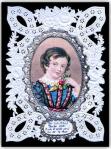
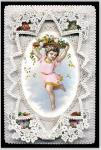
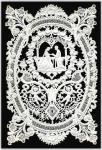
Victorian Valentines Day Cards PHOTOS

Christmas Stocking History

Hanging a Christmas stocking is a tradition that has been followed since times immemorial. It is believed that St. Nicholas would fill the stockings with gifts, on the eve of Christmas. Small kids eagerly wait for his arrival and the gifts that he would bring along with him. They decorate their stockings beautifully and hang them nearby fireplace. Although there are no written records of the origin of Christmas stockings, there are some popular stories that have been believed since generations. One of the most popular legend talks about the history of Christmas. In the article, we have provided interesting information on the origin and history of Christmas stockings.

Origin Of Christmas Stocking
Many centuries back, there lived a poor man in a village. He had three beautiful daughters. His wife had passed away due to some illness and he had spent all his money to cure his wife. Thus, he was left with no money to marry off his daughters. The three daughters were very kind and strong and this is what worried their father even more. He was concerned what would happen to them after his death. One fine day, St. Nicholas was passing through the village, when he overheard the discussion of some villagers talking about the pitiable condition of the three girls. St. Nicholas wanted to help the poor father, but he knew that the old man wouldn’t accept money from him.

St. Nicholas decided to help the family secretly, without letting anybody else know about it. He waited until it was night and stealthily sneaked into their house, through the chimney. He had three bags of gold coins with him, one for each girl. As he was looking for a place to keep those three bags, he noticed stockings of the three girls that were hung over the mantelpiece for drying. He put each bag in each stocking and then went away. When the girls and their father woke up the next morning, they were thrilled to find the bags of gold coins. He happily married off his daughters, one after the other, and they remained happy for the rest of their lives. The story about St. Nicholas being so generous spread throughout the village and then all over the land. Since then, it has been a tradition to hang stocking on Christmas in the hope that St. Nicholas would bring a present
.

Decorating Your Own Victorian Christmas Tree

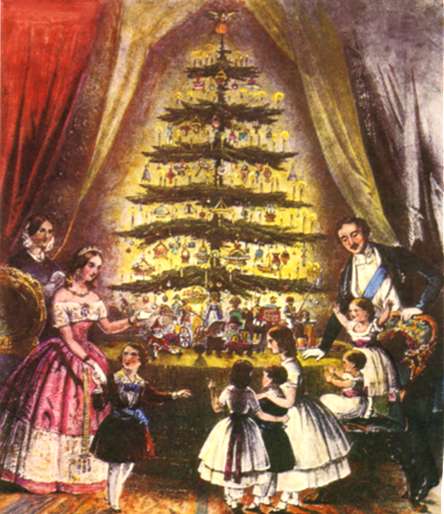
The Victorians loved their Christmas trees, and decorated them lavishly. Much time was spent in the weeks leading up to Christmas Eve making homemade ornaments to suspend on the tree branches.

Today store bought decorations have largely replaced homemade ornaments. But if you would like to have Victorian Christmas tree of your own, consider making your own authentic ornaments to hang on the branches of your tree.

Victorians lit their trees with candlelight, which isn’t practical or safe today, but you can now find some stores that carry replica electric lights that mimic candlelight and clip to your tree’s branches to get you started. From there, you can complete the look with these hand-made decorations:

* String popcorn and cranberries for garland. Do every other one or design a particular pattern of your own (three cranberries, two popcorn, five cranberries, etc.) depending on how much of each color you want.

* Dip small cookies cut like snowflakes into glue and then glitter for sparking accents on your tree. To preserve them, spray lightly with either craft preservative or hairspray.

* Paint walnuts (still in the shell) with gold or silver paint. Attach a thin ribbon bow to the top with a thumbtack and hang on the tree.

* Curl small paper doilies into cones and fill with hard candies, nuts or potpourri. Attach ribbon and tie to tree branches. You can find the doilies in a variety of pretty colors.

* Recycle old Christmas cards to decorate your Victorian Christmas tree. Cut out pictures you like and glue to cardboard, then highlight with glitter or metallic fabric paint. Attach colorful ribbons and hang.

You’ll be amazed at how your Victorian Christmas tree glitters and shines with its assortment of genuine period ornaments. Now sit back with a cup of mulled cider and enjoy!