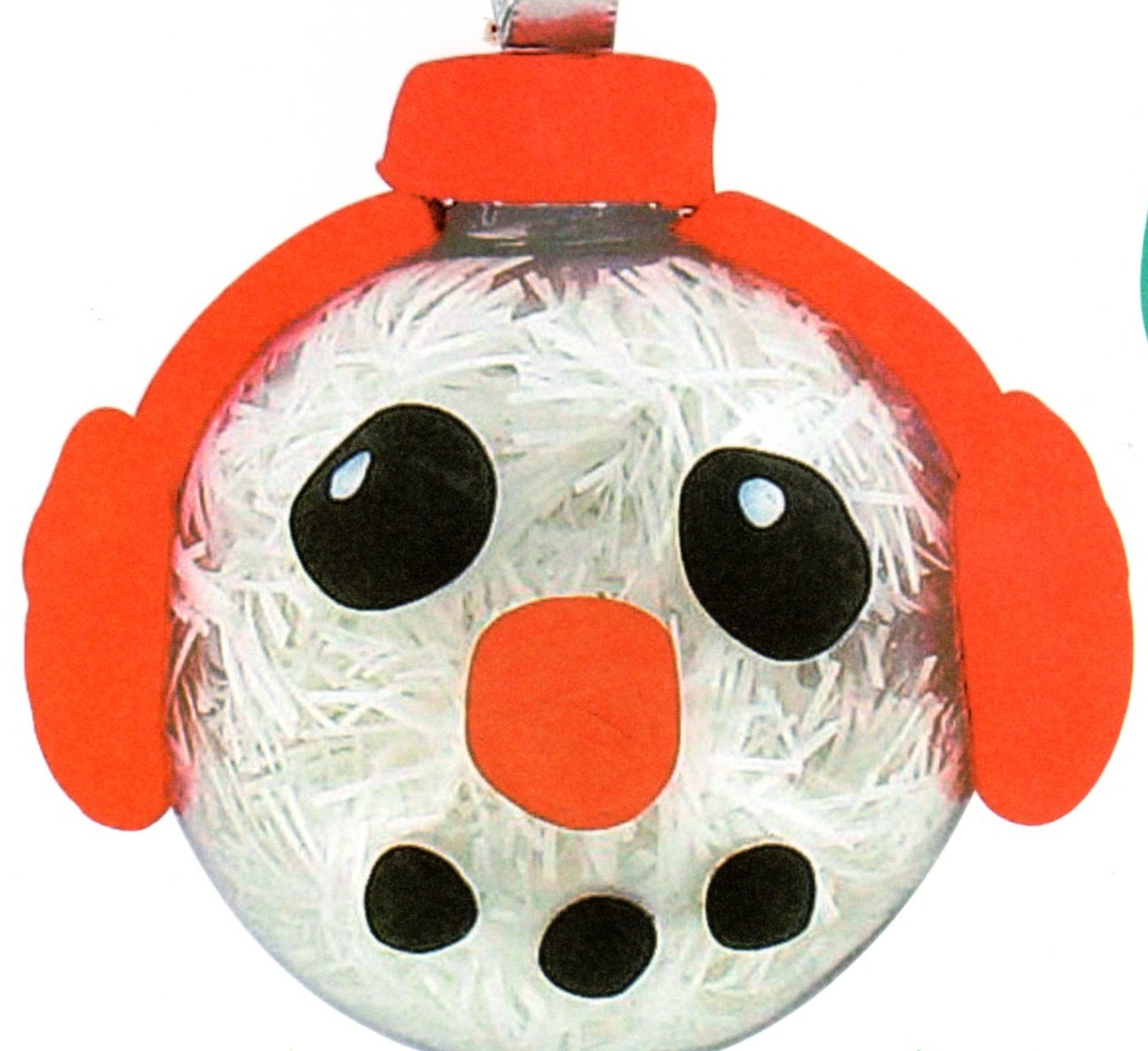
Christmas Snowman Ornament

Supplies
Fluffy-Red, Black, Orange and White
Sculpey* Clay Tool Starter Set
Glass Ornament – make sure you only
use a glass ornament; plastic ornaments
will melt in the oven D Ribbon D Acrylic Roller D Quick Drying Glue D Disposable Foil or Wax Paper D 12″ Piece of White Tree Garland

Instructions
Getting Started: Do not use unbaked clay on unprotected furniture or finished surfaces. Good working surfaces include a glass or metal surface, disposable foil or wax paper. Knead clay for 2 minutes. Bake on oven-proof glass or metal surface at 130 °C (275 °F for US customers) for 15 minutes per 6 mm CA”) of thickness. Do not use in microwave oven. Do not exceed the above temperatures or recommended baking time. All baking should be completed by an adult. Wash hands after use.

Step 1 Remove metal cap/hanger from ornament. Remove wire hanger from the cap and set aside. Make a red clay disk slightly larger than the diameter of the ornament cap.

Step 2 Wrap the red clay disk around the edges of the ornament cap. Using the 2 mm pointer tool from the Clay Tool Starter Set, poke holes through the red clay so the holes in the cap remain open to replace the hanger later.

Step 3 Make 2 wide red strips for the headband and 2 large red domes for the ear muffs. Then make 2 medium black disks for eyes and 3 little disks for mouth. Make 2 tiny white eye highlights and an orange cone shape for the nose.

Step 4 Place the face pieces firmly onto ornament, making sure each piece follows the curve of the glass. With the blunt point tool from Clay Tool Starter Set, texture the ear muffs. With the flat knife tool, texture the nose. Make sure the clay covered cap will go back on and that the ear muff headband does not interfere with the fitting of the cap. Bake as directed.

Step 5 Allow to cool then gently remove all the clay pieces. Glue them back on permanently and allow to dry. The clay cap covering will not need to be glued on. Replace the wire hanger into the holes in the cap. Fill ornament with white free garland. Replace the cap and add ribbon.

Christmas Jingle Bell Projects

Bell Wreath Supplies
Heavy gauge floral wire
Christmas theme colored bells
Chenille stems-gold, green, red
Broad width ribbon – red

Bell Wreath Instructions
Step 1 Make a circular loop with heavy gauge floral wire.
Step 2 String bells along wire and fit them closely together around the length of the loop.
Step 3 Use a pipe cleaner to wind around the bells at either end of the loop to hold the wreath shape together in a circle.
Step 4 Tie a bow around a pipe cleaner and then tie that pipe cleaner around the part of the loop that was joined together.

Bell Tree Supplies
12″ Floral cone, Styrofoam*
Christmas theme colored bells
Wrapping paper
Chenille stems – hot pink, turquoise, lime green
Craft feather boa – white
Glitter foam sheet, sticky back – hot pink
Glue
Gemstone-turquoise
Toothpick
Pattern printed from http://www.michaels.com
Pencil
Scissors

Bell Tree Instructions
Step 1 With hobby knife, cut a Styrofoam* floral cone down to desired size for tree.
Step 2 Cover cone with wrapping paper that matches the bells you will be using to decorate. Glue paper into place.
Step 3 String bells on lengths of chenille stems, keeping in mind how big your cone is.
Step 4 Join the strings of bells by twisting them together, end to end. Push one end of the joined chenille stems into the top of the cone.
Step 5 Begin circling the cone with the chenille stems and bells starting from the top and working down to the bottom in a spiral. Push in the other end of the pipe cleaner into the bottom edge of the cone.
Step 6 Wrap and glue craft boa to the base and top of the cone.
Step 7 Trace two stars and one base onto sticky foam sheet and cut out.
Step 8 Stick two stars together, sticky side to sticky side and insert a toothpick in between the stars half way in from the bottom.  Insert into the top of the tree. Glue gemstone onto front of star.
Step 9 Glue the tree onto center of base and glue craft boa around the bottom of the tree.

Distressing Techniques

Distress Inks have been specially formulated to produce an aged look on papers, photos, fibers and more. These inks are not “better” than other inks; they just work completely “different” for the purpose of creating an aged look.

Here are some key points that make Distress Inks different:

STAYS WET LONGER ; the Distress Ink formulation allows blending and shading on photos and paper, as well as embossing! Other dye inks dry too fast, especially on photos which would result in lines and marks for direct to paper techniques.  Not with Distress Inks!

COLOR WICKS OR SPREADS OUT – these inks will travel across the surface of your paper when spritzed with water; other dyes do not travel as much although they might bleed a little when wet, the Distress Inks actually “wick” or spread out much further creating several tone on tones.

COLOR STABILITY – the colors of the Distress Inks will not break down when wet or heated allowing you to have more color control for the finished look;  other “brown colored” dyes will break down when water is added leaving a pink & green hue.

COLOR PALETTE – Well these are unlike ANY other colors of inks you’ve seen!

*Antique Linen: the color of aged lace or linens found in the cherished heirlooms of grandmother’s trunk.

*Tea Dye: the orange hue of saturated tea bags with the results of dying in a tea bath for days.

*Vintage Photo: this color is captured right out of the photographs from times gone by.

*Walnut Stain: a rich, dark stain of an old walnut tree perfect to create a dark wash of color

* Fired Brick: the look of charred cinders from an old camp fire

* Weathered Wood: the patina on a dairy barn’s window frame

TO DISTRESS: I like to use water when I am distressing.  I think it gives the papers more of a weathered texture, so here’s how I start.

Working on any type of paper (manila, card stock, or text weight), crumple the paper up – always press in the center of any heavyweight card stock or manila stock – this will break the surface tension of the paper and allow you to crumple up the paper easier without tearing it.

Next rub the Distress pads over the surface – you can work with several different colors or just one – WALNUT STAIN IS IDEAL FOR THIS.

Then spray the inked surface with water (you will immediately notice the ink “travels” outward when water is applied as these inks are designed to react with water).

Heat the surface to dry – and here’s why…  Although you don’t have to Heat Set these inks for any reason, I like to dry the water using either my Heat Tool or a craft iron.  This will allow for more tone control and keep areas dark and others light.  Ironing the paper will also give you a much smoother surface to stamp on without compromising the aged finish.

Note: If you allow the surface to air-dry most of your color will end up on the edges only because the paper will bend and buckle when wet, forcing the ink and water to the edges.  Notice that these Distress Inks retain their color value even when wet and dried.  Other brown dyes will break down in color (sometimes leaving a pink and green hue).

FOR STAMPING:  What can I say about the many stamping applications these inks can achieve.  Once again the special formulation on these Distress Inks provides a versatile finish on papers yet still allow for “normal” stamping applications.  I like to stamp on uncoated (matte) papers and immediately rub the image with a cloth – this will soften or shadow your image WITHOUT smudging any detail, VINTAGE PHOTO, WALNUT STAIN and TEA DYE are wonderful for this one!  Another surface is glossy card stock – keep in mind this is a different type of dye ink so when you stamp on glossy, certain areas of your image will “bead” up, once again providing a Distressed look without you doing a thing (this is probably one of my most favorite looks) – some areas of the image appear “pitted”.  Brayering on glossy cardstock is also wonderful because you can still manipulate the inks with different tools, brushes, fingers, whatever.  Even after the ink is applied you can achieve amazing texture and color shading.

ON PHOTOS:  Finally an ink formulated for photos!  Whether you’re a scrapbooker or not you can use all types of photos (vintage or new ones) on your cards and pages.  Distress Inks work on MOST types of black and white photos – inkjet, laser, toner copies, and regular photos. Always test the type of photo paper and printer first!!!

Tinting Photos:

*Tint your photos using your choice of Distress Ink colors and the Cut n’ Dry Nibs.

* Drag the nib across the Distress pad to pick up ink and color directly on to your photo using the nib ; the inks blend without leaving any lines.

* For larger background areas, tint the photo using a cosmetic make up sponge or craft sponge.

* Tap the foam on to the Distress pad and wipe inks on to your photo.  Repeat for desired look.

Distressing Photos:

* To Distress, begin with the lightest colors ANTIQUE LINEN only (direct to photo).  Cover the photo in the lighter color. ; THIS WILL NOT SMEAR ANY OF THE DISTRESS INKS COLORS YOU TINTED WITH!

*Blend the photo with a clean piece of foam or cosmetic make up sponge immediately after applying ink.

*Next, age the edges with VINTAGE PHOTO or WALNUT STAIN by applying the ink with foam or cosmetic make up sponge.

Rubber Stamping History

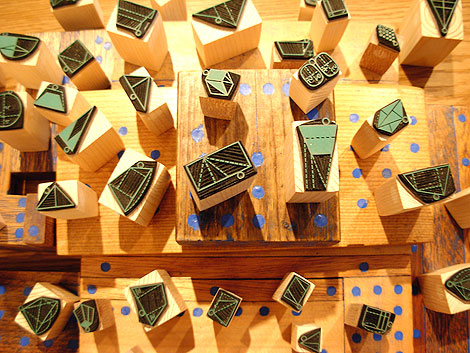
Can you make a common denomination between rubber stamping and Myan civilization? Rubber Stamping is, beyond a doubt, one of the fastest growing crafts today. With its inexpensive materials and creative limitless boundaries, rubber stamping provides millions with hours of fun and creativity. Here’s a brief history:

• Spanish explorers were the first to talk about a “sticky substance” that bounced, used by South American Indians. Though it didn’t revolutionalize the world at that time, these same Indians were using a primitive form of rubber stamping to “mark and tattoo” images on men and women.

• In 1736, Charles Marie de la Condamine, a French scientist studying the Amazon, sent a piece of “India Rubber” back to France.

• Rubber got its name in 1770, when the scientist Sir Joseph Priestly made a comment about a substance “excellently adapted to the purpose of wiping from paper the mark of black lead pencil.” Hence the “rubbing out” of pencil marks gave it the term “rubber”. Up until this time, people wishing to erase pencil marks had to use bread crumbs.

• Rubber Stamping owes much gratitude to a hardware store owner who decided to quit his job to solve the “sticky problem” he had heard about. Though his persistence was tested time and again, even filing bankruptcy and going to jail for failure to pay debts, Charles Goodyear eventually discovered that heat was the secret to rubber’s “curing”.

• As early as 1866, a man carved information in a flat piece of rubber and mounted it to a curved block of wood. This 4″x 6″ mounted rubber stamp was being used to print information on bath tubs.

• Early rubber stamps consisted mainly of words and phrases used to mark packages and manufactured products. Stamping suppliers began to spring up in Ohio and the West.

• Rubber stamping as a hobby took off in the early 1970’s with companies such as All Night Media (1974) and Hero Arts (1974). Soon the craze had caught and many other companies decided to cash in on a hobby that would last for decades.

• It wasn’t until a boom in the 1990’s that rubber stamping became so popular with millions of crafter’s worldwide. As thousands of companies begin to produce rubber stamps, the availability and unique designs became common everywhere!

It’s no wonder why rubber stamping has turned into a worldwide crafting phenomenon. Women and men alike have found hundreds of creative uses for rubber stamps, from scrapbooking and cardmaking, to gift bags and 3D artwork. Give it a try, you’ll see!

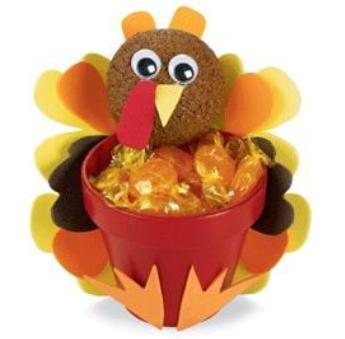
Thanksgiving Turkey Place Setting

Materials:

  • DecoArt® Patio Paint – Pinecone Brown
  • DecoArt® Patio Paint – Tuscan Red
  • Clay Pot
  • Container of Water
  • Disposable Plate for Paint Palette
  • Paper Towels
  • Craft Smart® Paint Brush
  • Creatology™ Foam Sheet – Red
  • Creatology™ Foam Sheet – Brown
  • Creatology™ Foam Sheet – Orange
  • Creatology™ Foam Sheet – Yellow
  • Blunt Scissors
  • Tracing and Transfer Paper
  • Creatology™ Wiggle Eyes
Instructions:
  1. Print patterns. Trace and transfer patterns onto foam sheets (refer to photo for colors) and cut out shapes with scissors.
  2. Use brush and Tuscan Red to paint pot.
  3. Use brush and Pinecone Brown to paint Styrofoam® ball.
  4. Push Styrofoam® Ball down over rim of pot to form head as shown.
  5. ADULT: Position and glue in place the eyes, beak, waddle, wings, feet and tail feathers.
  6. Add a persons name on the pot or add a “sign” that the turkey can hold with a persons name on it for a place setting.