Victorian Valentines History

The true origin of Valentine’s Day may never by known, since it is only legend that tells of the Christian martyr, Valentinus, who sent a letter of affection to his jailer’s daughter on the eve of his execution.  There is no historical evidence to back up the legend, as romantic as it is, but it seems the romanticism itself is enough to give credence to the origin of this holiday.  We do know, however, that the Romans celebrated the pagan festival of Lupercalia on February 14, commemorating the rural god Faunus, patron of husbandry and guardian of the secrets of nature. It is believed that birds chose their mates for the coming season on this day.

The earliest known (proven) valentines are poems, composed for the Valentine’s Day festivals for the courts of 14th-century England an France.  These poems celebrated ‘joyous recreation and conversation about love’. It is believed that this is when the custom of drawing lots for valentines began.  Girls drew boys’ names and boys drew girls’ names so everyone had a pair of valentines to choose from.  Whether the drawing itself resulted in many love affairs, or the lotteries were fixed in advance (which was not uncommon,) we shall never know.

By the 17th Century, lotteries were less common, and selections more deliberate.  It also became customary to present a gift along with the valentine card.  These gifts ranged from love-knots of plaited straw to the opulent jewelry showered upon royal mistresses.

By the mid-18th century, costly valentine gifts were being replaced by elaborate versions of written love messages.   Ideally, these were poetic compositions. But while the artistic embellished their poems with lace and drawings, the malicious embellished theirs with vulgar or cruel greetings which they sent to the ill-favored, long-unmarried or deformed.  Thus, valentines were usually sent anonymously.  Both to protect the giver and the receiver.

Valentine’s Day reached its height of celebration in the Victorian Era.

Valentine cards were more cherished that Christmas cards (which weren’t printed commercially until 1846), perhaps because of the sentimentality attached to them.  Due to this popularity, designing cards became a highly competitive market, with a vast array of motifs and verses.  Suddenly, cards were being produced in tens of thousands, from whimsy and slightly vulgar, to truly sentimental, their designs included lace paper, embossed envelopes, glass or metal mirrors, ribbons, dried ferns and fake advertisements, bank notes and marriage licenses.

Valentine cards were so popular that their production became a flourishing trade amongst cheapjack printers in central London.  Commercially printed valentine cards quickly superseded home-made offerings of earlier times.  They reached the height of their popularity during the 1870s and 80s.  Yet even though they were mass-produced, they still featured birds with real feathers, posies of dried flowers and spun-glass hearts, all trimmed with ribbons and gold lace.

Some valentines were so thick with embellishments, they came in presentation boxes. Some unfolded like fans, while mechanical valentines had levers or disks which made figures dance, hands move and birds flutter their wings.

The lyrics in these cards were as effusive as the decorations.  Whether sent by a steady beau or a secret admirer, these cards were unabashedly sentimental, pleading for affection and pledging undying devotion happily ever after.  Even men kept these tokens of affection hidden in their bureau drawers.

But as times changed, so did customs.  And as less became more on the advent of World War I, valentine cards became a dying art.

New Years History

New Year festivities are synonymous with partying and bad hangovers nowadays, but New Year is actually one of the oldest celebrations. It is first recorded as a major event in Babylon around 4000 years ago. The Babylonians knew how to throw a party, as celebrations lasted for eleven days, putting our modern excesses to shame.

The Romans celebrated new year in March until Julius Caesar re-worked the calender to begin on January 1, although in order to do so Caesar had to make the year 46BC last 445 days. The celebration of new year as a holiday has been popular in Europe for the last 400 years. In 1582 Pope Gregory XIII re-established January 1 as New Year’s day with calendar reform.

The ancient Babylonians can also lay claim to the practice of setting New Year’s resolutions. A popular resolution was to return borrowed farm equipment, a resolution many in the countryside today can say is still valid. Those hoping to lose some weight after huge Christmas dinners aren’t in luck. A variety of foods also play a role in New Year celebrations, helping to pile on those festive pounds.

Many cultures believe ring shaped foods will bring luck, symbolising things coming full circle. The Dutch, for example, eat doughnuts for luck. In America black eyed peas are commonly eaten with ham, and in Scotland shortbread and whisky are ubiquitous. Spanish people eat 12 grapes with each chime of the bells, and in Japan a bowl of ‘year-crossing’ noodles are eaten. Many people are adamant their resolutions to lose weight will start the very next day, naturally
Read on

In different cultures. events on New Years day can have an effect on the luck for the rest of the year. In many Western cultures the first visitor to the home, or ‘first footer’, will bring luck if tall and dark haired. In Scotland it is common for people to go ‘first footing’ around friends and families homes, having a whisky in each along the way.

Strange New Year traditions can be found all over the world. In Ireland it was once tradition to bang Christmas bread against the walls and doors to scare away bad spirits. In Colombia, Cuba and Puerto Rico a life-sized doll is filled with things that have bad memories associated with them, then it is dressed up in old clothes. At midnight, this ‘Mr. Old Year’ is set on fire.

Brazilians wear white clothes to symbolize peace for the coming year, and in Greece children leave their shoes out to be filled with gifts. In Scotland, New Year’s eve is known as Hogmanay and is a key party night across the country. Scottish poet Robbie Burns is also behind the song ‘Auld Lang Syne’, sung at New Year throughout the world.

Christmas Carol Origins

Maria Augusta Trapp has documented history of carols in a clear and concise way. According to her, singing and caroling at Christmas is one of the oldest folk customs of the day and has been present since the time when Christianity and Christmas season were still at their budding stages. It is a worldwide custom and there has been lot of research on the subject and several books have been written about it. Originally, music compositions and songs at Christmas were in the form of chants and hymns. Caroling originally meant ‘circle dance’ and the words to accompany this festive dance were later added to the tradition.

Initially, the church looked down upon carols and carol singing as a pagan custom and they could not be included in the sacred services. However, in the countryside, many simple folk songs and Nativity carols were written and gaine popularity too. In 1223, Saint Francis of Assisi introduced carols into the formal worship of the church during a Christmas Midnight Mass in a cave in Greccio, in the province of Umbria. That night, the songs and music that accompanied this sacred and formal event were not hymns but carols. Ever since then, carols caught on with the masses and were at their prime in the Middle Ages, when they were almost always a part of the mystery plays.

There was a time, when wandering minstrels and waits or watchmen that guarded the old walled cities in the night used to pass their time by singing carols and also sang them to the people who used to pass them by. They would go from home to home, singing carols and entertaining people and may be get a treat in return. Later groups of musicians began singing carols and playing them for various events that were held during the Christmas season. Today, carol singing has becoming an important of this holiday season and a number of caroling events are organized throughout the world during the festive season, especially on Christmas Eve!

Christmas Stocking History

Hanging a Christmas stocking is a tradition that has been followed since times immemorial. It is believed that St. Nicholas would fill the stockings with gifts, on the eve of Christmas. Small kids eagerly wait for his arrival and the gifts that he would bring along with him. They decorate their stockings beautifully and hang them nearby fireplace. Although there are no written records of the origin of Christmas stockings, there are some popular stories that have been believed since generations. One of the most popular legend talks about the history of Christmas. In the article, we have provided interesting information on the origin and history of Christmas stockings.

Origin Of Christmas Stocking
Many centuries back, there lived a poor man in a village. He had three beautiful daughters. His wife had passed away due to some illness and he had spent all his money to cure his wife. Thus, he was left with no money to marry off his daughters. The three daughters were very kind and strong and this is what worried their father even more. He was concerned what would happen to them after his death. One fine day, St. Nicholas was passing through the village, when he overheard the discussion of some villagers talking about the pitiable condition of the three girls. St. Nicholas wanted to help the poor father, but he knew that the old man wouldn’t accept money from him.

St. Nicholas decided to help the family secretly, without letting anybody else know about it. He waited until it was night and stealthily sneaked into their house, through the chimney. He had three bags of gold coins with him, one for each girl. As he was looking for a place to keep those three bags, he noticed stockings of the three girls that were hung over the mantelpiece for drying. He put each bag in each stocking and then went away. When the girls and their father woke up the next morning, they were thrilled to find the bags of gold coins. He happily married off his daughters, one after the other, and they remained happy for the rest of their lives. The story about St. Nicholas being so generous spread throughout the village and then all over the land. Since then, it has been a tradition to hang stocking on Christmas in the hope that St. Nicholas would bring a present
.

Decorating Your Own Victorian Christmas Tree

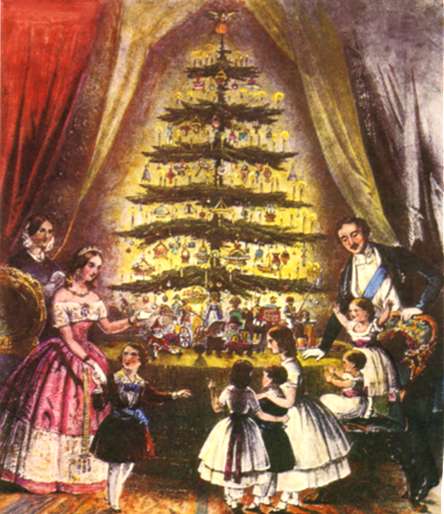
The Victorians loved their Christmas trees, and decorated them lavishly. Much time was spent in the weeks leading up to Christmas Eve making homemade ornaments to suspend on the tree branches.

Today store bought decorations have largely replaced homemade ornaments. But if you would like to have Victorian Christmas tree of your own, consider making your own authentic ornaments to hang on the branches of your tree.

Victorians lit their trees with candlelight, which isn’t practical or safe today, but you can now find some stores that carry replica electric lights that mimic candlelight and clip to your tree’s branches to get you started. From there, you can complete the look with these hand-made decorations:

* String popcorn and cranberries for garland. Do every other one or design a particular pattern of your own (three cranberries, two popcorn, five cranberries, etc.) depending on how much of each color you want.

* Dip small cookies cut like snowflakes into glue and then glitter for sparking accents on your tree. To preserve them, spray lightly with either craft preservative or hairspray.

* Paint walnuts (still in the shell) with gold or silver paint. Attach a thin ribbon bow to the top with a thumbtack and hang on the tree.

* Curl small paper doilies into cones and fill with hard candies, nuts or potpourri. Attach ribbon and tie to tree branches. You can find the doilies in a variety of pretty colors.

* Recycle old Christmas cards to decorate your Victorian Christmas tree. Cut out pictures you like and glue to cardboard, then highlight with glitter or metallic fabric paint. Attach colorful ribbons and hang.

You’ll be amazed at how your Victorian Christmas tree glitters and shines with its assortment of genuine period ornaments. Now sit back with a cup of mulled cider and enjoy!