
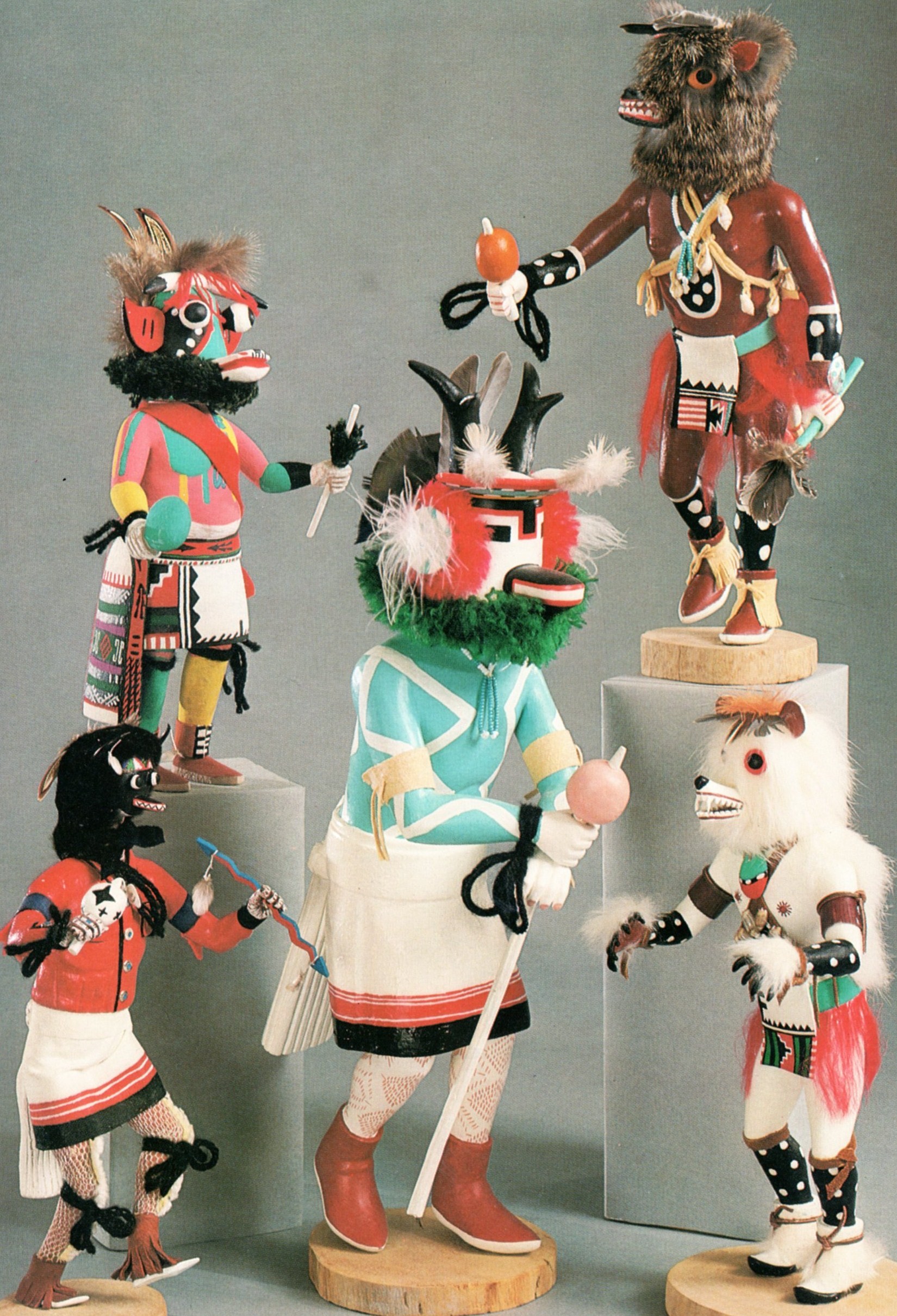
Kachina Dolls: The Animals

The animal Kachinas are the advisors, doctors and assistants of the Hopi. It is through the assistance of the animals that the Hopi have overcome monsters and cured strange diseases. In fact, the greatest doctor of them all is the Badger for it is he who knows all of the roots and herbs and how to administer them. The Bear shares in this ability. Other animals are warriors and know the ways of danger and can aid the men in be­coming like them.

All animals, however, share one attribute which is that they can remove their skins at will and hang them up like clothes. When they do they appear exactly as men, sitting about in their kivas. smoking and discussing serious matters. They are the Hopi’s closest neighbors and are always willing to assist if approached in a proper manner and asked for help. When prayer feathers and meal are not given they often withdraw until proper behavior is forthcoming.

The Animal Kachinas thus represent the relationship present be­tween the Hopi and the kacbina spirits which some may compare to a true friendship on the human level. It involves an exchange of special favors in their interaction, accompanied by an exchange of respectful gestures.

KWEO KACHINA Wolf Kachina
The Wolf Kachina appears as a side dancer who accompanies the herbivorous animals such as the Deer Kachina and the Mountain Sheep Kachina in the Soyohim Dances. He often clasps a stick in his hands which represents the bushes and trees that he hides behind as he stalks his prey. At the end of one of these dances the Hopi cast meal upon him and offer prayer feathers that they might also secure game using his prowess as a hunter. Dolls of this kachina arc, in contemporary times, elaborated with great teeth, lolling tongues and real fur that did not adorn the older dolls. There is almost always a Wolf Kachina on the shelf for purchase.

WAKAS KACHINA Cow Kachina
The Cow or Wakas Kachina is a comparatively late kachina. It was reputedly conceived and introduced by a Harm man around the turn of the century. The kachina enjoyed a long run of popularity right after its introduction and then again in recent years. The name is derived from the Spanish word vacas for cows. The kachina is danced to bring an increase in cattle.

MOSAIRU KACHINA Buffalo Kachina
The Buffalo Kachina is not the same figure as that seen in the social dance (see White Buffalo, p. 82) that has been carved in recent years. It is a kachina and is masked. Formerly these were made with a green face as well as one in black but in recent years the former has all but disappeared. It appears in the Plaza Dance usually with the mixed kachinas.

HON KACHINA Bear Kachma
There are a number of Bear Kachinas. Some are distinguished only by color such as the Blue, White, Yellow or Black Bear Kachinas. There are others such as Ursisimu, who have become extinct, and Ketowa Bisena, who is the person­age that belongs to the Bear Clan at Tewa. There are Bears fancifully dressed and Bears that are not. All Bear Kachinas are believed to be very powerful and capable of curing bad illnesses. They are also great warriors. Bear Kachinas appear most often in the Soyohim or Mixed Dances of springtime or occasion­ally as side dancers for the Chakwaina Kachinas.

CH6P-SOWI-ING KACHINA Antelope-Deer Kachma
This kachina points up the similarity of the Deer and Antelope Kachinas be­cause by exchanging the antelope horns for deer antlers the doll would become a Deer Kachina. Both Antelope and Deer may wear shirts, usually in cold weather, and either may have a white or blue face. Formerly the attributes of each were more rigidly separated than today.

CHOP KACHINA Antelope Kachina
The Antelope Kachina appears in the Plaza Dances either as a group in the Line Dance or as an individual in the Mixed Dance. He, as well as all other herbivorous animals, makes the rains come and the grass grow. He usually dances with a cane held in both hands and accompanied by the Wolf Kachina as a side dancer.

PONG KACHINA Mountain Sheep Kachina
The Mountain Sheep Kachina appears in Line Dances or as an occasional figure in the Mixed Dance. It dances holding a cane in both hands to represent the forelegs as it bends over and moves through the steps. The kachina has power over the rain as do the other herbivorous animals and is able to cure spasms as well.

KAWAI-I KACHINA Horse Kachina
The Horse Kachina derives its name from the Spanish word for horse, caballo. The kachina is of recent introduction as the Hopi did not adopt the horse until quite late, preferring the burro as a beast of burden, and their own two feet if speed was desired. Early travelers through Hopi country had difficulty with Hopi guides on foot setting a pace that soon exhausted their horses. The kachina is usually seen in Mixed Dances.

HONAN KACHINA Badger Kachina
The Hopi have two distinct forms of the Badger Kachina. This form is charac­teristic of Second Mesa and is a Chief Kachina who appears during the Powamu and the Pachavu ceremonies. It is a curing kachina. The costume and gear are not a fancier version of the other kachina but are instead of a form which probably arrived at a different time. There is some confusion on Third Mesa with the Sio Hemis Hu. However, that kachina does not have Badger tracks on its cheeks.

HONAN KACHINA Badger Kachina
This doll, characteristic of the smaller and more rapidly manufactured effigies, is also a Honan or Badger Kachina. It is more often seen during the Mixed Dances on Third Mesa or the Water Serpent Ceremony on First Mesa than during the Powamu. It bears a superficial resemblance to the Squirrel Kachina.
 

Victorian Fashion

Elaborate dresses, lavish balls, a beautiful countryside and images straight from the canvas of the great artists come to my mind when I think about the Victorian era. The Victorian period or the Victorian era can be termed as the period under the reign of Queen Victoria. This period was between the year-1837 to 1901. I am sure many women would love to slip back into time and fulfill their dream of wearing bustle skirts with some fancy feathered hats at some point in their lives! Rich fabrics and genteel women attending fancy dos with cultured men are some of the glimpses of the life back then! Here’s a look at the kind of fashion followed in the Victorian Era. Victorian fashion has many interesting things to note and you can delve into the depths of Victorian fashion, right here!

Victorian Fashion:
The term Victorian fashion is generally used only with regard to the United Kingdom. There were certain clothing styles and mannerisms that were observed during this period. In the early period of the Victorian Era, the silhouette for the woman was more of the demure kind. Women wore pointed bodice, which were long and had fitting waists. The bodice was designed to enhance the waist. In the early period, Victorian clothing for women was about restriction of arm movements. Another interesting feature were the detachable collars! The colors used in the early period of the Victorian fashion were soft, pastel shades. Patterns were delicate and fashionable, all designed to maintain the femininity of the woman.

Beehive shaped skirts was another characteristic feature of Victorian fashion. Here, garments were stiffened to give a particular appearance. Crin also known as horsehair, was used for a particular portion of a garment so that it stiffens in that particular area. Crin was used for hem linings and sleeve heads of the dresses.

Although cloth was manufactured in the mills, Victorian clothing in 1837 was generally designed and assembled by tailors and other such specialized people who were into designing clothes and hats. These people catered to only a specific few of the society who could afford this service; others stitched their clothes at home.

Bell shaped skirts also became a rage and these became wider in the 1830s. The bell shape soon became dome shaped. As these skirts became bigger and flared out, they also needed support from the inside. Victorian dresses therefore needed to be worn with a lot of petticoats. The lower portion was also supported by horsehair, which were woven into the pattern for the stiffened look.

The cashmere shawl was also a prominent feature of Victorian fashion. It was particularly noticed in 1840. By then, the shawl was used as wrap over the dresses. Women also wore heavy fabrics such as satins and silks and there was also a time when fabric dictated the status of the person in the society as well.

Slowly these huge ballooned Victorian skirts gave way to the hobble skirts. Hobble skirts brought into fashion narrow skirts, where in knee length corsets were combined with the entire ensemble. Hobble skirts often restricted movement, which is probably why they have been given this name. These slim skirts created a problem for women in the comfort factor yet they gained popularity with time. Today, the slim pencil skirt can still be witnessed in the fashion scenario in many modified ways.

Apart from horsehair, bustles were also used to increase the fullness of the skirts. Bustles were used to make the waist look smaller. Many times, the fullness of the fashion was spread out towards the back and this often fanned out in the shape of a train. Bustles were also seen in different shapes. Sometimes, these also created a hump below the waist area on the backside, which was considered to be a fashion statement in the Victorian era. The bustle therefore, can be considered to be yet another typical feature of Victorian fashion.

Victorian fashion for men was about Norfolk jackets and the sack suits. Men preferred to don themselves in casual attire.

Victorian fashion was thus quite elaborate as far as women’s clothing was concerned. Victorian clothing is still very much popular and the basics have been woven into new modern designs to create contemporary attire!

History Of The Boot

THESE BOOTS ARE MADE NOT ONLY FOR WALKING but for working in all kinds of weather—and looking smart, too. They were introduced in 1817 by Hoby of St. James’s Street, London, the personal shoemaker of Arthur Wellesley, the first Duke of Wellington, famous for defeating Napoleon at Waterloo. Wellingtons were initially designed to look good with the newfangled men’s fashion of wearing long trousers instead of knee breeches.

The boot’s predecessor, the Hessian, had a curvy folded-down top and heavy braid.The duke wanted something simpler, made from soft calfskin and cut closer to the leg. Sturdy enough to be battle-hardy yet stylish enough to be worn in the evening, the Wellington allowed the British gentry to look like their favorite war hero while standing tall in polished boots.

However, it was an American named Henry Lee Norris who came up with the idea of producing the Wellington in rubber. (Charles Goodyear had recently patented the process of vulcanizing.) The British Isles had a wet, muddy climate, so Norris headed to Scotland and, in 1856, founded the North British Rubber Company to produce the weather-resistant boots that were to become famous.

The Wellington has gone through many changes since its schizoid days as a foppish combat boot. In the 1860s, it was worn by soldiers in the American Civil War. And the cowboy boot was modeled after the full V- Wellington, so called because the whole front and whole Q£ back are each made from a single piece.

Production took off during both World Wars, when the military requested sturdy rubber footwear that would keep soldiers’ feet dry in the flooded trenches and provide civilians with long-lasting boots during wartime rationing. Introduced to Wellingtons in a time of great hardship, British men, women, and children have never given them up, and their appeal has spread far beyond the home turf.

In New Zealand,Wellies—or gumboots, as they’re known Down Under—come in white for doctors and nurses in rural hospitals. Green is a favorite with the Brits (Lady Diana Spencer was a green girl long before she married her prince), while black ones with brick-red soles can often be seen on fishermen up and down the U.S. East Coast and into Canada’s Maritime Provinces.

Today, children the world over splash through puddles in Wellies styled to look like ladybugs, ducks, and frogs. And, thanks to designers such as Paul Smith and Karl Lagerfeld, the streets of many a rainy fashion capital are a riot of Wellies decorated in candy colors, wild stripes, and funky prints.

Metal Rolled Collectors Pennies

Antique Questions & Answers

Q: At a recent yard sale, I purchased a radio with a Snow White and the Seven Dwarfs design. The radio still plays and has a good tone. Any information you can give me will be appreciated.

A: Your radio was manufactured by Emerson in 1939. The tuning and volume knobs, if original, are acorn designs and a jewel on Snow White’s dress lights up when the unit is turned on. According to the Official Price Guide to Disney Collectibles by Ted Hake, your radio is valued in the $825 to $3 250 range, depending on condition.

Q: I am getting older and would like to liquidate some of my older expensive collectibles and antiques. How do I go about finding a reputable dealer?

A: You should first find and identify dealers who buy and sell the items like those that you have. Don’t contact a furniture store if you have mostly collectible glass. Your next step is to ask for references and credentials. How long has the dealer been in business? Have there been any complaints filed at the Better Business Bureau? Most importantly, follow up on those references. Get informed.