
 The true origin of Valentine’s Day may never by known, since it is only legend that tells of the Christian martyr, Valentinus, who sent a letter of affection to his jailer’s daughter on the eve of his execution. There is no historical evidence to back up the legend, as romantic as it is, but it seems the romanticism itself is enough to give credence to the origin of this holiday. We do know, however, that the Romans celebrated the pagan festival of Lupercalia on February 14, commemorating the rural god Faunus, patron of husbandry and guardian of the secrets of nature. It is believed that birds chose their mates for the coming season on this day.
The earliest known (proven) valentines are poems, composed for the Valentine’s Day festivals for the courts of 14th-century England an France. These poems celebrated ‘joyous recreation and conversation about love’. It is believed that this is when the custom of drawing lots for valentines began. Girls drew boys’ names and boys drew girls’ names so everyone had a pair of valentines to choose from. Whether the drawing itself resulted in many love affairs, or the lotteries were fixed in advance (which was not uncommon,) we shall never know.
By the 17th Century, lotteries were less common, and selections more deliberate. It also became customary to present a gift along with the valentine card. These gifts ranged from love-knots of plaited straw to the opulent jewelry showered upon royal mistresses.
By the mid-18th century, costly valentine gifts were being replaced by elaborate versions of written love messages. Ideally, these were poetic compositions. But while the artistic embellished their poems with lace and drawings, the malicious embellished theirs with vulgar or cruel greetings which they sent to the ill-favored, long-unmarried or deformed. Thus, valentines were usually sent anonymously. Both to protect the giver and the receiver.
Valentine’s Day reached its height of celebration in the Victorian Era.
Valentine cards were more cherished that Christmas cards (which weren’t printed commercially until 1846), perhaps because of the sentimentality attached to them. Due to this popularity, designing cards became a highly competitive market, with a vast array of motifs and verses. Suddenly, cards were being produced in tens of thousands, from whimsy and slightly vulgar, to truly sentimental, their designs included lace paper, embossed envelopes, glass or metal mirrors, ribbons, dried ferns and fake advertisements, bank notes and marriage licenses.
Valentine cards were so popular that their production became a flourishing trade amongst cheapjack printers in central London. Commercially printed valentine cards quickly superseded home-made offerings of earlier times. They reached the height of their popularity during the 1870s and 80s. Yet even though they were mass-produced, they still featured birds with real feathers, posies of dried flowers and spun-glass hearts, all trimmed with ribbons and gold lace.
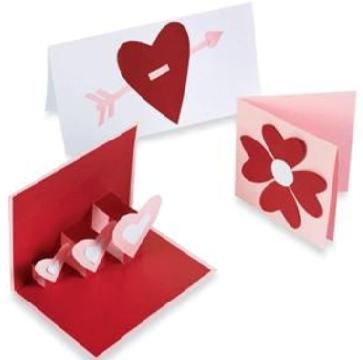
Some valentines were so thick with embellishments, they came in presentation boxes. Some unfolded like fans, while mechanical valentines had levers or disks which made figures dance, hands move and birds flutter their wings.
The lyrics in these cards were as effusive as the decorations. Whether sent by a steady beau or a secret admirer, these cards were unabashedly sentimental, pleading for affection and pledging undying devotion happily ever after. Even men kept these tokens of affection hidden in their bureau drawers.
But as times changed, so did customs. And as less became more on the advent of World War I, valentine cards became a dying art.

 Country & Victorian Times