
Christmas Carol Origins

Maria Augusta Trapp has documented history of carols in a clear and concise way. According to her, singing and caroling at Christmas is one of the oldest folk customs of the day and has been present since the time when Christianity and Christmas season were still at their budding stages. It is a worldwide custom and there has been lot of research on the subject and several books have been written about it. Originally, music compositions and songs at Christmas were in the form of chants and hymns. Caroling originally meant ‘circle dance’ and the words to accompany this festive dance were later added to the tradition.

Initially, the church looked down upon carols and carol singing as a pagan custom and they could not be included in the sacred services. However, in the countryside, many simple folk songs and Nativity carols were written and gaine popularity too. In 1223, Saint Francis of Assisi introduced carols into the formal worship of the church during a Christmas Midnight Mass in a cave in Greccio, in the province of Umbria. That night, the songs and music that accompanied this sacred and formal event were not hymns but carols. Ever since then, carols caught on with the masses and were at their prime in the Middle Ages, when they were almost always a part of the mystery plays.

There was a time, when wandering minstrels and waits or watchmen that guarded the old walled cities in the night used to pass their time by singing carols and also sang them to the people who used to pass them by. They would go from home to home, singing carols and entertaining people and may be get a treat in return. Later groups of musicians began singing carols and playing them for various events that were held during the Christmas season. Today, carol singing has becoming an important of this holiday season and a number of caroling events are organized throughout the world during the festive season, especially on Christmas Eve!

Christmas Stocking History

Hanging a Christmas stocking is a tradition that has been followed since times immemorial. It is believed that St. Nicholas would fill the stockings with gifts, on the eve of Christmas. Small kids eagerly wait for his arrival and the gifts that he would bring along with him. They decorate their stockings beautifully and hang them nearby fireplace. Although there are no written records of the origin of Christmas stockings, there are some popular stories that have been believed since generations. One of the most popular legend talks about the history of Christmas. In the article, we have provided interesting information on the origin and history of Christmas stockings.

Origin Of Christmas Stocking
Many centuries back, there lived a poor man in a village. He had three beautiful daughters. His wife had passed away due to some illness and he had spent all his money to cure his wife. Thus, he was left with no money to marry off his daughters. The three daughters were very kind and strong and this is what worried their father even more. He was concerned what would happen to them after his death. One fine day, St. Nicholas was passing through the village, when he overheard the discussion of some villagers talking about the pitiable condition of the three girls. St. Nicholas wanted to help the poor father, but he knew that the old man wouldn’t accept money from him.

St. Nicholas decided to help the family secretly, without letting anybody else know about it. He waited until it was night and stealthily sneaked into their house, through the chimney. He had three bags of gold coins with him, one for each girl. As he was looking for a place to keep those three bags, he noticed stockings of the three girls that were hung over the mantelpiece for drying. He put each bag in each stocking and then went away. When the girls and their father woke up the next morning, they were thrilled to find the bags of gold coins. He happily married off his daughters, one after the other, and they remained happy for the rest of their lives. The story about St. Nicholas being so generous spread throughout the village and then all over the land. Since then, it has been a tradition to hang stocking on Christmas in the hope that St. Nicholas would bring a present
.

Decorating Your Own Victorian Christmas Tree

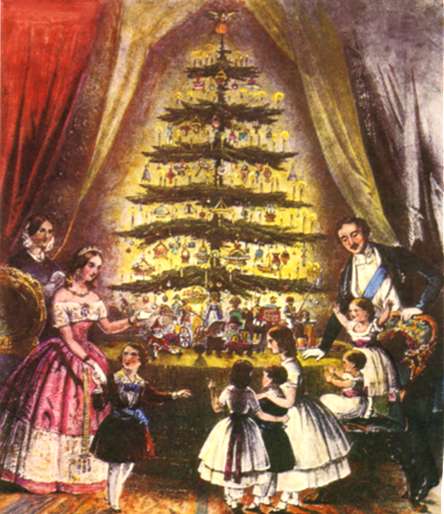
The Victorians loved their Christmas trees, and decorated them lavishly. Much time was spent in the weeks leading up to Christmas Eve making homemade ornaments to suspend on the tree branches.

Today store bought decorations have largely replaced homemade ornaments. But if you would like to have Victorian Christmas tree of your own, consider making your own authentic ornaments to hang on the branches of your tree.

Victorians lit their trees with candlelight, which isn’t practical or safe today, but you can now find some stores that carry replica electric lights that mimic candlelight and clip to your tree’s branches to get you started. From there, you can complete the look with these hand-made decorations:

* String popcorn and cranberries for garland. Do every other one or design a particular pattern of your own (three cranberries, two popcorn, five cranberries, etc.) depending on how much of each color you want.

* Dip small cookies cut like snowflakes into glue and then glitter for sparking accents on your tree. To preserve them, spray lightly with either craft preservative or hairspray.

* Paint walnuts (still in the shell) with gold or silver paint. Attach a thin ribbon bow to the top with a thumbtack and hang on the tree.

* Curl small paper doilies into cones and fill with hard candies, nuts or potpourri. Attach ribbon and tie to tree branches. You can find the doilies in a variety of pretty colors.

* Recycle old Christmas cards to decorate your Victorian Christmas tree. Cut out pictures you like and glue to cardboard, then highlight with glitter or metallic fabric paint. Attach colorful ribbons and hang.

You’ll be amazed at how your Victorian Christmas tree glitters and shines with its assortment of genuine period ornaments. Now sit back with a cup of mulled cider and enjoy!

A Santa History

Santa Claus was really St. Nicholas.  Saint Nicholas was born in 245 AD and died in 350 AD in Lycia, Anatolia, a province on the southwest coast of Asia Minor.  This part of the world is now Turkey.  He was a bishop of a church.  The legend of his generosity has been handed down throughout the years through thousands of churches.

In 1823, Clement C. Moore wrote “A Visit from St. Nicholas’, which showed Santa Claus driving a sleight drawn by “eight tiny reindeer.”  We know this story as “The Night Before Christmas.”   The image of Santa Claus, as we know him,  was drawn by Thomas Nast.

There are many legends of St. Nicholas, but this is the most famous legend and it includes elements of today’s Santa.  A nobleman who lived with his three daughters had fallen on hard times. The daughters had no chance of marriage, since their father could not pay their dowries.

One night, St. Nicholas threw a sack of gold through a window of the nobleman’s shabby castle, which was enough for one daughter’s marriage. The next night, he tossed another sack of gold through the window for the second daughter.

But on the third night, the window was closed. So, St. Nicholas climbed onto the roof and dropped the sack down the chimney. The next morning, the daughters found the gold in the stockings they had hung to dry by the fireplace.

That, my friends, is why we leave our stockings out for Santa Claus.

Charles Dickens Saved Christmas

By the early part of the nineteenth century Christmas had almost died out. The Times newspaper, for example, did not once mention Christmas between 1790 and 1835. Charles Dickens with his story A Christmas Carol did more than anyone to change all that. His tale of Scrooge, the Cratchit’s, and Tiny Tim was a smash hit from the start. He wrote the story in just two months, beginning in October 1843 and finishing at the end of November. The book was published on 17 December 1843 and immediately sold out.