Posies Made From Tissue Paper

1. Layer 5-by-15-inch sheets of tissue paper, alternating colors. Make 1-inch-wide accordion folds.

2. Wrap 1 end of a pipe cleaner around the center of the folded paper, and twist to secure. Round the edges of the folded paper with scissors.

3. Fan out folds, and gently pull apart each layer of tissue paper to create petals.

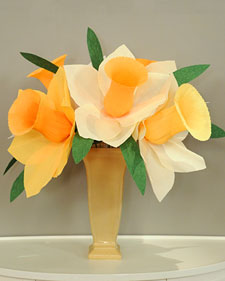
Daffodil Crepe Paper Flowers


Tools and Materials

  • Daffodil template
  • Florist crepe paper
  • Paper clips
  • Scissors
  • Pinking shears
  • 18-gauge paper-wrapped floral wire
  • Floral tape
  • Fabri-Tac adhesive
  • 20-gauge plain floral wire

Crepe Paper Daffodil How-To
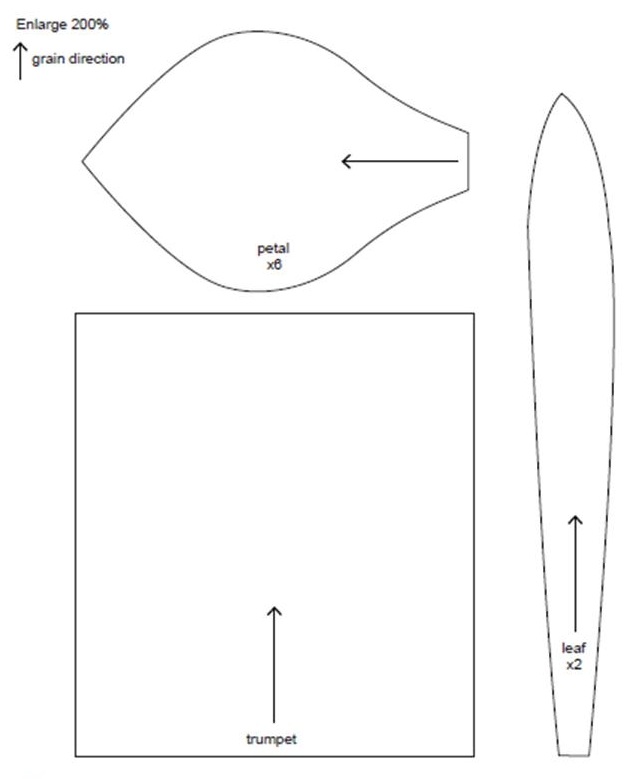
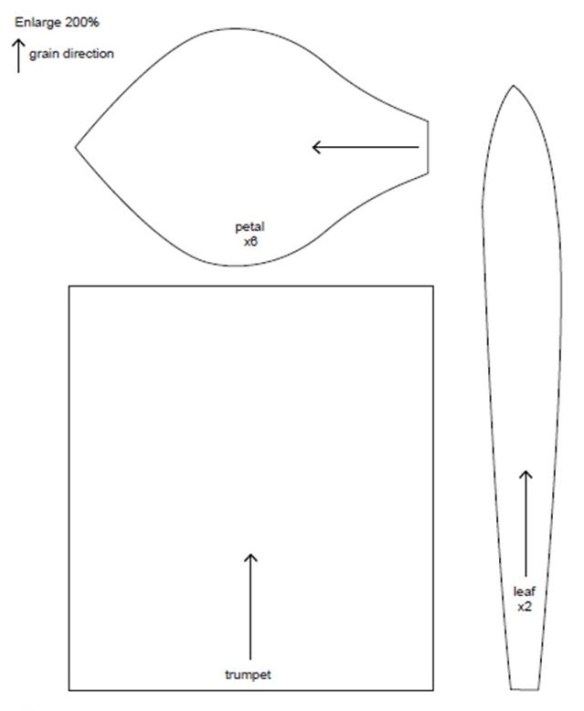
1. Download daffodil template, enlarge 200 percent, print, and cut out.

2. With paper clips, secure each element of the template to an appropriate shade of crepe paper, aligning the arrows with the grain of the paper. Cut out with scissors in the quantity indicated and trim top of trumpet piece with pinking shears.

3. To create stem, wrap together three 18-inch pieces of 18-gauge paper-wrapped floral wire with floral tape.

4. To create the bulbous bottom portion of the trumpet, place thumbs and forefingers together in the center of the trumpet piece, 3 inches from the bottom. Applying light pressure and moving outward, pull toward either edge, stretching the crepe paper as you go.

5. Run a bead of Fabri-Tac adhesive down one long edge of the trumpet, and bring edges together to make a cylinder.

6. Fold and pinch bottom of cylinder to top of stem, and secure in place with floral tape.

7. Insert hand into cylinder, and use fingers to shape the base of the trumpet.

8. Stretch pinked edge of trumpet against the grain of the crepe paper, and curl down with fingers.

9. Evenly space three petals around the base of the trumpet and secure in place with floral tape. Repeat with the remaining three petals.

10. With floral tape, attach each leaf to a 15-inch length of 20-gauge plain floral wire. Use more floral tape to secure each leaf to the daffodil stem.

PATTERN:
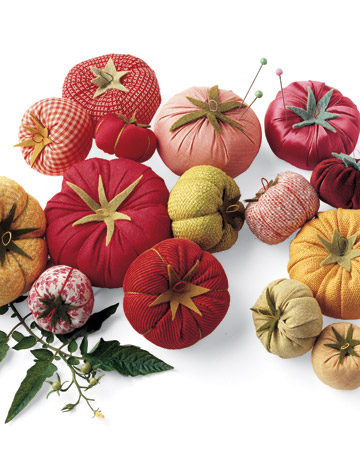
Tomato Sewing Pincushions

1. Cut a rectangle of fabric on the bias that’s twice as long as it is wide (the largest we made was 3 1/4 inches in diameter and required a 10-by-5-inch piece).With fabric facing right side up, fold in half as shown, and join ends with a 1/4-inch seam. Sew a running stitch around the top edge; tightly pull thread to cinch fabric, and secure with stitches.

2. Turn pouch right side out. Stuff with batting (cotton batting is firmer than polyester). Sew a running stitch around the open end; pull thread to cinch fabric. Tack shut with a few stitches and knot. To flatten, double-thread a cording needle with crochet thread and pull it through the “core” a few times. Mimic a tomato’s fluted details by wrapping the thread around the cushion and back through the core several times. Knot thread at top to finish.

3. For heirloom tomatoes, cut a circle of fabric (the largest we made was 3 1/2 inches in diameter and required a 10-inch-diameter circle). With fabric wrong side up, sew a running stitch around perimeter. Place batting in center of fabric, and gather into a pouch. Stuff with more batting, pull thread to cinch, and tack with stitches. Flatten cushion and apply details as in step 2.

4. For tops, photocopy template, enlarging or reducing as desired; cut out. Trace template onto green felt with a disappearing-ink pen; cut out. Using a single-threaded needle, sew a loop onto top. Glue top to tomato.

Note: To sew cherry-tomato pincushions, start with swatches of fabric that are 2 3/4 by 4 3/4 inches. Follow steps 1 and 2 below, but don’t flatten cushion or add fluted details. For tops, cut symmetrical, six-pointed stars from green felt. Add loops, and attach them as in step 4.

Easter Egg Race

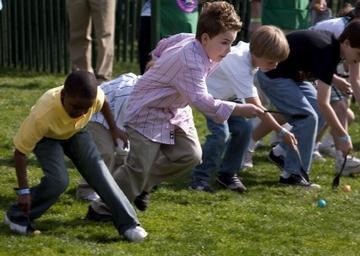
Give each child a tablespoon and a hard-boiled egg. The children form in line and one is the leader. Each one holds the spoon with the egg in its bowl at arm’s length and hops on one foot, following wherever the leader leads them.

The leader may take them up stairs, over stools, and any place hard to reach on one foot. To drop the egg or rest on both feet prevents one from continuing in the game. She must stay out until the next time round.

Easter Egg Roll

Mark on the table, or on the floor, if preferred, with chalk, four parallel lines, eight or ten feet long, and four or five inches apart. Thus there are three narrow spaces. At the end of each space make a circle, numbering the middle one 10, and the other two, 5. The middle space is marked 3, and the other two, 1.

The object of the game is to have each child roll five eggs, one at a time, down the middle space to the circles at the ends. If the egg goes into the middle circle, it counts 10, but if it stops in the middle space, it counts only 3, and so on, counting the number of the place where it stops.

Tally is kept for each child, the one scoring the most points wins the game.