Weight Loss Tool Kit

Weight Loss Tips & Strategies

{1} Ban the word “diet” from your vocabulary
Diets are temporary, the word implies you’ll go off it at some point rather than developing healthy habits you can maintain throughout your life. Plus “diet” is such a motivation-killer thanks to its many negative connotations (hunger and deprivation, to name just two). Focus on the positive aspects of eating healthfully, such as feeling more energetic.

{2} Don’t make it all about dress size
Yes, wanting to fit into your skinny jeans can inspire you to slim down, but you’re more likely to succeed if you think beyond the superficial. Meaningful goals like setting a good example for your kids or avoid­ing a health problem that runs in your family are more motivating and will make it easier for you to resist temptation. Write your goals down and refer to the list often to reinforce your determination.

{3} Be realistic
Forget everything the weight-loss infomercials tell you: Dropping a dress size in a matter of days is pure fantasy. Trying to lose too much too quickly will frustrate you, and you’ll be more likely to give up on your weight-loss plan when it doesn’t happen. Aiming to shed a pound a week is more realistic. Better yet, don’t just focus on the scale. Create easily attainable mini-goals like using skim milk in your coffee instead of half-and-half. Meeting them will help you feel successful and excited to make more healthy changes.

{3} Don’t indulge a craving the minute it strikes
It will probably go away in 15 to 20 minutes (we’re serious!). Distract your­self while you wait out a yearning for cookies by drinking a glass of water, playing a game on the computer or tak­ing a walk. Or simply picture anything other than cookies. In a recent study conducted at Flinders University, in Australia, volunteers who had been experiencing food cravings reported that those cravings eased after they were asked to think about nonfood images and aromas.

{4} Avoid peer pressure
You’ve probably heard that women are more likely to overindulge when they eat with other women. To avoid social dining sabotage on girls’ night out, check the restaurant’s menu on its website (or look it up on menupages .com) and make a healthy meal choice ahead of time. Picture yourself saying your order and asking the waiter for water with lemon instead of soda. Placing your order first helps, too—once you’ve asked for the grilled chicken salad with dressing on the side, you won’t be as easily swayed by a pal who orders mac and cheese.

{5} Ditch the put-downs
Negative beliefs like “I have no will­power” or “I’ll always be this heavy” can easily become self-fulfilling prophecies. (Needless to say, they won’t do much for you in the motiva­tion department, either.) The good news is that positive self-labels can also influence reality. People who describe themselves as being healthy eaters report consuming more fruits and vegetables and fewer unhealthy foods, according to a study con­ducted at the University of Ottawa. Think it, be it—there’s no easier weight-loss strategy than that!

Auld Lang Syne

The song, “Auld Lang Syne,” is sung at the stroke of midnight in almost every English-speaking country in the world to bring in the new year. At least partially written by Robert Burns in the 1700’s, it was first published in 1796 after Burns’ death. Early variations of the song were sung prior to 1700 and inspired Burns to produce the modern rendition. An old Scottish tune, “Auld Lang Syne” literally means “old long ago,” or simply, “the good old days.”

Should auld acquaintance be forgot,
And never brought to mind?
Should auld acquaintance be forgot,
And auld lang syne?

For auld lang syne, my dear,
For auld lang syne,
We’ll tak a cup of kindness yet,
For auld lang syne!

And there’s a hand my trusty fiere,
And gie’s a hand o thine,
And we’ll tak a right guid-willie waught,
For auld lang syne

For auld lang syne, my dear,
For auld lang syne,
We’ll tak a cup of kindness yet,
For auld lang syne!

New Years History

New Year festivities are synonymous with partying and bad hangovers nowadays, but New Year is actually one of the oldest celebrations. It is first recorded as a major event in Babylon around 4000 years ago. The Babylonians knew how to throw a party, as celebrations lasted for eleven days, putting our modern excesses to shame.

The Romans celebrated new year in March until Julius Caesar re-worked the calender to begin on January 1, although in order to do so Caesar had to make the year 46BC last 445 days. The celebration of new year as a holiday has been popular in Europe for the last 400 years. In 1582 Pope Gregory XIII re-established January 1 as New Year’s day with calendar reform.

The ancient Babylonians can also lay claim to the practice of setting New Year’s resolutions. A popular resolution was to return borrowed farm equipment, a resolution many in the countryside today can say is still valid. Those hoping to lose some weight after huge Christmas dinners aren’t in luck. A variety of foods also play a role in New Year celebrations, helping to pile on those festive pounds.

Many cultures believe ring shaped foods will bring luck, symbolising things coming full circle. The Dutch, for example, eat doughnuts for luck. In America black eyed peas are commonly eaten with ham, and in Scotland shortbread and whisky are ubiquitous. Spanish people eat 12 grapes with each chime of the bells, and in Japan a bowl of ‘year-crossing’ noodles are eaten. Many people are adamant their resolutions to lose weight will start the very next day, naturally
Read on

In different cultures. events on New Years day can have an effect on the luck for the rest of the year. In many Western cultures the first visitor to the home, or ‘first footer’, will bring luck if tall and dark haired. In Scotland it is common for people to go ‘first footing’ around friends and families homes, having a whisky in each along the way.

Strange New Year traditions can be found all over the world. In Ireland it was once tradition to bang Christmas bread against the walls and doors to scare away bad spirits. In Colombia, Cuba and Puerto Rico a life-sized doll is filled with things that have bad memories associated with them, then it is dressed up in old clothes. At midnight, this ‘Mr. Old Year’ is set on fire.

Brazilians wear white clothes to symbolize peace for the coming year, and in Greece children leave their shoes out to be filled with gifts. In Scotland, New Year’s eve is known as Hogmanay and is a key party night across the country. Scottish poet Robbie Burns is also behind the song ‘Auld Lang Syne’, sung at New Year throughout the world.

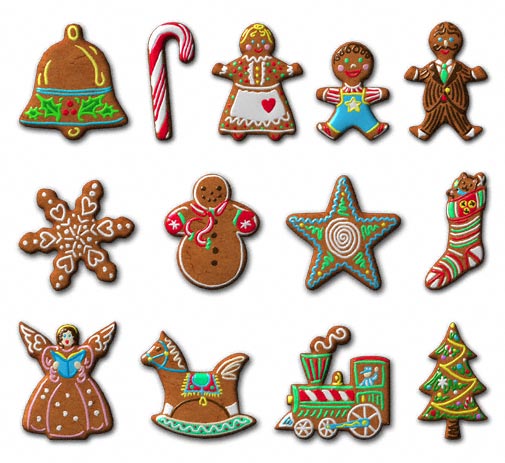
Gingerbread Cookies

3/4 cup firmly packed C&H° Golden
or Dark Brown Sugar
1/2 cup butter or margarine, softened
2 eggs
1/4 cup molasses
3 1/4 cups all-purpose flout
2 teaspoons ginger
1 1/2 teaspoons baking soda
1/2 teaspoon each: allspice, nutmeg, cinnamon and salt
Preheat oven to 350°F. Grease cookie sheets.

Beat Sugar and Water in large bowl until light and fluffy. Add eggs and molasses. Stir together remainng ingridients in medium bowl. Gradually add to sugar mixture until well blended. Refrigerate dough I hour or until easy to handle.
On well-floured surface, roll out half of dough at a time to ‘/8 inch thickness. Cut into desired shapes. Place on prepared cookie sheet. Bake 8- 1 0 minutes. Cool on rack. Decorate with sugar icing as desired. Makes about 24 (5-inch) cookies.
Icing: Combine 3/4 cup plus I tablespoon Powdered Sugar, I tablespoon milk, and food coloring as desired.