
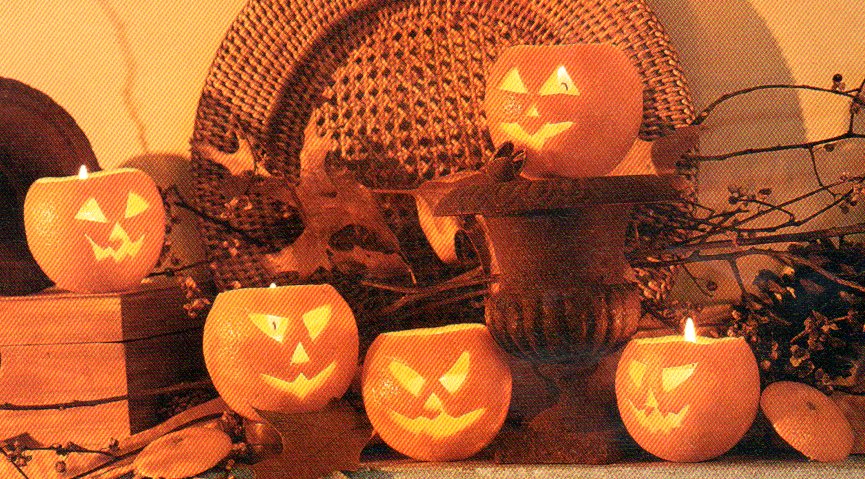
 Use fall leaves and twigs to landscape a backdrop for a group of unique candle holders. Elevate some of the oranges on boxes and urns for height variation.
This Halloween, scare up a batch of bewitching little candle holders to add a ghostly glow to a table or mantel. Made from oranges, these little jack-o’-lanterns are so small that you can use them in multiples for big impact. To create a seasonal centerpiece, cluster them among leaves on a platter or cake stand or simply use individual candle holders to mark place settings at a Halloween supper.
It lakes just minutes to make each one. First. cut a slice from the top of an orange, and scoop out the contents, saving the fruit for cooking or a salad. Cut out spooky eyes, a nose, and mouth from each orange with a craft knife. For the candles, use tea lights, the type of small candle that’s enclosed in aluminum to contain the melting wax. Use dried leaves and berries in combination with the jack-o’-lanterns, being careful to keep all flammable materials well away from the heat of the candles. To prevent the lightweight oranges from being tipped over, place a piece of sticky florist clay on the bottom of each one.
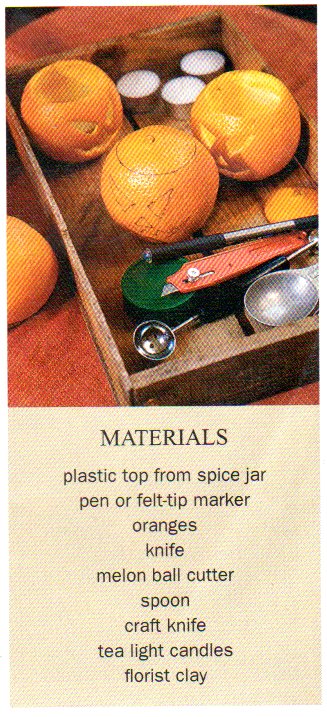 Step 1: Use the top of a spice jar as a guide for drawing a circle around the top of an orange. Then draw a face onto one side, (A pen or felt-tip marker works best.) Slice off the top of the orange. Scoop out the contents with a melon ball cutter, using a knife to cut the fruit away from the sides of the orange.
Step 2: Place the curve of a large spoon inside the orange, against the drawn face. Using a craft knife, cut out the features of the jack-o’-lantern. (The spoon gives a surface to cut against and protects your fingers from the knife.)
Step 3: Set a tea light candle inside the orange. Use a small piece of florist clay to keep the jack-o’-lantern fixed to the spot where you’re displaying it.
 Country & Victorian Times