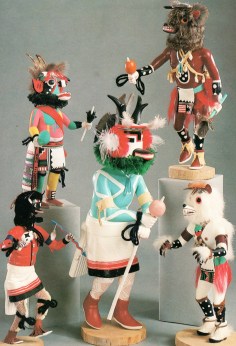
 The animal Kachinas are the advisors, doctors and assistants of the Hopi. It is through the assistance of the animals that the Hopi have overcome monsters and cured strange diseases. In fact, the greatest doctor of them all is the Badger for it is he who knows all of the roots and herbs and how to administer them. The Bear shares in this ability. Other animals are warriors and know the ways of danger and can aid the men in becoming like them.
All animals, however, share one attribute which is that they can remove their skins at will and hang them up like clothes. When they do they appear exactly as men, sitting about in their kivas. smoking and discussing serious matters. They are the Hopi’s closest neighbors and are always willing to assist if approached in a proper manner and asked for help. When prayer feathers and meal are not given they often withdraw until proper behavior is forthcoming.
The Animal Kachinas thus represent the relationship present between the Hopi and the kacbina spirits which some may compare to a true friendship on the human level. It involves an exchange of special favors in their interaction, accompanied by an exchange of respectful gestures.
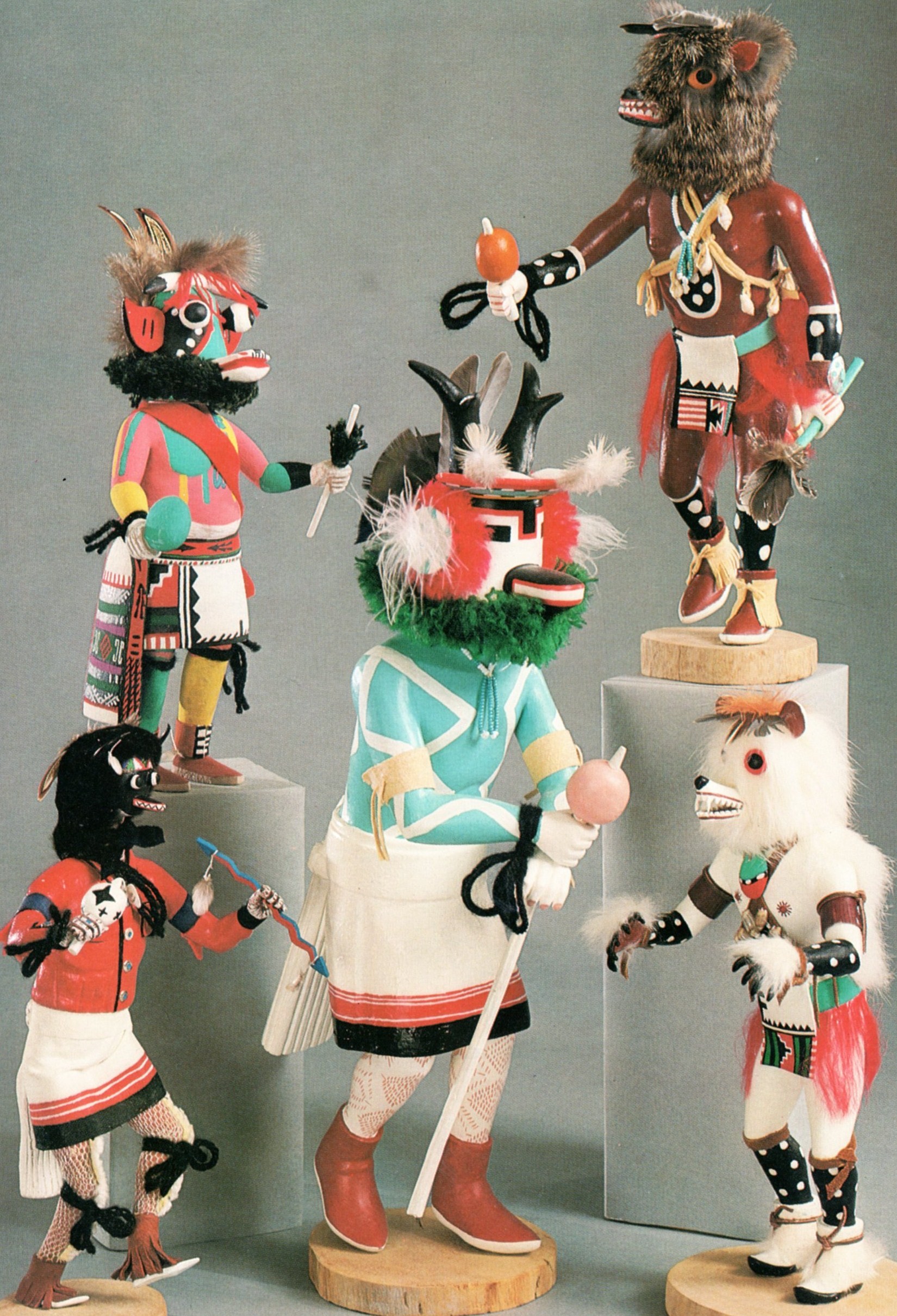
KWEO KACHINA Wolf Kachina
The Wolf Kachina appears as a side dancer who accompanies the herbivorous animals such as the Deer Kachina and the Mountain Sheep Kachina in the Soyohim Dances. He often clasps a stick in his hands which represents the bushes and trees that he hides behind as he stalks his prey. At the end of one of these dances the Hopi cast meal upon him and offer prayer feathers that they might also secure game using his prowess as a hunter. Dolls of this kachina arc, in contemporary times, elaborated with great teeth, lolling tongues and real fur that did not adorn the older dolls. There is almost always a Wolf Kachina on the shelf for purchase.
WAKAS KACHINA Cow Kachina
The Cow or Wakas Kachina is a comparatively late kachina. It was reputedly conceived and introduced by a Harm man around the turn of the century. The kachina enjoyed a long run of popularity right after its introduction and then again in recent years. The name is derived from the Spanish word vacas for cows. The kachina is danced to bring an increase in cattle.
MOSAIRU KACHINA Buffalo Kachina
The Buffalo Kachina is not the same figure as that seen in the social dance (see White Buffalo, p. 82) that has been carved in recent years. It is a kachina and is masked. Formerly these were made with a green face as well as one in black but in recent years the former has all but disappeared. It appears in the Plaza Dance usually with the mixed kachinas.
HON KACHINA Bear Kachma
There are a number of Bear Kachinas. Some are distinguished only by color such as the Blue, White, Yellow or Black Bear Kachinas. There are others such as Ursisimu, who have become extinct, and Ketowa Bisena, who is the personage that belongs to the Bear Clan at Tewa. There are Bears fancifully dressed and Bears that are not. All Bear Kachinas are believed to be very powerful and capable of curing bad illnesses. They are also great warriors. Bear Kachinas appear most often in the Soyohim or Mixed Dances of springtime or occasionally as side dancers for the Chakwaina Kachinas.
CH6P-SOWI-ING KACHINA Antelope-Deer Kachma
This kachina points up the similarity of the Deer and Antelope Kachinas because by exchanging the antelope horns for deer antlers the doll would become a Deer Kachina. Both Antelope and Deer may wear shirts, usually in cold weather, and either may have a white or blue face. Formerly the attributes of each were more rigidly separated than today.
CHOP KACHINA Antelope Kachina
The Antelope Kachina appears in the Plaza Dances either as a group in the Line Dance or as an individual in the Mixed Dance. He, as well as all other herbivorous animals, makes the rains come and the grass grow. He usually dances with a cane held in both hands and accompanied by the Wolf Kachina as a side dancer.
PONG KACHINA Mountain Sheep Kachina
The Mountain Sheep Kachina appears in Line Dances or as an occasional figure in the Mixed Dance. It dances holding a cane in both hands to represent the forelegs as it bends over and moves through the steps. The kachina has power over the rain as do the other herbivorous animals and is able to cure spasms as well.
KAWAI-I KACHINA Horse Kachina
The Horse Kachina derives its name from the Spanish word for horse, caballo. The kachina is of recent introduction as the Hopi did not adopt the horse until quite late, preferring the burro as a beast of burden, and their own two feet if speed was desired. Early travelers through Hopi country had difficulty with Hopi guides on foot setting a pace that soon exhausted their horses. The kachina is usually seen in Mixed Dances.
HONAN KACHINA Badger Kachina
The Hopi have two distinct forms of the Badger Kachina. This form is characteristic of Second Mesa and is a Chief Kachina who appears during the Powamu and the Pachavu ceremonies. It is a curing kachina. The costume and gear are not a fancier version of the other kachina but are instead of a form which probably arrived at a different time. There is some confusion on Third Mesa with the Sio Hemis Hu. However, that kachina does not have Badger tracks on its cheeks.
HONAN KACHINA Badger Kachina
This doll, characteristic of the smaller and more rapidly manufactured effigies, is also a Honan or Badger Kachina. It is more often seen during the Mixed Dances on Third Mesa or the Water Serpent Ceremony on First Mesa than during the Powamu. It bears a superficial resemblance to the Squirrel Kachina.
If you like this post and want to share it then click the service!

 Supplies

 Country & Victorian Times