
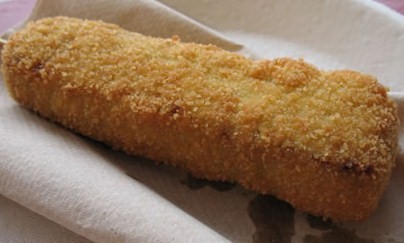
Fair Favorites: Deep Fried Candy Bars

1 egg
1 C. milk
1 Tbsp. of vegetable oil
1 C. all purpose flour
1 tsp. baking powder
a pinch of salt
1. Combine egg, milk and vegetable oil in a cup. In a bowl combine flour, baking powder and salt. Pour the wet ingredients into the dry and mix well with a whisk. Cover and chill for a few minutes as you heat the oil.
2. Use a chocolate covered candy bar for best results and make sure that it is chilled, some bars work better if frozen (Mars is the “traditional” bar but Snickers, Almond Joy, and even Twix and Kit Kat will work.) After the candy bars are chilled and cut remove the batter form the refrigerator and adjust the consistency if necessary.
3. Heat about 4cups of oil or shortening in a medium skillet to 385 F. Drop the chilled candy bar in the batter and gently place into the oil. Cook only until the outside is golden. Remove and drain on brown paper. Allow to cool a minute, the inside can easily burn your mouth

Caramel & Chocolate Creme Pie

Ingredients:

18 OREO Cookies, finely crushed (about 1-1/2 cups)
3 Tbsp.  butter, melted
4 oz. (1/2 of 8-oz. pkg.) PHILADELPHIA Cream Cheese, softened
2 Tbsp.  caramel ice cream topping
1 cup thawed COOL WHIP Whipped Topping
1 pkg.  (3.9 oz.) JELL-O Chocolate Instant Pudding
1-1/2 cups cold milk
Directions:

COMBINE cookie crumbs and butter; press onto bottom and up side of 9-inch pie plate sprayed with cooking spray. Refrigerate until ready to use.

MIX cream cheese and caramel topping in medium bowl until well blended. Gently stir in COOL WHIP; spread onto bottom of crust.

BEAT pudding mix and milk with whisk 2 min.; pour over cream cheese layer. Refrigerate 3 hours.

A Funny Joke

Have you ever felt just a little too old?….. Heres a funny tale:

My name is Alice, and I want to tell you a story about me feeling way to old: I was sitting in the waiting room waiting to see the dentist. I noticed his DDS diploma on the wall which bore his full name. Suddenly, I remembered a tall, handsome, dark-haired boy with the same name that had been in my high school class some 40-ODD years ago.

I had to take a step back and think: Is this the same guy that I had a crush on way back then? Upon seeing him, However, I quickly discarded and such thought. This balding, gray haired man with deeply lined face was way too old to have been my classmate.

After he examined my teeth, I asked him if he had attended Morgan Park High School which he replied to “Yes. Yes, I did. I’m a mustang!” I asked when he graduated and he answered “In 1975. Why do you ask?” I told him he was in my class and he looked real closely at me AND THEN…….

THEN, THAT UGLY, OLD, BALD, WRINKLED FACED, FAT-BUTTED, GRAY-HAIRED, DECREPIT  OLD MAN ASKED, “‘WHAT DID YOU TEACH???”

Zipper History

On August 29, 1893, Whitcomb L. Judson, a mechanical engineer in Chicago, received a patent for the first “clasp-locker”—a series of clunky eyes and hooks that fastened together with a slider. Judson replaced the long, buttonhooked shoelaces on his boots and the boots of his business partner, Lewis Walker, with clasp-lockers.

Unable to interest any manufacturers in his new-fangled gadget, Judson and Walker displayed the invention at the 1893 Chicago World’s Fair—where it was virtually ignored by the twenty-one million attendees.
Eventually, the United States Postal Service placed an order for twenty mailbags fastened with Judson’s clasp-lockers, but the clasp-lockers jammed too often to make the bags useful. Judson died in 1909—before perfecting his invention or finding a practical use for it.

In 1913, Swedish-American engineer Gideon Sundback perfected Judson’s invention by replacing the cumbersome hook-and-eye design with a more reliable and less bulky meshed-tooth slider fastener. During World War I, the
United States Army ordered Sundback’s invention for use on uniforms and equipment. Manufacturers began using the metal slide fasteners on boots, change purses, and money belts—and eventually on clothing. Since few people knew how to use the slide fasteners, clothing manufacturers included small instruction booklets on how to operate and maintain the contraption. In 1922, the B. F. Goodrich Company gave the trademark Zipper to its new rubber galoshes with new “hookless fasteners.” Goodrich reportedly coined the word “zipper,” onomatopoeia for the sound the device made when he zipped up his boots. The catchy name made the zipper a household word and a common fastener on clothing. In 1935, fashion designer Elsa Schiaparelli introduced a line of clothing bursting with decorative colored zippers of various sizes, turning the zipper into a popular fashion statement.

Geography Lesson Time (Kind-A-But-Not-Really)

•  In 1517, when Spanish explorer Francisco Fernandez de Cordoba arrived in what is now known as Mexico’s Yucatan peninsula, he asked the Mayan Indians what they called their land. The Mayans replied “Yucatan,” which means “What do you want?”

• In 1521, Portuguese explorer Ferdinand Magellan, having crossed the Pacific Ocean without encountering a storm, called it Mar Pacifico, meaning “peaceful sea.” In reality, the Pacific Ocean is home to some of the most destructive storms, tidal waves, and typhoons on earth.

• In 1770, English explorer Captain James Cook landed in Australia and asked the aborigines what they called the large marsupials indigenous to the continent. He was told “kangaroo,” which, unbeknownst to Cook, is an aboriginal word for “I don’t know.”

• In 1796, a city in Ohio was named after its founder, Moses Cleaveland, a surveyor for the Connecticut Land Company. In 1831, a newspaper misspelled the city’s name as Cleveland. The city’s name has been incorrectly spelled Cleveland ever since.

•  The name Nome was wrongly copied from a British map of Alaska drawn around 1850. The original map maker had written “? Name” to mark the town.

•  In the 1880s, two surveyors worked together to map the western border of South Dakota along the same meridian. One surveyor walked south, the second surveyor walked north. The surveyor walking south accidentally started out a mile west of the surveyor walking north, so the western border of South Dakota jumps one mile east-west where it hits the southern border of Montana.