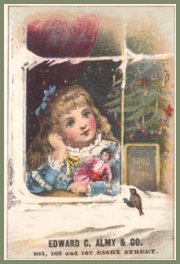
 On many Victorian Parlor tables, a place of honor was reserved for the Bible, family album, post card album and a huge scrapbook. In the latter were lovely pasted advertising cards which were acquired by different members of the family. When members of the family went out to shop, they were given colorful trade cards with their purchases. At the local food store, many of these cards came packaged in tins of teas and coffees. Each member of the family would have been quite delighted to receive these free cards. The color cards were the most cherished. Lithography had just been introduced and any colorful bits of paper were treasured. As family members brought new cards home, everyone became excited. The family members began to go to many different stores to see if they had any cards and if they would look nice in their books.
Images of Santa Claus and other Holiday symbols were always welcome during the Christmas season. Advertisers during the Victorian period were no different than advertisers today. They wanted people to spend lots of money on their products for the Holidays. Cheerful images of Jolly Old St. Nick, Christmas trees, and happy children with toys were designed to promote the “giving spirit”. Christmas, followed by Easter, was the most popular holiday in which you will find trade cards
Although the commercial aspects of Christmas were greatly looked down upon from many of the church pulpits, merchants continued to promote Christmas. Toy stores, confectioners’ shops and German bakeries began to stay open late and to festoon their windows with red silk bunting and holly. Holiday shoppers could not resist the cakes, the smells of cinnamon kuchens and sweet almond paste. 1874 was the year of the first window displays with a Christmas theme at Macy’s. One window displayed an amphitheater of wax, rag, bisque and hand-painted porcelain dolls imported from Germany France, Austria, Switzerland and Bohemia. In another window, scenes from Uncle Tom’s Cabin were composed in a panorama with steam-driven movable parts. 1867 was the first year that Macy’s department store in New York City remained open until midnight on Christmas Eve. In 1880 Woolworths first sold manufactured Christmas tree ornaments, and they caught on very quickly.
Victorian Trade Cards were a popular way for advertisers to lure customers to purchase their products or to shop in their stores. Victorian Trade Cards featuring scenes of families celebrating Christmas give us a wonderful glimpse of what it must have been like in many Victorian homes during the Holiday season. If you look closely at many of the pictures, you will see Christmas trees lit by candles and covered with handmade decorations and fancy hand-blown glass balls. Some of the images show presents hanging from the tree branches. This was a common practice during the Victorian Era. Other cards show decorations inside the homes featuring fresh evergreens and berries.
If you like this post and want to share it then click the service!

 By the early part of the nineteenth century Christmas had almost died out. The Times newspaper, for example, did not once mention Christmas between 1790 and 1835. Charles Dickens with his story A Christmas Carol did more than anyone to change all that. His tale of Scrooge, the Cratchit’s, and Tiny Tim was a smash hit from the start. He wrote the story in just two months, beginning in October 1843 and finishing at the end of November. The book was published on 17 December 1843 and immediately sold out.


 Country & Victorian Times