Victorian Valentines History

The true origin of Valentine’s Day may never by known, since it is only legend that tells of the Christian martyr, Valentinus, who sent a letter of affection to his jailer’s daughter on the eve of his execution.  There is no historical evidence to back up the legend, as romantic as it is, but it seems the romanticism itself is enough to give credence to the origin of this holiday.  We do know, however, that the Romans celebrated the pagan festival of Lupercalia on February 14, commemorating the rural god Faunus, patron of husbandry and guardian of the secrets of nature. It is believed that birds chose their mates for the coming season on this day.

The earliest known (proven) valentines are poems, composed for the Valentine’s Day festivals for the courts of 14th-century England an France.  These poems celebrated ‘joyous recreation and conversation about love’. It is believed that this is when the custom of drawing lots for valentines began.  Girls drew boys’ names and boys drew girls’ names so everyone had a pair of valentines to choose from.  Whether the drawing itself resulted in many love affairs, or the lotteries were fixed in advance (which was not uncommon,) we shall never know.

By the 17th Century, lotteries were less common, and selections more deliberate.  It also became customary to present a gift along with the valentine card.  These gifts ranged from love-knots of plaited straw to the opulent jewelry showered upon royal mistresses.

By the mid-18th century, costly valentine gifts were being replaced by elaborate versions of written love messages.   Ideally, these were poetic compositions. But while the artistic embellished their poems with lace and drawings, the malicious embellished theirs with vulgar or cruel greetings which they sent to the ill-favored, long-unmarried or deformed.  Thus, valentines were usually sent anonymously.  Both to protect the giver and the receiver.

Valentine’s Day reached its height of celebration in the Victorian Era.

Valentine cards were more cherished that Christmas cards (which weren’t printed commercially until 1846), perhaps because of the sentimentality attached to them.  Due to this popularity, designing cards became a highly competitive market, with a vast array of motifs and verses.  Suddenly, cards were being produced in tens of thousands, from whimsy and slightly vulgar, to truly sentimental, their designs included lace paper, embossed envelopes, glass or metal mirrors, ribbons, dried ferns and fake advertisements, bank notes and marriage licenses.

Valentine cards were so popular that their production became a flourishing trade amongst cheapjack printers in central London.  Commercially printed valentine cards quickly superseded home-made offerings of earlier times.  They reached the height of their popularity during the 1870s and 80s.  Yet even though they were mass-produced, they still featured birds with real feathers, posies of dried flowers and spun-glass hearts, all trimmed with ribbons and gold lace.

Some valentines were so thick with embellishments, they came in presentation boxes. Some unfolded like fans, while mechanical valentines had levers or disks which made figures dance, hands move and birds flutter their wings.

The lyrics in these cards were as effusive as the decorations.  Whether sent by a steady beau or a secret admirer, these cards were unabashedly sentimental, pleading for affection and pledging undying devotion happily ever after.  Even men kept these tokens of affection hidden in their bureau drawers.

But as times changed, so did customs.  And as less became more on the advent of World War I, valentine cards became a dying art.
Decorating Your Own Victorian Christmas Tree

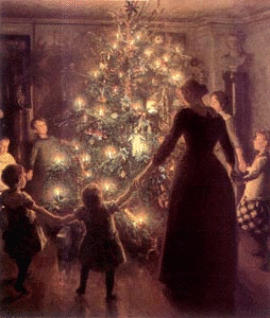
The Victorians loved their Christmas trees, and decorated them lavishly. Much time was spent in the weeks leading up to Christmas Eve making homemade ornaments to suspend on the tree branches.

Today store bought decorations have largely replaced homemade ornaments. But if you would like to have Victorian Christmas tree of your own, consider making your own authentic ornaments to hang on the branches of your tree.

Victorians lit their trees with candlelight, which isn’t practical or safe today, but you can now find some stores that carry replica electric lights that mimic candlelight and clip to your tree’s branches to get you started. From there, you can complete the look with these hand-made decorations:

* String popcorn and cranberries for garland. Do every other one or design a particular pattern of your own (three cranberries, two popcorn, five cranberries, etc.) depending on how much of each color you want.

* Dip small cookies cut like snowflakes into glue and then glitter for sparking accents on your tree. To preserve them, spray lightly with either craft preservative or hairspray.

* Paint walnuts (still in the shell) with gold or silver paint. Attach a thin ribbon bow to the top with a thumbtack and hang on the tree.

* Curl small paper doilies into cones and fill with hard candies, nuts or potpourri. Attach ribbon and tie to tree branches. You can find the doilies in a variety of pretty colors.

* Recycle old Christmas cards to decorate your Victorian Christmas tree. Cut out pictures you like and glue to cardboard, then highlight with glitter or metallic fabric paint. Attach colorful ribbons and hang.

You’ll be amazed at how your Victorian Christmas tree glitters and shines with its assortment of genuine period ornaments. Now sit back with a cup of mulled cider and enjoy!

Victorian Advertising Cards

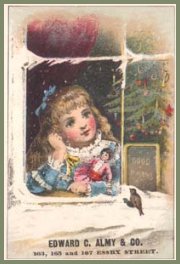
On many Victorian Parlor tables, a place of honor was reserved for the Bible, family album, post card album and a huge scrapbook. In the latter were lovely pasted advertising cards which were acquired by different members of the family. When members of the family went out to shop, they were given colorful trade cards with their purchases. At the local food store, many of these cards came packaged in tins of teas and coffees. Each member of the family would have been quite delighted to receive these free cards. The color cards were the most cherished. Lithography had just been introduced and any colorful bits of paper were treasured. As family members brought new cards home, everyone became excited. The family members began to go to many different stores to see if they had any cards and if they would look nice in their books.

Images of Santa Claus and other Holiday symbols were always welcome during the Christmas season. Advertisers during the Victorian period were no different than advertisers today. They wanted people to spend lots of money on their products for the Holidays. Cheerful images of Jolly Old St. Nick, Christmas trees, and happy children with toys were designed to promote the “giving spirit”. Christmas, followed by Easter, was the most popular holiday in which you will find trade cards

Although the commercial aspects of Christmas were greatly looked down upon from many of the church pulpits, merchants continued to promote Christmas. Toy stores, confectioners’ shops and German bakeries began to stay open late and to festoon their windows with red silk bunting and holly. Holiday shoppers could not resist the cakes, the smells of cinnamon kuchens and sweet almond paste. 1874 was the year of the first window displays with a Christmas theme at Macy’s. One window displayed an amphitheater of wax, rag, bisque and hand-painted porcelain dolls imported from Germany France, Austria, Switzerland and Bohemia. In another window, scenes from Uncle Tom’s Cabin were composed in a panorama with steam-driven movable parts. 1867 was the first year that Macy’s department store in New York City remained open until midnight on Christmas Eve. In 1880 Woolworths first sold manufactured Christmas tree ornaments, and they caught on very quickly.

Victorian Trade Cards were a popular way for advertisers to lure customers to purchase their products or to shop in their stores. Victorian Trade Cards featuring scenes of families celebrating Christmas give us a wonderful glimpse of what it must have been like in many Victorian homes during the Holiday season. If you look closely at many of the pictures, you will see Christmas trees lit by candles and covered with handmade decorations and fancy hand-blown glass balls. Some of the images show presents hanging from the tree branches. This was a common practice during the Victorian Era. Other cards show decorations inside the homes featuring fresh evergreens and berries.

Victorian Christmas Decorating

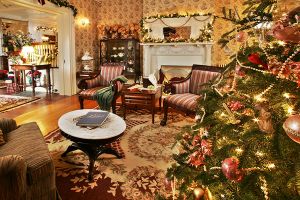
The Victorians decorated their homes in bold wallpaper, ornate furnishings, lace, and richly-colored draperies, and this love for decorating carried right over into the way they decorated for the holidays, as well. Although many of the Victorians had very little money to spend on extravagant decorations, they were enthusiastic in their celebration of the Christmas season. They turned to nature for inspiration and found fresh, rich greenery, flowers, pinecones, berries, and fruit which were all used to create colorful displays. Early in December the Victorian household began to decorate, covering every available inch of the house with greenery. Spruce, balsam, laurel, cedar, ivy, mistletoe, and holly graced tables, banniesters, chandeliers, archways, columns, and woodwork. Mistletoe dangled from the ceiling of the entry hall. Even picture frames and mirrors were wrapped with evergreen rope. Wreaths could be found hung on doors or behind windowpanes.

The Victorian parlor played an important role for the holiday season. The parlor was transformed into an enchanted winter wonderland filled with decorations such as garlands of cranberries and popcorn, tinsel and paper chains, paper and lace ornaments, tissue-paper snowflakes, glittering glass balls, angels, fairies and Santas. The candles on a glittering tree adorned with an angel or star on the treetop became the centerpiece of the room. Under the Christmas tree sat the tempting gifts, wrapped in colorful paper and tied with taffeta ribbons. Some were lavishly garnished with the addition of fine flowers and greenery. Colored glass lamps and candles throughout the room cast a festive glow. The fire blazed merrily, and stockings dangled from the fireplace filled to bulging with gifts and treats. An army of toy soldiers marched on the mantel above. The fragrance of cedar boughs drifted throughout the house, and arrangements of holly and ivy brought the peace of the winter woods indoors.

A Victorian Christmas Tree History

Behind the double doors of the Victorian parlor stood the Christmas tree, an old German custom the Victorians enlarged upon both in style and decoration. This tradition had come to England by way of Queen Victoria’s great-great-grandfather King George I.

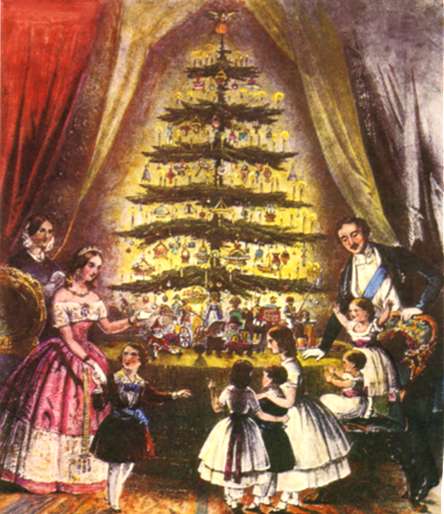
When she was Queen, Victoria had a Christmas tree at Windsor Castle. In 1848, an etching of Victoria, Albert, and their children gathered acround their decorated tree was published in The Illustrated London News. At about the same time, Charles Minnegerode, a German professor at the College of William and Mary, trimmed a small evergreen to delight the children at the St. George Tucker House. Martha Vandergrift, aged 95, recalled the grand occasion, and her story appeared in the Richmond News Leader on December 25, 1928. Presumably Mrs. Vandergrift remembered the tree and who decorated it more clearly than she did the date. The newspaper gave 1845 as the time, three years after Minnegerode’s arrival in Williamsburg. Perhaps the first Christmas tree cheered the Tucker household as early as 1842.

As a result, Christmas trees became the popular fashion in England and the central feature of the Victorian family Christmas. German settlers had brought the custom to America, but when the same illustration of Victoria and her family appeared in Goody’s Lady’s Book in 1850, Christmas trees became even more popular in American then in England.

What made the Victorian Christmas tree so special was its elaborate decoration. Decorations included gingerbread men, marzipan candies, hard candies, cookies, fruit, cotton-batting Santas, paper fans, tin soldiers, whistles, wind-up toys, pine cones, dried fruits, nuts, berries, and trinkets of all kinds. Paper cornucopias filled with nuts, candies, and other treats were the Victorian favorite. It was not uncommon to find some small homemade gifts, such as tiny hand-stitched dolls or children’s mittens, and freshly baked treats like sugar cookies. Hand-dipped candles were placed carefully on each of the branches. A Christmas doll or angel could usually be found adorning the top of the tree.

Children often helped to make the tree decorations. They would string garlands of popcorn or cranberries, or make chains of paper flowers. Some families set up a Nativity or outdoor scene under the tree, using moss for grass and mirrors for ponds.

Later in the century imported ornaments from Germany began to replace the homemade ones. First came glass icicles and hand-blown glass globes called kugels. Dresdens, which were embossed silver and gold cardboard ornaments, took exotic shapes–moons, butterflies, fish, birds, ships, animals, flowers, trolley cars, and even automobiles.

A Victorian family’s most prized ornament was the Nuremberg angel atop the tree. It had wings of spun glass, a crinkled gold skirt, and a wax or bisque face. Angles or cherubs represented the Victorian ideal of childlike or womanly innocence.