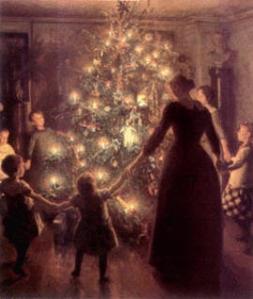
 Behind the double doors of the Victorian parlor stood the Christmas tree, an old German custom the Victorians enlarged upon both in style and decoration. This tradition had come to England by way of Queen Victoria’s great-great-grandfather King George I.
When she was Queen, Victoria had a Christmas tree at Windsor Castle. In 1848, an etching of Victoria, Albert, and their children gathered acround their decorated tree was published in The Illustrated London News. At about the same time, Charles Minnegerode, a German professor at the College of William and Mary, trimmed a small evergreen to delight the children at the St. George Tucker House. Martha Vandergrift, aged 95, recalled the grand occasion, and her story appeared in the Richmond News Leader on December 25, 1928. Presumably Mrs. Vandergrift remembered the tree and who decorated it more clearly than she did the date. The newspaper gave 1845 as the time, three years after Minnegerode’s arrival in Williamsburg. Perhaps the first Christmas tree cheered the Tucker household as early as 1842.
As a result, Christmas trees became the popular fashion in England and the central feature of the Victorian family Christmas. German settlers had brought the custom to America, but when the same illustration of Victoria and her family appeared in Goody’s Lady’s Book in 1850, Christmas trees became even more popular in American then in England.
What made the Victorian Christmas tree so special was its elaborate decoration. Decorations included gingerbread men, marzipan candies, hard candies, cookies, fruit, cotton-batting Santas, paper fans, tin soldiers, whistles, wind-up toys, pine cones, dried fruits, nuts, berries, and trinkets of all kinds. Paper cornucopias filled with nuts, candies, and other treats were the Victorian favorite. It was not uncommon to find some small homemade gifts, such as tiny hand-stitched dolls or children’s mittens, and freshly baked treats like sugar cookies. Hand-dipped candles were placed carefully on each of the branches. A Christmas doll or angel could usually be found adorning the top of the tree.
Children often helped to make the tree decorations. They would string garlands of popcorn or cranberries, or make chains of paper flowers. Some families set up a Nativity or outdoor scene under the tree, using moss for grass and mirrors for ponds.
Later in the century imported ornaments from Germany began to replace the homemade ones. First came glass icicles and hand-blown glass globes called kugels. Dresdens, which were embossed silver and gold cardboard ornaments, took exotic shapes–moons, butterflies, fish, birds, ships, animals, flowers, trolley cars, and even automobiles.
A Victorian family’s most prized ornament was the Nuremberg angel atop the tree. It had wings of spun glass, a crinkled gold skirt, and a wax or bisque face. Angles or cherubs represented the Victorian ideal of childlike or womanly innocence.
If you like this post and want to share it then click the service!

 Children in Victorian England had the task of writing greetings to their parents in their very best handwriting. Sometimes adults wrote Christmas letters to each other, but this could take up a great deal of time. The printed Christmas card solved the problem. The custom of sending printed cards was started in England by Henry Cole, who did not have time to write letters to each of his relatives. He asked an artist, John Calcott Horsley, to design a card for him. About 1,000 of these cards were printed, and those not used by Sir Henry were sold by the printer for one shilling. This was not cheap, which may be why they did not sell very well. With the introduction of the “penny post” in 1840, it became cheaper to send mail, and as a result of color printing and the invention of printing machines, cards could be printed faster and cheaper. The first company to print and sell Christmas cards on a large scale was Charles Goodall & Sons of London in 1862. The first charity card was produced in 1949 by UNICEF. Richard H. Pease, a printer from Albany, New York, is credited with sending the first specially printed Christmas card in America, in 1851. It managed to make the first mistake in Christmas card history. The card showed a building on which was hung a banner proclaiming “Pease’s Great Variety Store.”


 Country & Victorian Times