Pets Questions & Answers

Dogs are one thing. But come on, can you really train a cat?
True, it’s a lot easier to train a dog. But you can walk cats on a harness out­doors and you can teach them to do basic things, like sit or come, using food rewards. You just have to be more patient.

Okay,  let’s  start  with scratching up the furni­ture. How do you get your cat to cut it out?
Scratching is a natural behavior for cats—they do it to remove the dead outer layer of their claws, to mark territory with the scent glands in their paws and just to get exercise. Since you can’t stop the behavior you need to give your cat some­thing that’s okay to scratch. Cats like the feel of rough, irregular surfaces, which is why most scratch­ing posts are carpeted. Put one right beside the piece of furniture your cat has been using and encourage it to scratch that instead.

What about a cat that suddenly stops using the litter box?
First, check with your vet to see if there’s an underlying medical condi­tion such as a urinary tract infection. Then it’s time to play detective. Is the litter box near its food or water? They don’t like that. Is the litter clean? Has the arrival of a new baby or animal in the household upset the cat? Sometimes cats don’t like a particular brand of litter, so if you decided to change it recently, switch back.

So many cats insist on drinking out of faucets. What’s up with that?
Cats love running water, probably because it’s cool and fresh. You can buy a water fountain that’s made specifically for cats. It’s basically a plug-in water bowl with a reser­voir. The device recirculates water, so it’s always running. Put the fountain next to the faucet the cat has been drinking from and gradually move it from there to wherever you want it.

How do I keep my cat off the kitchen counter tops? Give it something more interesting to do. Put a climbing tree right in the kitchen and buy new cat toys. Also, cut clutter. The more stuff on the coun­ter, the more appealing it is to a cat.

Pet Care In The Winter

As we prepare for the joys.of the holiday season, we must remember to protect our pets from the rigors of winter weather. The veterinarians at Animal Humane offer the following tips to safeguard your pet’s health and happiness during the cold winter months:

• Keep young, elderly and small pets indoors. Small animals cannot tolerate the cold as well as larger pets with greater body mass. Just like humans, the very young and the very old are weaker, feebler and always, at greater risk to succumbing to pneumonia or even freezing to death.

• Be aware of the many ways that automobifes can be deadly to pets in the winter. Cats frequently seek out the warmth of automobile engines for example and can be injured or killed by the fan when a motor is started. As a precaution, develop the habit of banging on the hood of you’r car before engaging the engine.

• Never leave your pet unattended in a car. Not only is it illegal, but animals can freeze to death quickly in the small, cold space.

•  Make sure your radiator is not leaking antifreeze, which smells and tastes sweet but is deadly to animals. Have your vehicle professionally serviced on a regular basis. Also, consider switching to pet-friendly propylene glycol products rather than those containing ethyleneglycol.

• Provide your pet sufficient food. Animals have greater caloric and nutritional requirements during cold weather, especially if they spend time outdoors.

• Fill your pet’s bowl with plenty of fresh water, which is even more impprtant than food to an outdoor pet in winter. And make certain the water source is not frozen.

• Don’t permit holiday guests to offer your pets food, bones or alcohol. At the very least, this can cause severe gastric upset. At worst, brittle cooked bones can rupture the intestinal tract, spicy foods can produce hemorrhagic gastroenteritis; and alcohol can induce intoxication, coma or death.

•  Keep poinsettias, holly, mistletoe, Star of Bethlehem and holiday bouquets safely out of Fido’s and Miss Kitty’s reach. If your pet ingests a potentially harmful substance, call the American Society for the Prevention of Animal Cruelty Animal Poison Control Center at 888.426-4435 and seek veterinary care immediately.

• Keep your pet warm and dry. An animal’s coat is natural insulation. Resist the temptation to thin it or shave it. Invest in a warm coat or sweater for outdoor activity if your pet is small or has short hair.

• Provide a dry, insulated shelter where your pet can escape drafts and the elements, preferably off the ground.

•  Have your pets microchipped and tagged with your address and phone number. If they do become lost, they can be quickly and safely returned to you.

The Mexican Pantry

Ancho chile: When fresh poblano chiles are dried, they’re called anchos. Mildly spicy, like their fresh counterparts, anchos give a rich sweetness to marinades or a simmering pot of chili.

Cilantro; This familiar Mexican herb is used only when fresh; it loses all flavor when dried. It provides an explosive sprinkle over lots of street foods, mostly as a component of salsa and guacamole. Store it wrapped in barely damp paper towels in a plastic bag, in the warmest part of the refrigerator.

Guajillo chile: These smooth-skinned, brick- or cranberry-red dried chiles are a little spicier than anchos, and not nearly as sweet. They’re often ground into a powder that gives a tangy jolt to fresh fruits and vegetables; teamed with anchos, they lend multilayered flavor to stews and soups.

Jicama; This root vegetable is the color of a potato, and not much bigger. Sliced or julienned, it adds a slightly sweet, juicy crunch to chicken salads or coleslaw. You can also peel it, slice it, and eat it as a snack, as Mexicans do.

Masa harina: Corn tortillas are made from dried grain (field) corn cooked with mineral lime, then ground into a paste called masa. Several decades ago, a method to dehydrate and powder the perishable masa was discovered; the result became known as masa harina, or masa flour.

Poblano chile: This mildly spicy, dark-green fresh chile resembles a small bell pepper, but with a pointed end, tougher skin, and more compact flesh. The flavor is also similar to that of a bell pepper, only more concentrated and complex.

Queso anejo: This hard, aged cheese, made from cow’s milk, adds a salty kick to whatever it touches. Dishes that always get a dusting of grated queso anejo, such as enchiladas, grilled corn on the cob, and street snacks made from corn masa, would be naked without it—like pasta without Romano or Parmesan.

Serrano chile: These bullet-shaped, hot green chiles are about 2×2 inches long and 1 1-2 inch wide. They have a punchy flavor that is heaven to green-chile lovers—much less sweet than a jalapeno.

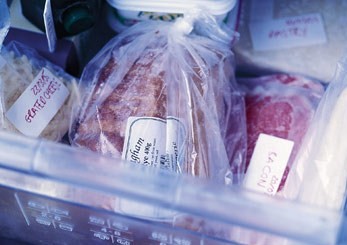
6 Things You Can Freeze

1. EGGS Lightly beaten eggs, beaten yolks, or whites can be frozen, but not an egg in its shell. Store in lidded ice cube trays. (One egg fills two cubes.)
2. COOKED RICE Spread cooled rice on a lined baking sheet Rub with a small amount of vegetable oil so grains separate. Freeze, then transfer to a freezer bag.
3. GINGER ROOT Wrap peeled ginger in plastic, then put in freezer bag. Ginger grates well while still frozen.
4. CHEESE Cut hard (Parmesan, pecorino) and semi-hard cheeses (cheddar, Swiss) into ix4-inch blocks, wrap in plastic, then put in a freezer bag. Grate hard cheeses while frozen; thaw others in the refrigerator.
5. BUTTER or MARGARINE Store in a freezer bag, in its original packaging, for up to six months. Thaw in the refrigerator. Dont freeze whipped butter.
6. NUTS Store in airtight container or freezer bag for up to six weeks. Use right from the freezer for recipes—no need to thaw.


Olive Oil

OLIVE OILS ARE PIVOTAL TO THIS DIET – Good olive oils are as complex and varied as wine, yet buying the healthiest kinds is easy. Jadah Elizabeth is keen on cold-pressed extra virgin oil olive because it contains the most phenols, the source of much of its healthfulness. Exceptional olive oils have flavors and aromas that are far beyond those of the bland jugs at the supermarket. They can taste of such things as pepper, citrus, grass (really, its good), and almond.

Cold-pressed extra virgin olive oil is especially good for drizzling over vegetables and pasta noodles, orfor dipping bread. Virgin olive oil is next best, and is fine for sauteeing. “Light” olive oil refers strictly to color and mild taste. It is not reduced-calorie.
Light, heat, and air will spoil your stash, given enough time. Keep oils in an airtight bottle, in a cool cabinet, away from sunlight for up to a year. Even the best olive oils come in a wide range of prices, so experiment until you find a few brands you like at a reasonable price.