
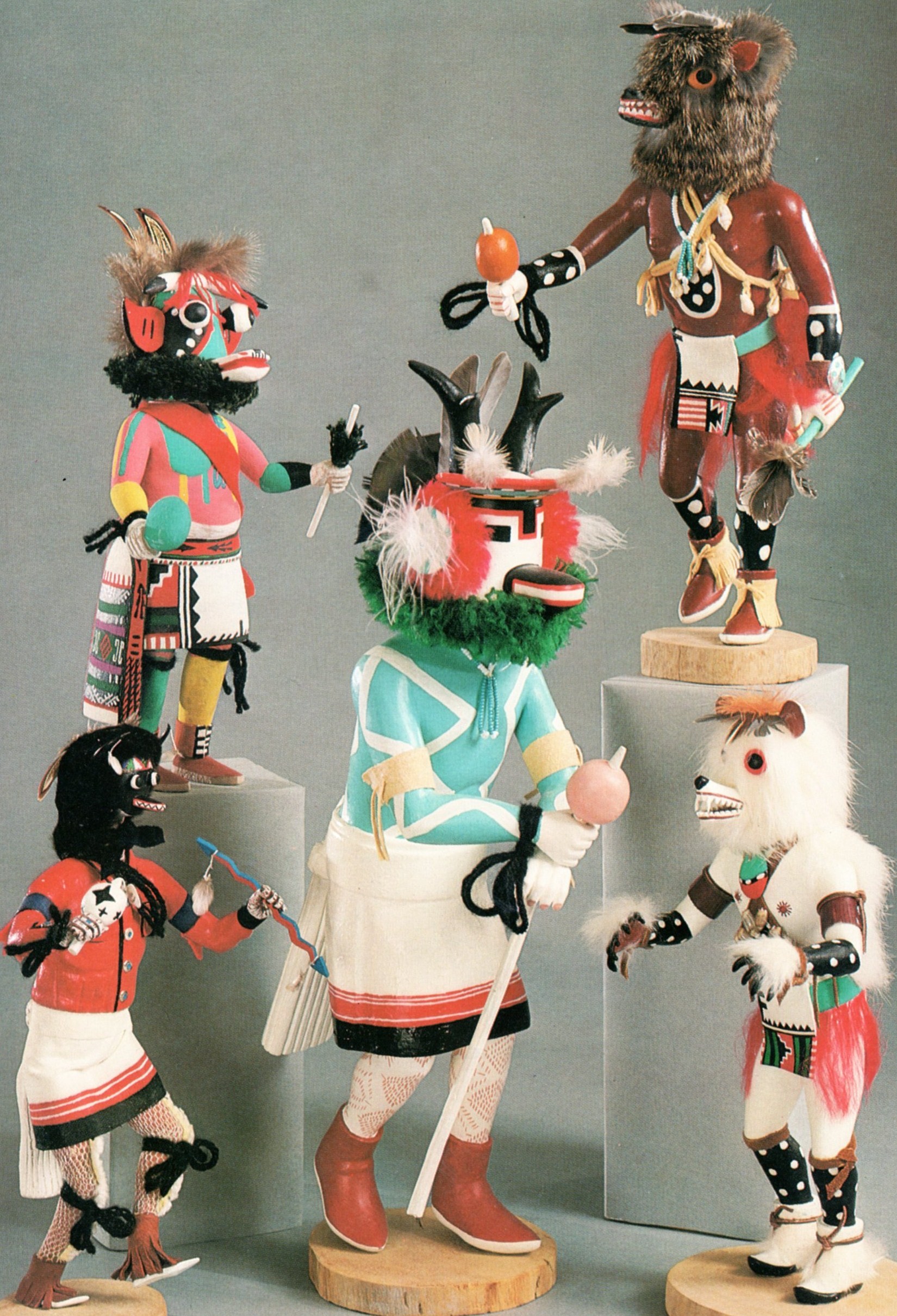
Kachina Dolls: The Animals

The animal Kachinas are the advisors, doctors and assistants of the Hopi. It is through the assistance of the animals that the Hopi have overcome monsters and cured strange diseases. In fact, the greatest doctor of them all is the Badger for it is he who knows all of the roots and herbs and how to administer them. The Bear shares in this ability. Other animals are warriors and know the ways of danger and can aid the men in be­coming like them.

All animals, however, share one attribute which is that they can remove their skins at will and hang them up like clothes. When they do they appear exactly as men, sitting about in their kivas. smoking and discussing serious matters. They are the Hopi’s closest neighbors and are always willing to assist if approached in a proper manner and asked for help. When prayer feathers and meal are not given they often withdraw until proper behavior is forthcoming.

The Animal Kachinas thus represent the relationship present be­tween the Hopi and the kacbina spirits which some may compare to a true friendship on the human level. It involves an exchange of special favors in their interaction, accompanied by an exchange of respectful gestures.

KWEO KACHINA Wolf Kachina
The Wolf Kachina appears as a side dancer who accompanies the herbivorous animals such as the Deer Kachina and the Mountain Sheep Kachina in the Soyohim Dances. He often clasps a stick in his hands which represents the bushes and trees that he hides behind as he stalks his prey. At the end of one of these dances the Hopi cast meal upon him and offer prayer feathers that they might also secure game using his prowess as a hunter. Dolls of this kachina arc, in contemporary times, elaborated with great teeth, lolling tongues and real fur that did not adorn the older dolls. There is almost always a Wolf Kachina on the shelf for purchase.

WAKAS KACHINA Cow Kachina
The Cow or Wakas Kachina is a comparatively late kachina. It was reputedly conceived and introduced by a Harm man around the turn of the century. The kachina enjoyed a long run of popularity right after its introduction and then again in recent years. The name is derived from the Spanish word vacas for cows. The kachina is danced to bring an increase in cattle.

MOSAIRU KACHINA Buffalo Kachina
The Buffalo Kachina is not the same figure as that seen in the social dance (see White Buffalo, p. 82) that has been carved in recent years. It is a kachina and is masked. Formerly these were made with a green face as well as one in black but in recent years the former has all but disappeared. It appears in the Plaza Dance usually with the mixed kachinas.

HON KACHINA Bear Kachma
There are a number of Bear Kachinas. Some are distinguished only by color such as the Blue, White, Yellow or Black Bear Kachinas. There are others such as Ursisimu, who have become extinct, and Ketowa Bisena, who is the person­age that belongs to the Bear Clan at Tewa. There are Bears fancifully dressed and Bears that are not. All Bear Kachinas are believed to be very powerful and capable of curing bad illnesses. They are also great warriors. Bear Kachinas appear most often in the Soyohim or Mixed Dances of springtime or occasion­ally as side dancers for the Chakwaina Kachinas.

CH6P-SOWI-ING KACHINA Antelope-Deer Kachma
This kachina points up the similarity of the Deer and Antelope Kachinas be­cause by exchanging the antelope horns for deer antlers the doll would become a Deer Kachina. Both Antelope and Deer may wear shirts, usually in cold weather, and either may have a white or blue face. Formerly the attributes of each were more rigidly separated than today.

CHOP KACHINA Antelope Kachina
The Antelope Kachina appears in the Plaza Dances either as a group in the Line Dance or as an individual in the Mixed Dance. He, as well as all other herbivorous animals, makes the rains come and the grass grow. He usually dances with a cane held in both hands and accompanied by the Wolf Kachina as a side dancer.

PONG KACHINA Mountain Sheep Kachina
The Mountain Sheep Kachina appears in Line Dances or as an occasional figure in the Mixed Dance. It dances holding a cane in both hands to represent the forelegs as it bends over and moves through the steps. The kachina has power over the rain as do the other herbivorous animals and is able to cure spasms as well.

KAWAI-I KACHINA Horse Kachina
The Horse Kachina derives its name from the Spanish word for horse, caballo. The kachina is of recent introduction as the Hopi did not adopt the horse until quite late, preferring the burro as a beast of burden, and their own two feet if speed was desired. Early travelers through Hopi country had difficulty with Hopi guides on foot setting a pace that soon exhausted their horses. The kachina is usually seen in Mixed Dances.

HONAN KACHINA Badger Kachina
The Hopi have two distinct forms of the Badger Kachina. This form is charac­teristic of Second Mesa and is a Chief Kachina who appears during the Powamu and the Pachavu ceremonies. It is a curing kachina. The costume and gear are not a fancier version of the other kachina but are instead of a form which probably arrived at a different time. There is some confusion on Third Mesa with the Sio Hemis Hu. However, that kachina does not have Badger tracks on its cheeks.

HONAN KACHINA Badger Kachina
This doll, characteristic of the smaller and more rapidly manufactured effigies, is also a Honan or Badger Kachina. It is more often seen during the Mixed Dances on Third Mesa or the Water Serpent Ceremony on First Mesa than during the Powamu. It bears a superficial resemblance to the Squirrel Kachina.
 

Rubber Stamping Terms & Techniques

Angel Company Is a term common in the rubber stamp industry.  This term identifies a company that allows the consumer to use their stamps to create products for resale.  Each company has a different policy so it is wise to contact each stamp manufacturer for information on their respective copyright policies.  Common restrictions may include: limiting the amount of hand stamped sample for resale, making sure that products are had stamped and not electronically reproduced, and restriction from using licensed properties such as Warner Bros.™, Suzy Zoo™ and Cynthia Hart™.

Dye Based Ink A quick drying water based ink.  Colors are most vibrant on white, glossy coated papers and card stock.  Not recommended for use with embossing powder.  Ink fades with time and when exposed to light.

Pigment Ink Thick, slow-drying ink.  Colors are rich and vibrant even on colored papers and cards.  The ink will not dry on glossy coated papers unless embossed.

Crafters Ink Multi-purpose, permanent ink with a longer drying time than acrylic paint.  It is highly pigmented and the colors are mixable.  It works on a variety of surfaces and is great for numerous craft applications such as fabric, wood, paper and painted surfaces.  It must be heat set on fabric.

Embossing (or Thermal Embossing) A technique using stamps with embossing or pigment ink, embossing powder and a heat source to create raised images.  Stamp image with ink and immediately sprinkle with embossing powder over stamped image.  Tap excess powder and reserve for future use.  Heat image with embossing tool until powder melts.

Embossing Ink Slow drying ink used for Thermal Embossing.  See Embossing above.

Inking a Stamp There are several ways to ink a stamp:

1.Using Felt Ink Pads – Tap stamp firmly onto ink pad until stamp is evenly inked.  Raised felt ink pads can also be picked up and patted on stamp to apply color.

2.Using Foam Ink Pads – tap stamp gently onto ink pad until stamp is evenly inked.  Raised foam ink pads can also be picked up and patted onto stamp to apply color.

3.Using Brush Markers – Use only water based brush tip markers as solvent or alcohol type inks will stain and dry rubber out.  Brush markers are used by applying the brush tip marker directly onto the stamp.  Multicolor impressions are achieved by using additional colors on various areas of the stamp.  Remoisten inks prior to stamping by breathing on the inked stamp or huffing.

4.Using Wedge Sponges – Use the flat edge of this sponge to apply inks or paints to the stamp in a patting motion.

5.Using Stamp Cleaner – Used to clean ink from stamps.  Use applicator top to apply cleaner to stamp, them pat stamp dry on paper towels.

6.Using A Stamping Mat – A durable foam mat used as a work surface for stamping.  The mat gives slightly allowing the best ink impressions.  Particularly useful for oversized stamps.

7.Using A Stamping Paint – A highly pigmented, acrylic paint specially formulated to be permanent on a variety of surfaces.  This paint has a slower drying time than acrylic paint to allow the user to apply different colors to a stamp for multi-color impressions.  Fabric must be heat set on reverse side to make permanent.

8.Using A Wedge Sponge – Used to apply paint to stamps.  Load paint or ink on flat edge of sponge.  Pat paint or ink onto surface of stamp.  Also used as a tool to sponge color onto a variety of surfaces such as paper, fabric and wood.

Masking A technique of covering a stamped image to protect it from subsequent applications of color.  A method used to create foregrounds and backgrounds.

Instructions:

1.Stamp foreground image onto surface first.
2.Re-stamp image on a second piece of paper or Post it Note™.
3.Cut the second image out.
4.Align cut out image (or mask it) over the first image or foreground image.
5.Stamp second image overlapping the mask
6.Remove the mask.
7.The second stamped image appears to be in the background.

Mirror Image Stamp A flat rubber stamp used as a tool to create a reverse or mirror image of a rubber stamp.

Instructions:

1.Ink a rubber stamp design.
2.Stamp on Mirror Image Stamp
3.The use the Mirror Image to stamp the image onto paper.
4.Image will be reversed.
5.This imprint will be light because it is a second generation print.  Image can be touched up with markers if desired.

Distressing Techniques

Distress Inks have been specially formulated to produce an aged look on papers, photos, fibers and more. These inks are not “better” than other inks; they just work completely “different” for the purpose of creating an aged look.

Here are some key points that make Distress Inks different:

STAYS WET LONGER ; the Distress Ink formulation allows blending and shading on photos and paper, as well as embossing! Other dye inks dry too fast, especially on photos which would result in lines and marks for direct to paper techniques.  Not with Distress Inks!

COLOR WICKS OR SPREADS OUT – these inks will travel across the surface of your paper when spritzed with water; other dyes do not travel as much although they might bleed a little when wet, the Distress Inks actually “wick” or spread out much further creating several tone on tones.

COLOR STABILITY – the colors of the Distress Inks will not break down when wet or heated allowing you to have more color control for the finished look;  other “brown colored” dyes will break down when water is added leaving a pink & green hue.

COLOR PALETTE – Well these are unlike ANY other colors of inks you’ve seen!

*Antique Linen: the color of aged lace or linens found in the cherished heirlooms of grandmother’s trunk.

*Tea Dye: the orange hue of saturated tea bags with the results of dying in a tea bath for days.

*Vintage Photo: this color is captured right out of the photographs from times gone by.

*Walnut Stain: a rich, dark stain of an old walnut tree perfect to create a dark wash of color

* Fired Brick: the look of charred cinders from an old camp fire

* Weathered Wood: the patina on a dairy barn’s window frame

TO DISTRESS: I like to use water when I am distressing.  I think it gives the papers more of a weathered texture, so here’s how I start.

Working on any type of paper (manila, card stock, or text weight), crumple the paper up – always press in the center of any heavyweight card stock or manila stock – this will break the surface tension of the paper and allow you to crumple up the paper easier without tearing it.

Next rub the Distress pads over the surface – you can work with several different colors or just one – WALNUT STAIN IS IDEAL FOR THIS.

Then spray the inked surface with water (you will immediately notice the ink “travels” outward when water is applied as these inks are designed to react with water).

Heat the surface to dry – and here’s why…  Although you don’t have to Heat Set these inks for any reason, I like to dry the water using either my Heat Tool or a craft iron.  This will allow for more tone control and keep areas dark and others light.  Ironing the paper will also give you a much smoother surface to stamp on without compromising the aged finish.

Note: If you allow the surface to air-dry most of your color will end up on the edges only because the paper will bend and buckle when wet, forcing the ink and water to the edges.  Notice that these Distress Inks retain their color value even when wet and dried.  Other brown dyes will break down in color (sometimes leaving a pink and green hue).

FOR STAMPING:  What can I say about the many stamping applications these inks can achieve.  Once again the special formulation on these Distress Inks provides a versatile finish on papers yet still allow for “normal” stamping applications.  I like to stamp on uncoated (matte) papers and immediately rub the image with a cloth – this will soften or shadow your image WITHOUT smudging any detail, VINTAGE PHOTO, WALNUT STAIN and TEA DYE are wonderful for this one!  Another surface is glossy card stock – keep in mind this is a different type of dye ink so when you stamp on glossy, certain areas of your image will “bead” up, once again providing a Distressed look without you doing a thing (this is probably one of my most favorite looks) – some areas of the image appear “pitted”.  Brayering on glossy cardstock is also wonderful because you can still manipulate the inks with different tools, brushes, fingers, whatever.  Even after the ink is applied you can achieve amazing texture and color shading.

ON PHOTOS:  Finally an ink formulated for photos!  Whether you’re a scrapbooker or not you can use all types of photos (vintage or new ones) on your cards and pages.  Distress Inks work on MOST types of black and white photos – inkjet, laser, toner copies, and regular photos. Always test the type of photo paper and printer first!!!

Tinting Photos:

*Tint your photos using your choice of Distress Ink colors and the Cut n’ Dry Nibs.

* Drag the nib across the Distress pad to pick up ink and color directly on to your photo using the nib ; the inks blend without leaving any lines.

* For larger background areas, tint the photo using a cosmetic make up sponge or craft sponge.

* Tap the foam on to the Distress pad and wipe inks on to your photo.  Repeat for desired look.

Distressing Photos:

* To Distress, begin with the lightest colors ANTIQUE LINEN only (direct to photo).  Cover the photo in the lighter color. ; THIS WILL NOT SMEAR ANY OF THE DISTRESS INKS COLORS YOU TINTED WITH!

*Blend the photo with a clean piece of foam or cosmetic make up sponge immediately after applying ink.

*Next, age the edges with VINTAGE PHOTO or WALNUT STAIN by applying the ink with foam or cosmetic make up sponge.

Rubber Stamping History

Can you make a common denomination between rubber stamping and Myan civilization? Rubber Stamping is, beyond a doubt, one of the fastest growing crafts today. With its inexpensive materials and creative limitless boundaries, rubber stamping provides millions with hours of fun and creativity. Here’s a brief history:

• Spanish explorers were the first to talk about a “sticky substance” that bounced, used by South American Indians. Though it didn’t revolutionalize the world at that time, these same Indians were using a primitive form of rubber stamping to “mark and tattoo” images on men and women.

• In 1736, Charles Marie de la Condamine, a French scientist studying the Amazon, sent a piece of “India Rubber” back to France.

• Rubber got its name in 1770, when the scientist Sir Joseph Priestly made a comment about a substance “excellently adapted to the purpose of wiping from paper the mark of black lead pencil.” Hence the “rubbing out” of pencil marks gave it the term “rubber”. Up until this time, people wishing to erase pencil marks had to use bread crumbs.

• Rubber Stamping owes much gratitude to a hardware store owner who decided to quit his job to solve the “sticky problem” he had heard about. Though his persistence was tested time and again, even filing bankruptcy and going to jail for failure to pay debts, Charles Goodyear eventually discovered that heat was the secret to rubber’s “curing”.

• As early as 1866, a man carved information in a flat piece of rubber and mounted it to a curved block of wood. This 4″x 6″ mounted rubber stamp was being used to print information on bath tubs.

• Early rubber stamps consisted mainly of words and phrases used to mark packages and manufactured products. Stamping suppliers began to spring up in Ohio and the West.

• Rubber stamping as a hobby took off in the early 1970’s with companies such as All Night Media (1974) and Hero Arts (1974). Soon the craze had caught and many other companies decided to cash in on a hobby that would last for decades.

• It wasn’t until a boom in the 1990’s that rubber stamping became so popular with millions of crafter’s worldwide. As thousands of companies begin to produce rubber stamps, the availability and unique designs became common everywhere!

It’s no wonder why rubber stamping has turned into a worldwide crafting phenomenon. Women and men alike have found hundreds of creative uses for rubber stamps, from scrapbooking and cardmaking, to gift bags and 3D artwork. Give it a try, you’ll see!