Posies Made From Tissue Paper

1. Layer 5-by-15-inch sheets of tissue paper, alternating colors. Make 1-inch-wide accordion folds.

2. Wrap 1 end of a pipe cleaner around the center of the folded paper, and twist to secure. Round the edges of the folded paper with scissors.

3. Fan out folds, and gently pull apart each layer of tissue paper to create petals.

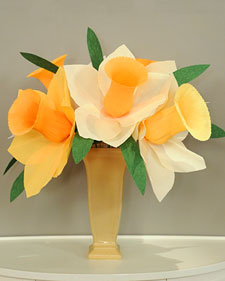
Daffodil Crepe Paper Flowers


Tools and Materials

  • Daffodil template
  • Florist crepe paper
  • Paper clips
  • Scissors
  • Pinking shears
  • 18-gauge paper-wrapped floral wire
  • Floral tape
  • Fabri-Tac adhesive
  • 20-gauge plain floral wire

Crepe Paper Daffodil How-To
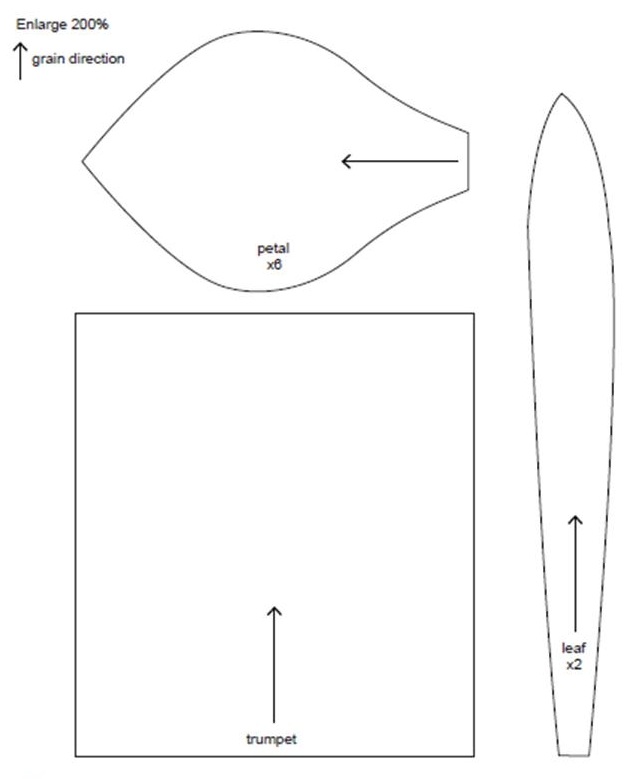
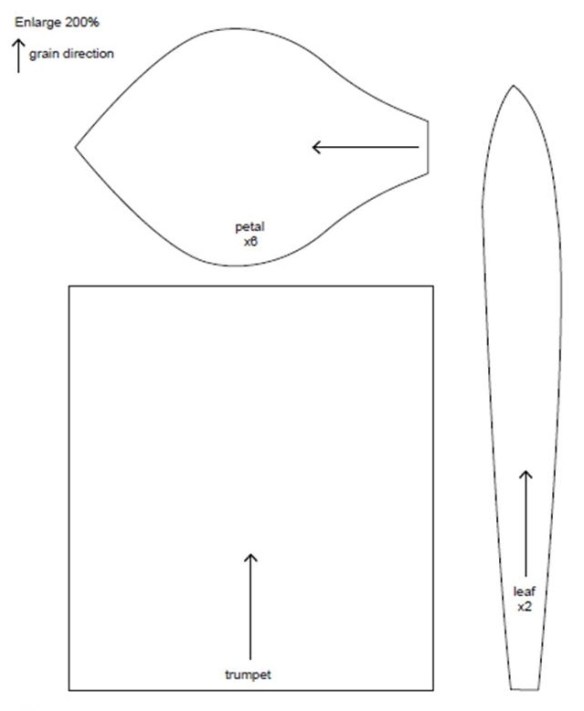
1. Download daffodil template, enlarge 200 percent, print, and cut out.

2. With paper clips, secure each element of the template to an appropriate shade of crepe paper, aligning the arrows with the grain of the paper. Cut out with scissors in the quantity indicated and trim top of trumpet piece with pinking shears.

3. To create stem, wrap together three 18-inch pieces of 18-gauge paper-wrapped floral wire with floral tape.

4. To create the bulbous bottom portion of the trumpet, place thumbs and forefingers together in the center of the trumpet piece, 3 inches from the bottom. Applying light pressure and moving outward, pull toward either edge, stretching the crepe paper as you go.

5. Run a bead of Fabri-Tac adhesive down one long edge of the trumpet, and bring edges together to make a cylinder.

6. Fold and pinch bottom of cylinder to top of stem, and secure in place with floral tape.

7. Insert hand into cylinder, and use fingers to shape the base of the trumpet.

8. Stretch pinked edge of trumpet against the grain of the crepe paper, and curl down with fingers.

9. Evenly space three petals around the base of the trumpet and secure in place with floral tape. Repeat with the remaining three petals.

10. With floral tape, attach each leaf to a 15-inch length of 20-gauge plain floral wire. Use more floral tape to secure each leaf to the daffodil stem.

PATTERN:
Tomato Sewing Pincushions

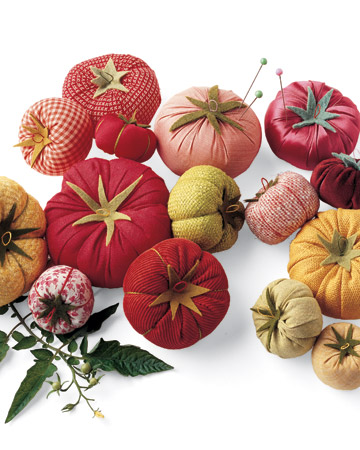
1. Cut a rectangle of fabric on the bias that’s twice as long as it is wide (the largest we made was 3 1/4 inches in diameter and required a 10-by-5-inch piece).With fabric facing right side up, fold in half as shown, and join ends with a 1/4-inch seam. Sew a running stitch around the top edge; tightly pull thread to cinch fabric, and secure with stitches.

2. Turn pouch right side out. Stuff with batting (cotton batting is firmer than polyester). Sew a running stitch around the open end; pull thread to cinch fabric. Tack shut with a few stitches and knot. To flatten, double-thread a cording needle with crochet thread and pull it through the “core” a few times. Mimic a tomato’s fluted details by wrapping the thread around the cushion and back through the core several times. Knot thread at top to finish.

3. For heirloom tomatoes, cut a circle of fabric (the largest we made was 3 1/2 inches in diameter and required a 10-inch-diameter circle). With fabric wrong side up, sew a running stitch around perimeter. Place batting in center of fabric, and gather into a pouch. Stuff with more batting, pull thread to cinch, and tack with stitches. Flatten cushion and apply details as in step 2.

4. For tops, photocopy template, enlarging or reducing as desired; cut out. Trace template onto green felt with a disappearing-ink pen; cut out. Using a single-threaded needle, sew a loop onto top. Glue top to tomato.

Note: To sew cherry-tomato pincushions, start with swatches of fabric that are 2 3/4 by 4 3/4 inches. Follow steps 1 and 2 below, but don’t flatten cushion or add fluted details. For tops, cut symmetrical, six-pointed stars from green felt. Add loops, and attach them as in step 4.

Bring On That Wonderful Country Summer

Easter Lily History

The Easter season is masked with several legends and folklores about the lily and its religious significance. Easter Lily is the traditional flower of Easter and is highly regarded as a joyful symbol of elegance, beauty, spirituality, hope, and life. In Christendom the lily has come to symbolize the resurrection of Jesus because of its delicacy of form and its snow white colors. But have you ever wondered about the history and significance of this symbolic Easter flower, which adds elegance, grace and fragrance to millions of homes and churches during the spring time.

Every year, on the first Sunday after the first full moon, churches are filled with exquisite Easter lilies. Churches at Easter time grace the altars and surround the cross with Easter Lilies, to commemorate the resurrection of Jesus Christ.

This importance rests even more clearly on a legend that the blood of Jesus, as it fell from the cross, was by a miracle transformed into flowers which filled heaven and earth.The popular Easter lily we use today to celebrate the holiday is referred to as  the white-robed apostles of hope.  These beautiful trumpet shaped white flowers were brought to the United States in 1875 from Japan by an American tourist and named after the florist who made it popular. The flower retells the resurrection story with its life cycle. These snow white flowers symbolize new life and hope.

The bulb of these flowers buried in the ground represents the tomb of Jesus and the glorious white trumpet-like fragrant flowers which grow from the bulbs symbolize His life after death. The snowy white color stands for the purity of the Divine Savior and the joy of the resurrection while the trumpet shape signifies Gabriel’s trumpet call to rebirth and new life.

Order a special gift of flowers for someone to show that you are thinking of just them. The perfect gift of flowers is perfect for birthdays, weddings, anniversaries, or on that “I’m sorry day!”, or any day! Order flowers online now from a trusted florist that will provide quality product at the perfect price!