Bakelite History

In 1907, American chemist Leo Hen-drik Baekeland, a Belgian immigrant and former organic chemistry pro­fessor at the University of Ghent, began his attempts to synthesize a rubber substitute in his home labo­ratory. He combined phenol and formaldehyde to make the first synthetic resin that could be substi­tuted for hard rubber. He called his discovery Bakelite, and Baekeland became known as the “father of plastics.”

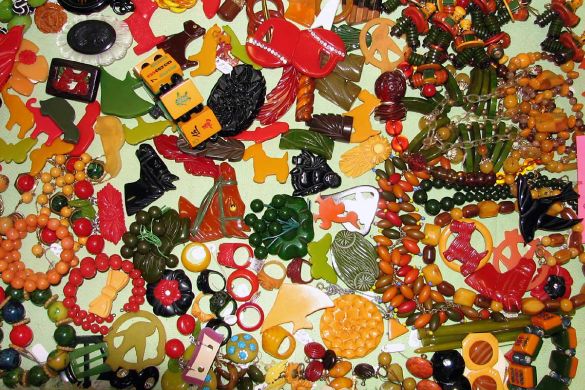
Once shaped under heat and pressure, Bakelite, tinted in a variety of colors, became rock solid, resisting heat, acids, and electric currents. Unlike rubber, which dried out and cracked, Bakelite endured, making the perfect synthetic polymer from which to mold bracelets, pot and pan handles, the heads of electrical plugs, and radio dials.

In 1927, the Catalin Corporation acquired Bakelite, selling the bracelets through upscale department stores like Saks Fifth Avenue, B. Altman, and Bonwit Teller, but also through F. W. Woolworth and Sears. During the Depression, socialites who could no longer afford to buy jewelry at Tiffa­ny’s and Cartier, embraced vibrantly colored Bakelite bracelets adorned with  rhinestones   and  costing between twenty cents and three dol­lars. In 1942, Bakelite and Catalin stopped making colorful costume jewelry and instead concentrated their efforts on manufacturing telephones, aviator goggles, and other products for use by the mili­tary. By the end of the war, manufacturers switched to newly developed injection-molded plastics, like Lucite, Fiberglass, vinyl, and acrylic, making Bakelite obsolete. Today, Bakelite is prized solely by collectors who scour flea markets, swap meets, and antique shows.

Photo credit:  [ http://gaslightshadows.com/bakelite.html  ] Please visit this great website chocked full of great information!

Christmas Carol Origins

Maria Augusta Trapp has documented history of carols in a clear and concise way. According to her, singing and caroling at Christmas is one of the oldest folk customs of the day and has been present since the time when Christianity and Christmas season were still at their budding stages. It is a worldwide custom and there has been lot of research on the subject and several books have been written about it. Originally, music compositions and songs at Christmas were in the form of chants and hymns. Caroling originally meant ‘circle dance’ and the words to accompany this festive dance were later added to the tradition.

Initially, the church looked down upon carols and carol singing as a pagan custom and they could not be included in the sacred services. However, in the countryside, many simple folk songs and Nativity carols were written and gaine popularity too. In 1223, Saint Francis of Assisi introduced carols into the formal worship of the church during a Christmas Midnight Mass in a cave in Greccio, in the province of Umbria. That night, the songs and music that accompanied this sacred and formal event were not hymns but carols. Ever since then, carols caught on with the masses and were at their prime in the Middle Ages, when they were almost always a part of the mystery plays.

There was a time, when wandering minstrels and waits or watchmen that guarded the old walled cities in the night used to pass their time by singing carols and also sang them to the people who used to pass them by. They would go from home to home, singing carols and entertaining people and may be get a treat in return. Later groups of musicians began singing carols and playing them for various events that were held during the Christmas season. Today, carol singing has becoming an important of this holiday season and a number of caroling events are organized throughout the world during the festive season, especially on Christmas Eve!

About Kwanzaa


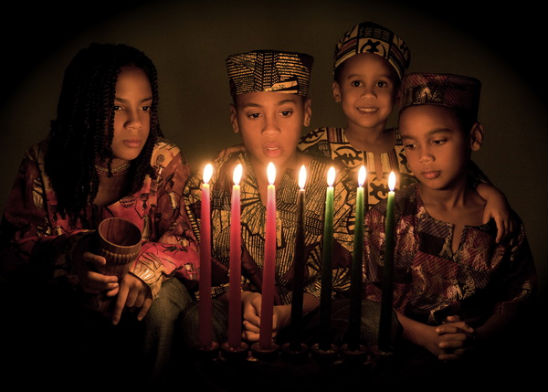
The name Kwanzaa is derived from the phrase “matunda ya kwanza” which means “first fruits” in Swahili. Each family celebrates Kwanzaa in its own way, but celebrations often include songs and dances, African drums, storytelling, poetry reading, and a large traditional meal. On each of the seven nights, the family gathers and a child lights one of the candles on the Kinara (candleholder), then one of the seven principles is discussed. The principles, called the Nguzo Saba (seven principles in Swahili) are values of African culture which contribute to building and reinforcing community among African-Americans. Kwanzaa also has seven basic symbols which represent values and concepts reflective of African culture.  An African feast, called a Karamu, is held on December 31.

The candle-lighting ceremony each evening provides the opportunity to gather and discuss the meaning of Kwanzaa. The first night, the black candle in the center is lit (and the principle of umoja/unity is discussed). One candle is lit each evening and the appropriate principle is discussed.
Seven Principles

The seven principles, or Nguzo Saba are a set of ideals created by Dr. Maulana Karenga. Each day of Kwanzaa emphasizes a different principle.

Unity: Umoja (oo–MO–jah)
To strive for and maintain unity in the family, community, nation, and race.

Self-determination: Kujichagulia (koo–gee–cha–goo–LEE–yah)
To define ourselves, name ourselves, create for ourselves, and speak for ourselves.

Collective Work and Responsibility: Ujima (oo–GEE–mah)
To build and maintain our community together and make our brother’s and sister’s problems our problems and to solve them together.

Cooperative Economics: Ujamaa (oo–JAH–mah)
To build and maintain our own stores, shops, and other businesses and to profit from them together.

Purpose: Nia (nee–YAH)
To make our collective vocation the building and developing of our community in order to restore our people to their traditional greatness.

Creativity: Kuumba (koo–OOM–bah)
To do always as much as we can, in the way we can, in order to leave our community more beautiful and beneficial than we inherited it.

Faith: Imani (ee–MAH–nee)
To believe with all our heart in our people, our parents, our teachers, our leaders, and the righteousness and victory of our struggle.

All About Hanukkah

Hanukkah, the Jewish Festival of Lights celebrates the revolt of the Maccabees in 165 BCE against the Syrian-Greek forces that had been occupying the Jewish temple in Jerusalem. After chasing the invading forces out, the victors found only enough oil in the desecrated temple to last one day, but miraculously the flame survived for eight days. This lay the foundation for the eight- day celebration of the holiday and the importance of oil in the menu planning for this period. The other important food item is dairy because, according to tradition, one of the factors contributing to the success of the Jews was that a brave woman named Judith fed salty cheese to the Syrian general, causing him to be so thirsty he drank wine until passing out. After he fell asleep she decapitated him, and his head was used to demoralize the rest of the army.

To celebrate the miracle of the oil, latkes have become a standard part of Hanukkah meals in America. In Israel, jelly donuts, or ” Sufganiyot”, is the representative food.

During this festival children look forward to playing the dreidl game, or s’vivon in Hebrew. The dreidl is a spinning top with Hebrew letters around it. It was originally used as a way to teach Hebrew to children under the guise of a game so that their captors would not realize what they were doing.

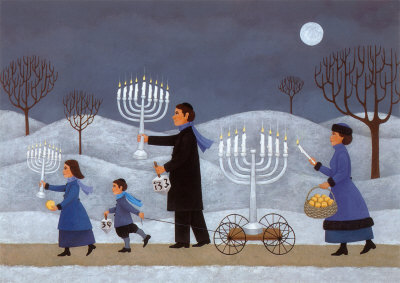
The most important symbol for the holiday is the menorah, the eight-branched candelabra. On each night of the celebration one extra candle is lit, until all eight are glowing on the last evening. Prayers and singing accompany the candle lighting.

Although Hanukkah was originally a minor holiday on the Jewish calendar, it has gained much greater prominence in America. The custom of giving presents to children during this holiday was adopted in the U.S., and generally children receive a gift for each night of the celebration. Children also receive foil wrapped chocolate coins called gelt, either as gifts or prizes for winning at the dreidl game.

But the most important part of the celebration is sharing time with family and friends, passing along the story of the Maccabee success to children, and sharing a piece of Jewish history with non-Jewish friends. With eight nights to party, Jewish families can plan a variety of activities to amuse young and old. Consider some of the following ideas to create traditions of your own:

* Make one night ” grandparent night” where the focus is on grandparents sharing the holiday with their children and grandchildren.
* Another night can be ” book night” where books are exchanged with one another, and special stories are read aloud.
* Dedicate one night to sharing the story of Hanukkah and traditions with non-Jewish friends and neighbors.
* Join in the celebration at your family’s synagogue.
* Take the family on a cultural outing another night such as a trip to the theater, symphony, or ballet.

Christmas Stocking History

Hanging a Christmas stocking is a tradition that has been followed since times immemorial. It is believed that St. Nicholas would fill the stockings with gifts, on the eve of Christmas. Small kids eagerly wait for his arrival and the gifts that he would bring along with him. They decorate their stockings beautifully and hang them nearby fireplace. Although there are no written records of the origin of Christmas stockings, there are some popular stories that have been believed since generations. One of the most popular legend talks about the history of Christmas. In the article, we have provided interesting information on the origin and history of Christmas stockings.

Origin Of Christmas Stocking
Many centuries back, there lived a poor man in a village. He had three beautiful daughters. His wife had passed away due to some illness and he had spent all his money to cure his wife. Thus, he was left with no money to marry off his daughters. The three daughters were very kind and strong and this is what worried their father even more. He was concerned what would happen to them after his death. One fine day, St. Nicholas was passing through the village, when he overheard the discussion of some villagers talking about the pitiable condition of the three girls. St. Nicholas wanted to help the poor father, but he knew that the old man wouldn’t accept money from him.

St. Nicholas decided to help the family secretly, without letting anybody else know about it. He waited until it was night and stealthily sneaked into their house, through the chimney. He had three bags of gold coins with him, one for each girl. As he was looking for a place to keep those three bags, he noticed stockings of the three girls that were hung over the mantelpiece for drying. He put each bag in each stocking and then went away. When the girls and their father woke up the next morning, they were thrilled to find the bags of gold coins. He happily married off his daughters, one after the other, and they remained happy for the rest of their lives. The story about St. Nicholas being so generous spread throughout the village and then all over the land. Since then, it has been a tradition to hang stocking on Christmas in the hope that St. Nicholas would bring a present
.