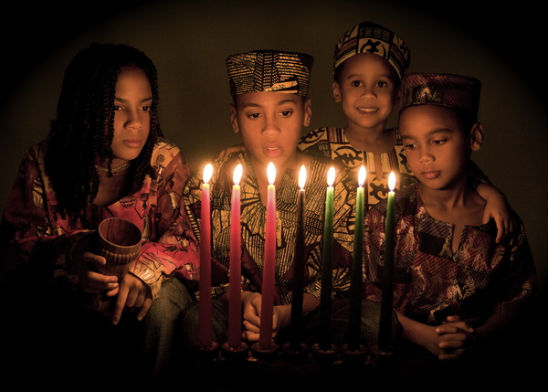
The name Kwanzaa is derived from the phrase “matunda ya kwanza” which means “first fruits” in Swahili. Each family celebrates Kwanzaa in its own way, but celebrations often include songs and dances, African drums, storytelling, poetry reading, and a large traditional meal. On each of the seven nights, the family gathers and a child lights one of the candles on the Kinara (candleholder), then one of the seven principles is discussed. The principles, called the Nguzo Saba (seven principles in Swahili) are values of African culture which contribute to building and reinforcing community among African-Americans. Kwanzaa also has seven basic symbols which represent values and concepts reflective of African culture. An African feast, called a Karamu, is held on December 31.
The candle-lighting ceremony each evening provides the opportunity to gather and discuss the meaning of Kwanzaa. The first night, the black candle in the center is lit (and the principle of umoja/unity is discussed). One candle is lit each evening and the appropriate principle is discussed.
Seven Principles
The seven principles, or Nguzo Saba are a set of ideals created by Dr. Maulana Karenga. Each day of Kwanzaa emphasizes a different principle.
Unity: Umoja (oo–MO–jah)
To strive for and maintain unity in the family, community, nation, and race.
Self-determination: Kujichagulia (koo–gee–cha–goo–LEE–yah)
To define ourselves, name ourselves, create for ourselves, and speak for ourselves.
Collective Work and Responsibility: Ujima (oo–GEE–mah)
To build and maintain our community together and make our brother’s and sister’s problems our problems and to solve them together.
Cooperative Economics: Ujamaa (oo–JAH–mah)
To build and maintain our own stores, shops, and other businesses and to profit from them together.
Purpose: Nia (nee–YAH)
To make our collective vocation the building and developing of our community in order to restore our people to their traditional greatness.
Creativity: Kuumba (koo–OOM–bah)
To do always as much as we can, in the way we can, in order to leave our community more beautiful and beneficial than we inherited it.
Faith: Imani (ee–MAH–nee)
To believe with all our heart in our people, our parents, our teachers, our leaders, and the righteousness and victory of our struggle.
If you like this post and want to share it then click the service!

 In a large bowl, beat together 1 quart
 Country & Victorian Times