Christmas Jingle Bell Projects

Bell Wreath Supplies
Heavy gauge floral wire
Christmas theme colored bells
Chenille stems-gold, green, red
Broad width ribbon – red

Bell Wreath Instructions
Step 1 Make a circular loop with heavy gauge floral wire.
Step 2 String bells along wire and fit them closely together around the length of the loop.
Step 3 Use a pipe cleaner to wind around the bells at either end of the loop to hold the wreath shape together in a circle.
Step 4 Tie a bow around a pipe cleaner and then tie that pipe cleaner around the part of the loop that was joined together.

Bell Tree Supplies
12″ Floral cone, Styrofoam*
Christmas theme colored bells
Wrapping paper
Chenille stems – hot pink, turquoise, lime green
Craft feather boa – white
Glitter foam sheet, sticky back – hot pink
Glue
Gemstone-turquoise
Toothpick
Pattern printed from http://www.michaels.com
Pencil
Scissors

Bell Tree Instructions
Step 1 With hobby knife, cut a Styrofoam* floral cone down to desired size for tree.
Step 2 Cover cone with wrapping paper that matches the bells you will be using to decorate. Glue paper into place.
Step 3 String bells on lengths of chenille stems, keeping in mind how big your cone is.
Step 4 Join the strings of bells by twisting them together, end to end. Push one end of the joined chenille stems into the top of the cone.
Step 5 Begin circling the cone with the chenille stems and bells starting from the top and working down to the bottom in a spiral. Push in the other end of the pipe cleaner into the bottom edge of the cone.
Step 6 Wrap and glue craft boa to the base and top of the cone.
Step 7 Trace two stars and one base onto sticky foam sheet and cut out.
Step 8 Stick two stars together, sticky side to sticky side and insert a toothpick in between the stars half way in from the bottom.  Insert into the top of the tree. Glue gemstone onto front of star.
Step 9 Glue the tree onto center of base and glue craft boa around the bottom of the tree.

Rubber Stamping History

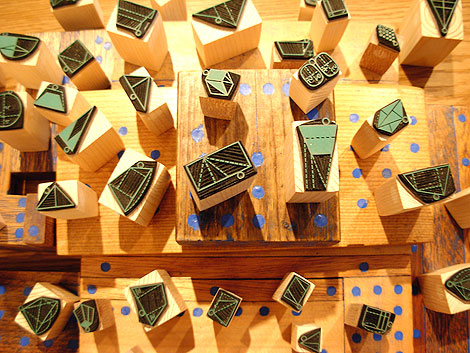
Can you make a common denomination between rubber stamping and Myan civilization? Rubber Stamping is, beyond a doubt, one of the fastest growing crafts today. With its inexpensive materials and creative limitless boundaries, rubber stamping provides millions with hours of fun and creativity. Here’s a brief history:

• Spanish explorers were the first to talk about a “sticky substance” that bounced, used by South American Indians. Though it didn’t revolutionalize the world at that time, these same Indians were using a primitive form of rubber stamping to “mark and tattoo” images on men and women.

• In 1736, Charles Marie de la Condamine, a French scientist studying the Amazon, sent a piece of “India Rubber” back to France.

• Rubber got its name in 1770, when the scientist Sir Joseph Priestly made a comment about a substance “excellently adapted to the purpose of wiping from paper the mark of black lead pencil.” Hence the “rubbing out” of pencil marks gave it the term “rubber”. Up until this time, people wishing to erase pencil marks had to use bread crumbs.

• Rubber Stamping owes much gratitude to a hardware store owner who decided to quit his job to solve the “sticky problem” he had heard about. Though his persistence was tested time and again, even filing bankruptcy and going to jail for failure to pay debts, Charles Goodyear eventually discovered that heat was the secret to rubber’s “curing”.

• As early as 1866, a man carved information in a flat piece of rubber and mounted it to a curved block of wood. This 4″x 6″ mounted rubber stamp was being used to print information on bath tubs.

• Early rubber stamps consisted mainly of words and phrases used to mark packages and manufactured products. Stamping suppliers began to spring up in Ohio and the West.

• Rubber stamping as a hobby took off in the early 1970’s with companies such as All Night Media (1974) and Hero Arts (1974). Soon the craze had caught and many other companies decided to cash in on a hobby that would last for decades.

• It wasn’t until a boom in the 1990’s that rubber stamping became so popular with millions of crafter’s worldwide. As thousands of companies begin to produce rubber stamps, the availability and unique designs became common everywhere!

It’s no wonder why rubber stamping has turned into a worldwide crafting phenomenon. Women and men alike have found hundreds of creative uses for rubber stamps, from scrapbooking and cardmaking, to gift bags and 3D artwork. Give it a try, you’ll see!

ACEO’s = What are they???

What ACEO is all about

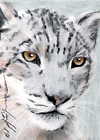
ACEO stands for “Art Cards, Editions and Originals”. These cards have one main rule – they are 3.5 inches by 2.5 inches – the size of a trading card.

The reason for this is, of course, that Art Cards are made to be traded! But while artists were happily trading cards, the general public was left out in the cold, having no Art Cards to trade. A group of artists realized this, and quickly made their cards available for sale at remarkably low prices so that everyone could join in the fun!

Cards are also sold either as originals or editions. Make sure you know which you are buying! If it is a print it should say so, and it should be numbered and signed, usually on the back.

Art Cards can be a riot! Artists from all over the world are creating, and now selling these little gems in different mediums and of different subjects. Watercolor, Oil, Acrylic, Colored Pencil, Pastels, Pyrography, Pen and Ink, Sketching, Collage – the sky is the limit. Abstract, Surrealism, Outsider Art, Impressionism, Expressionism -every style you can think of – and then some!. Every interest and subject is covered! Extremely collectable Pocket Art, you can’t stop at just one!

Indoor & Outdoor Banners

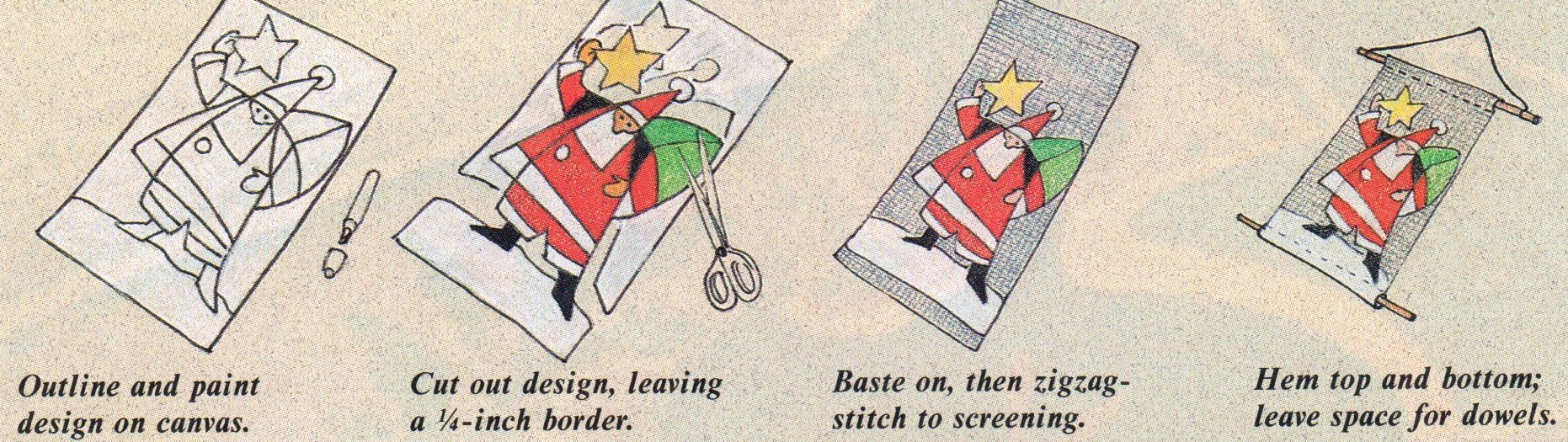
Heralding the holidays, these colorful ban­ners greet visitors at the street, by the front door, or in the house. These contemporary versions of medieval gonfalons have a ban­ner-shaped backing of weatherproof fiber-glass screening ordinarily used in doors and windows. Our banners show a waving Santa, a Nutcracker rat, and a persimmon branch, but you can copy and enlarge any favorite image or printed message. Because the screening is almost transparent, the image seems to float in air.

To make these banners, simply paint, cut out, and sew can­vas shapes to screening. The screening is sold by the foot in 2-, 3-, and 6-foot-wide rolls (30, 40, and 90 cents per foot) at most hardware and building supply stores.

Start by drawing a full-size paper pattern, then transfer it onto off-white artist’s canvas (available in craft and art supply stores) with fabric markers. Paint in the colors with acrylic or fabric paint. Iron the canvas flat (some fabric paints require heat to set them in any case). Follow the steps below to cut out and sew the fabric to the screen.

Finally, at the top and bottom of the screening, make a hem generous enough for a ‘/2-inch-diameter dowel. The top dowel should be wider than the banner and hang from fishing line or thread. The bottom dowel, cut to the banner’s width, unobtrusively keeps it hanging straight.

Hummel History

In 1876, Franz Goebel started a porcelain firm near the town of Oeslauby, Germany. After several years of porcelain production in the factory, Franz’s son, William expanded the Goebel product line and changed the company name to W. Goebel Porzellanfabrik. Convinced that the American market would assist sales, William developed a U.S. product line and sent his 16-year-old son, Max Louis, to America. By 1911, Max Louis Goebel returned to German to move the factory into the 20th century.
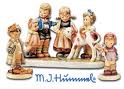
In the 1930s, Franz Goebel thought that in a world of political turmoil, customers would respond to a product that depicted the gentle innocence of childhood. The artwork of a Franciscan Sister and gifted artists trained at the Munich Academy, Maria Innocentia Hummel, was introduced to Mr. Goebel. The nun made drawings of country children that were printed as art cards which gained popularity.

Based on the artwork of Sister Hummel, Goebel wanted to produce a line of figurines. The artist was contacted at the Convent of Siessen and was shown clay models based on her drawings. Sister Hummel and the Convent of Siessen granted sole rights to Goebel to create ceramic figures based on her original artwork. Sister Hummel personally approved the sculpting and painting of each porcelain piece. It was determined that earthenware, pioneered by Goebel in the 1920s, was the proper medium for the new line.

About Sister Hummel Maria Innocentia Hummel was born in Bavaria in 1909. In 1927, she enrolled in Munich’s famed Academy of Applied Arts and befriended two Franciscan Sisters from a teaching order that emphasized the arts. She decided to enter the Convent of Siessen upon graduation from art school in 1931, and by 1934, the young nun took the name Maria Innocentia replacing the name Bertha.

The members of the convent encouraged the Sister to pursue her artwork. Soon, small German publishers began printing her artwork in the form of postcards. These charming cards came to the attention of Franz Goebel, the head of the Goebel porcelain company.

The artist worked personally with Goebel’s Master sculptors and painters to create the figurines. First introduced in 1935, the Hummel figurines were an immediate success. The relationship between Hummel and Goebel continued amicably until Sister Hummel’s untimely death at 37 in 1946. Goebel carried on her artistic legacy with new Hummel pieces.
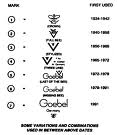
Hummel signature and markings To determine if a figurine, plate, or bell is a genuine Hummel piece, there are definitive marks of identification that should be evident. The mark of Sister M. I. Hummel is incised on every piece. Sister Hummel requested that her personal stamp of approval would appear on every piece and under the direction of the members of the convent, approvals were made with care. All Hummels have a mold number which is a number that is incised on the bottom of each M. I. Hummel figurine at the factory. Another definitive identifier is the Goebel stamp on the underside of the figurine which is an official Goebel trademark. While the trademark has changed over the years, every authentic M. I. Hummel figurine will have a Goebel stamp on its underside. When any change in the backstamp had occurred, it has been a source of great excitement for M. I. Hummel collectors.

Values and specific figurines Hummel figurines are highly sought after by collectors with several models valued at hundreds, even thousands, of dollars per piece. Pieces such as “For Father”, “Globe Trotter”, “Little Goat Herder”, and “Going to Grandmas” are good examples of valuable collectibles. As with all collectibles, condition and rarity will affect value, but don’t let anyone tell you that your Hummel figurine is not collectible or not valuable. Remember, someone who is interested in buying your Hummels for their collection or for resale in their store will most likely not provide an accurate appraised value. Why? They don’t want to pay top dollar for a valuable Hummel!