Bakelite History

In 1907, American chemist Leo Hen-drik Baekeland, a Belgian immigrant and former organic chemistry pro­fessor at the University of Ghent, began his attempts to synthesize a rubber substitute in his home labo­ratory. He combined phenol and formaldehyde to make the first synthetic resin that could be substi­tuted for hard rubber. He called his discovery Bakelite, and Baekeland became known as the “father of plastics.”

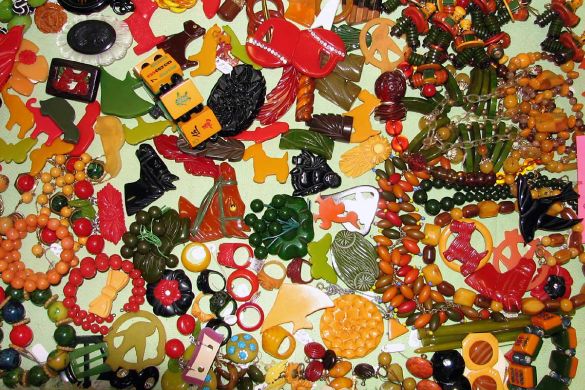
Once shaped under heat and pressure, Bakelite, tinted in a variety of colors, became rock solid, resisting heat, acids, and electric currents. Unlike rubber, which dried out and cracked, Bakelite endured, making the perfect synthetic polymer from which to mold bracelets, pot and pan handles, the heads of electrical plugs, and radio dials.

In 1927, the Catalin Corporation acquired Bakelite, selling the bracelets through upscale department stores like Saks Fifth Avenue, B. Altman, and Bonwit Teller, but also through F. W. Woolworth and Sears. During the Depression, socialites who could no longer afford to buy jewelry at Tiffa­ny’s and Cartier, embraced vibrantly colored Bakelite bracelets adorned with  rhinestones   and  costing between twenty cents and three dol­lars. In 1942, Bakelite and Catalin stopped making colorful costume jewelry and instead concentrated their efforts on manufacturing telephones, aviator goggles, and other products for use by the mili­tary. By the end of the war, manufacturers switched to newly developed injection-molded plastics, like Lucite, Fiberglass, vinyl, and acrylic, making Bakelite obsolete. Today, Bakelite is prized solely by collectors who scour flea markets, swap meets, and antique shows.

Photo credit:  [ http://gaslightshadows.com/bakelite.html  ] Please visit this great website chocked full of great information!

3 Days Left Before Christmas

!!!!!3 Days Left…..Merry Christmas!!!!!

Winter Storm & Extreme Cold: Preparation For Disaster

Before Winter Storms and Extreme Cold

Add the following supplies to your disaster supplies kit:

  • Rock salt to melt ice on walkways
  • Sand to improve traction
  • Snow shovels and other snow removal equipment.

Prepare your home and family

  • Prepare for possible isolation in your home by having sufficient heating fuel; regular fuel sources may be cut off. For example, store a good supply of dry, seasoned wood for your fireplace or wood-burning stove.
  • Winterize your home to extend the life of your fuel supply by insulating walls and attics, caulking and weather-stripping doors and windows, and installing storm windows or covering windows with plastic.
  • Winterize your house, barn, shed or any other structure that may provide shelter for your family, neighbors, livestock or equipment. Clear rain gutters; repair roof leaks and cut away tree branches that could fall on a house or other structure during a storm.
  • Insulate pipes with insulation or newspapers and plastic and allow faucets to drip a little during cold weather to avoid freezing.
  • Keep fire extinguishers on hand, and make sure everyone in your house knows how to use them. House fires pose an additional risk, as more people turn to alternate heating sources without taking the necessary safety precautions.
  • Learn how to shut off water valves (in case a pipe bursts).
  • Know ahead of time what you should do to help elderly or disabled friends, neighbors or employees.
  • Hire a contractor to check the structural ability of the roof to sustain unusually heavy weight from the accumulation of snow – or water, if drains on flat roofs do not work.

Prepare your car

  • Check or have a mechanic check the following items on your car:
    • Antifreeze levels – ensure they are sufficient to avoid freezing.
    • Battery and ignition system – should be in top condition and battery terminals should be clean.
    • Brakes – check for wear and fluid levels.
    • Exhaust system – check for leaks and crimped pipes andrepair or replace as necessary. Carbon monoxide is deadly and usually gives no warning.
    • Fuel and air filters – replace and keep water out of the system by using additives and maintaining a full tank of gas.
    • Heater and defroster – ensure they work properly.
    • Lights and flashing hazard lights – check for serviceability.
    • Oil – check for level and weight. Heavier oils congeal more at low temperatures and do not lubricate as well.
    • Thermostat – ensure it works properly.
    • Windshield wiper equipment – repair any problems and maintain proper washer fluid level.
  • Install good winter tires. Make sure the tires have adequate tread. All-weather radials are usually adequate for most winter conditions. However, some jurisdictions require that to drive on their roads, vehicles must be equipped with chains or snow tires with studs.
  • Maintain at least a half tank of gas during the winter season.
  • Place a winter emergency kit in each car that includes:
    • a shovel
    • windshield scraper and small broom
    • flashlight
    • battery powered radio
    • extra batteries
    • water
    • snack food
    • matches
    • extra hats, socks and mittens
    • First aid kit with pocket knife
    • Necessary medications
    • blanket(s)
    • tow chain or rope
    • road salt and sand
    • booster cables
    • emergency flares
    • fluorescent distress flag

Dress for the Weather

  • Wear several layers of loose fitting, lightweight, warm clothing rather than one layer of heavy clothing. The outer garments should be tightly woven and water repellent.
  • Wear mittens, which are warmer than gloves.
  • Wear a hat.
  • Cover your mouth with a scarf to protect your lungs.

Homemade “Little Debbie Cakes”

WHAT YOU NEED
From the supermarket:
• 5 egg whites
• 5 egg yolks, beaten
• 2 cups sifted confectioners’ sugar
• 4 tablespoons regular cocoa
• Crisco All-Vegetable Shortening
• All-purpose flour
• Wax paper
• 3 tablespoons milk
•  1 cup heavy cream, whipped and flavored with sugar and vanilla
WHAT TO DO
Beat egg whites until frothy. Add one cup confectioners’ sugar and beat until stiff. Add three tablespoons cocoa and mix well. Fold in egg yolks. Grease a ten-by-fifteen inch jelly roll pan with vegetable shortening. Line the bottom
of the pan with a sheet of wax paper, then grease and flour the wax paper and the inside of the rest of the pan. Spread the cake mixture evenly in the pan and bake twenty minutes at 375 degrees Fahrenheit.
While the cake bakes, combine the milk, one cup confectioners’ sugar, and one tablespoon cocoa to make icing. Blend until smooth.
Sprinkle confectioners’ sugar over a clean dish towel, and turn out the baked cake on it. Cover the cake with a second dish towel dampened with water until the cake cools. Spread with whipped cream over the top of the cake. Roll up both ends of the cake toward the center, creating two rolls. Cut the rolls apart, cut each roll in half, and frost with icing. Makes four cakes.

Homemade “Cracker Jack”

6 cups popped corn

1 cup roasted and unsalted peanuts

1 tablespoon butter

1/2 cup molasses

1/4 cup sugar

Pour popcorn and peanuts into a large pan. Melt butter in a saucepan, then add the molasses and sugar, blending the ingredients together. Heat to the soft-crack stage at 290 degrees F. Pour the liquid candy over the mixed popcorn and peanuts, stirring the mixture with a wooden spoon to make sure the popcorn and peanuts are evenly coated with candy. Lay on wax paper to dry. Makes six cups.