The Wedding Day has arrived, the most important event in a Victorian girl’s life. It is the day her mother has prepared her for from the moment she was born. The Victorian girl knew no other ambition. She would marry, and she would marry well.
The wedding itself and the events leading up to the ceremony are steeped in ancient traditions still evident in Victorian customs. One of the first to influence a young girl is choosing the month and day of her wedding. June has always been the most popular month, for it is named after Juno, Roman goddess of marriage. She would bring prosperity and happiness to all who wed in her month. Practicality played a part in this logic also. If married in June, the bride was likely to birth her first child in Spring, allowing her enough time to recover before the fall harvest.
June also signified the end of Lent and the arrival of warmer weather. That meant it was time to remove winter clothing and partake in one’s annual bath. April, November and December were favored also, so as not to conflict with peak farm work months. October was an auspicious month, signifying a bountiful harvest. May, however, was considered unlucky. “Marry in May and rue the day,” an old proverb goes. But “Marry in September’s shine, your living will be rich and fine.”
In the Southern United Sates, April was favored, as it was less hot, and a bride’s favorite flowers were in bloom–jasmine and camellia.
Brides were just as superstitious about days of the week. A popular rhyme goes:
Marry on Monday for health,
Tuesday for wealth,
Wednesday the best day of all,
Thursday for crosses,
Friday for losses, and
Saturday for no luck at all.
The Sabbath day was out of the question.
Once the bride chose her wedding day, a prerogative conferred upon her by the groom, she could begin planning her trousseau, the most important item of which was her wedding dress.
Brides have not always worn white for the marriage ceremony. In the 16th and 17th centuries for example, girls in their teens married in pale green, a sign of fertility. A mature girl in her twenties wore a brown dress, and older women even wore black. From early Saxon times to the 18th century, only poorer brides came to their wedding dressed in white–a public statement that she brought nothing with her to the marriage. Other brides wore their Sunday best.
Color of the gown was thought to influence one’s future life.
White–chosen right
Blue–love will be true
Yellow–ashamed of her fellow
Red–wish herself dead
Black–wish herself back
Grey–travel far away
Pink–of you he’ll always think
Green-ashamed to be seen
 Ever since Queen Victoria wed in 1840, however, white has remained the traditional color for wedding gowns and bouquets. A woman then used her dress for Court Presentation after marriage, usually with a different bodice.
The early Victorian wedding dress had a fitted bodice, small waist, and full skirt (over hoops and petticoats.) It was made of organdy, tulle, lace, gauze, silk, linen or cashmere. The veil was a fine gauze, sheer cotton or lace. The reasonable cost of a wedding gown in 1850 was $500, according to Godey’s, with $125 for a veil. By 1861, more elaborate gowns cost as much as $1500 if constructed with lace.
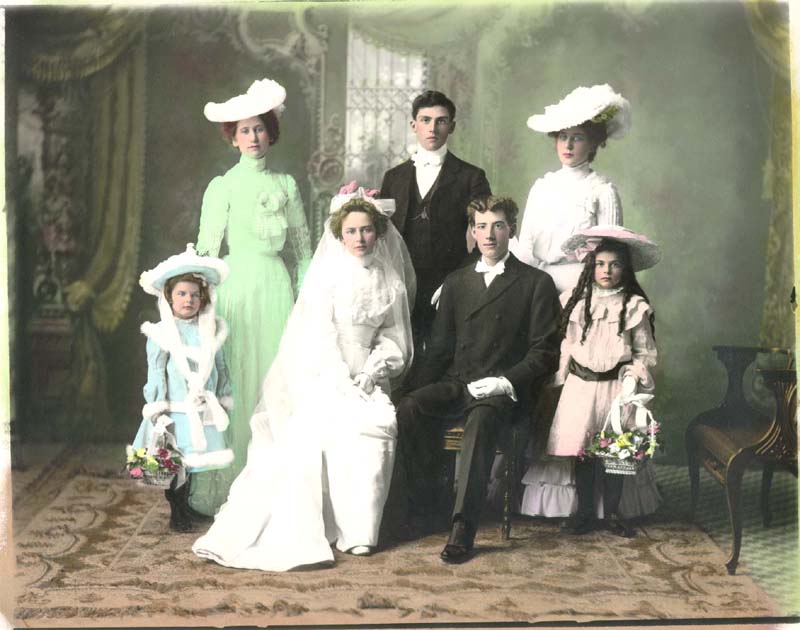
Formal weddings during this period were all white, including the bridesmaid’s dresses and veils. Veils were attached to a coronet of flowers, usually orange blossoms for the bride and roses or other in-season flowers for the attendants. The bride’s accessories included: short white kid gloves, hanky embroidered with her maiden name initials, silk stockings embroidered up the front, and flat shoes decorated with bows or ribbons at the instep.
The American Frontier bride of the 1850s and 60s usually chose cambric, wool or linen dresses in a variety of colors. Few wore white, as the dress was used later for special events and church. Many had a warm, colorful shawl in paisley or plaid which draped her shoulders at the wedding. The shawl was then used for christenings, social events and an extra blanket in winter. A warm shawl was more cherished than a wedding dress.
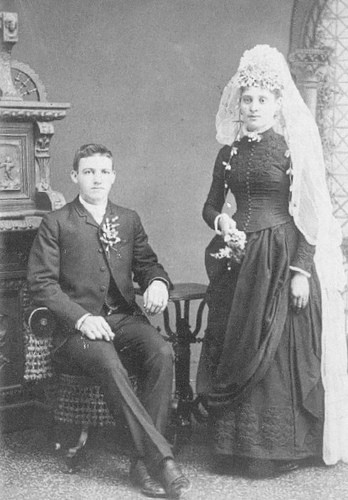
For the mid-Victorian bride (1870s) there was an emergence of middle class wealth, and with it a display of their new riches. Wedding gowns fashioned by Worth in Paris were the ultimate status symbol. And if one couldn’t afford an original, one copied them. Full court trains were now part of the wedding ensemble, as were long veils, a bustle, elegant details and two bodices–a modest one for the wedding and a low one for special occasions.
The late Victorians (1890s) saw the bustle disappear, a demi-train and large sleeves now in fashion. If the bride married in church, the dress must have a train, with a veil of the same length. The veil could be lace or silk tulle. From the mid-Victorian era to the 1890s, the veil covered the bride’s face and was not lifted until after church. The veil was not used as a shawl after the wedding any more, however. White kid gloves were long enough to tuck under the sleeves, and had a slit in one finger to slip the ring on without removing the glove. Slippers were of white kid, satin or brocade and the heels rose to one inch.
For the widow who remarried in the early and mid-Victorian eras, she did not wear white, had no bridesmaids, no veil and no orange blossoms, (a sign of purity.) She usually wore a pearl or lavender satin gown trimmed with ostrich feathers. In the later decades, she was allowed attendants as well as pages, but no veil or orange blossoms. She could wear a shade or two away from white, preferring rose, salmon, ivory or violet.
As for jewelry, diamonds have always been popular. When white dresses were in vogue, pearl and diamond combinations were fashionable. The mid-Victorians had a more extravagant display of wealth, often a diamond tiara for the ceremony. Combination pieces of diamond jewelry that could be separated later as individual pieces were popular. Traditionally, the jewelry worn by the bride was a gift from her husband. The earlier in the day the wedding, the less jewelry.
Finally, for the bride, you may recall the English rhyme: “Something old, something new, something borrowed, something blue, and a lucky sixpence in your shoe.” Something old was often a family heirloom and the bride’s link with the past. Something new could be her dress or a gift from the groom. Something borrowed was of real value like a veil or headpiece, and returned to the owner. Something blue was often the garter or an embroidered handkerchief. The touch of blue symbolized faithfulness, while the sixpence ensured future wealth.
The grooms, too, were concerned with fashion on their wedding day, and turned to magazines for advice on how best to be turned out. In the early Victorian era, the bridegroom wore a frock coat of blue, mulberry or claret, and a flower favor in his lapel. By 1865, men’s coats were tailored with a special “flower-hole” for this purpose. His waistcoat was white, and his trousers of lavender doeskin. Black was out of the question. The best man and groomsmen wore frock coats also, but in a more subdued tone. The American frontier groom wore a flower on the lapel of his best suit, using whatever was in the bride’s bouquet.
By the mid-Victorian era, frock coats were seldom worn, the morning coat being preferable because of its smarter appearance. Some grooms still wore frock coats, however, and did so with a vest of black cloth, dark gray trousers, a folded cravat of medium color, and lavender gloves stitched in black.
 Fashions changed rapidly in the late Victorian years, from no need for gloves in 1885, to a must for gloves in 1886. By now, however, men wore pearl colored gloves with black embroidery. By 1899, the frock coat was back in style along with a double-breasted, light-colored waistcoat, dark tie, gray striped cashmere trousers, patent-leather button boots and pale tan kid gloves. Throughout the Victorian era, a black top hat was a necessity.
By the end of the Victorian era, boutonnieres were large–a bunch of lilies, a gardenia or stephanotis sprig. If the wedding was in the evening, as now allowed by English law, full dress tailcoats were in order, with white gloves and white waistcoat. The father of the bride dressed like the groom and groomsmen, and according to the time of day for the wedding.
Gowns for the bridesmaids had to be both practical and beautiful, for they became a part of the girl’s wardrobe after the ceremony. Some generous brides provided the dresses for their attendants. During the early Victorian years, skirts were full and bodices tiny. Tradition called for an all white wedding, but color could be added for an accent if the overall effect remained white. Bridesmaids covered their heads with short white veils falling from a coronet to just below the hip. Weddings at home did not require a veil, and often headpieces of flowers and ribbons were worn.
By the mid-Victorian era, bustles were the height of fashion. White was no longer the color, but was still worn at some weddings, often in combination with another color. By the 1890s, the Victorians were more willing to try innovative new fashions, closely following fashions from Paris. Large sleeves were in style, emphasizing the shoulders. Grey, violet and lilac were popular in England, while Americans preferred white, rose or green. By 1898, fashion dictated that the bridesmaids’ dresses be in direct contrast to the bride’s, so as not to distract from the beauty of her gown. That custom is still in practice today.
Children were a symbolic part of the Victorian wedding and had their own dress etiquette. Little girls could be flower girls or ring bearers. If older, they could be junior bridesmaids or maids of honor. Regardless of their role, their dresses were of white muslin tied with a ribbon sash that matched their shoes and stockings. The dresses were either long or short depending upon the prevailing styles and ages of the girls. The boys had the important role of holding the bride’s train. They dressed as court pages in velvet jackets, short trousers and round linen collars fastened by large bows of white crepe de chine or surah. Their laced shoes were black, unless it was a formal wedding, in which case they wore white silk hose, and buckles on their shoes. Their velvet suits could be black, blue, green or red, with a matching hat, which was optional. The hat was removed for a church ceremony.
Social customs dictated what the mothers and female guests wore, also, the difference subtle yet present. At a daytime wedding, guests wore walking or visiting costumes. The mothers, and other female family members, wore reception toilettes, being more elegant than daytime costumes, but less formal than evening dress. All women had to wear bonnets in church, but they were optional for at-home ceremonies. Bonnets were not worn for evening receptions. In the late Victorian era, black was suggested as an appropriate color for the mother of the bride. These were never made of black crepe, however, which signified mourning. If the mother was in mourning, she could put aside her crepe for the ceremony and wear purple velvet or silk in America, or cardinal red in England. Queen Victoria, the mother figure at many weddings, always wore black and white because she was in mourning for her “dearest Albert.”
Everyone is finally primped and curled. It is time for the ceremony to begin!
Before the 1880s, a couple was required by law to have a morning ceremony. By the late 1880s, permissible hours were extended until 3:00 p.m.. In the Eastern United States, the fashionable hours were between 10:00 a.m. and Noon because it was an English custom. In New York in 1890, half after three was also a fashionable hour. Southern American weddings, however, were almost always at 6:00 p.m. because it was cooler then.
The marriage ceremony took place either at home or in church, with many guests or few. In the 1850s, weddings were almost always held in church, and it was customary to use the bride’s parish. The clergyman and parish clerk were in attendance. After the ceremony, the couple signed their name in the parish register in the vestry. The bride signed her maiden name. Flowers decorated the church, the arrangements growing more elaborate as the decades wore on–from potted palms to festoons of evergreens and blossoms.
One usher was usually in charge of matters at church, while the others went to the bride’s house for their favors. In England, the bride pinned favors of white ribbon, flowers, lace and silver leaves on the ushers’ shoulders. In America, ushers wore boutonnieres in their lapels. In early Victorian England, the bridesmaids also made favors and pinned them on the sleeves and shoulders of the guests as they left the ceremony. Later in the era, even the servants and horses wore flowers. The servants’ favors were handmade by the bride and included a special memento if she’d known them from childhood.
Guests in mourning entered the church quietly and hid amongst the crowd, so as not to cast negative aspersions on the couple.
In England, a country bride and her wedding party walked to church on a carpet of blossoms to assure a happy path through life. For the wealthier, a grey horse pulling the wedding carriage was considered good luck. Church bells pealed forth as the couple entered the church, not only to make the populace aware of the ceremony taking place, but also to scare away any evil forces lurking nearby.
The wedding ring was usually a plain gold band with the initials of the couple and the date of their wedding engraved inside. There were few double ring ceremonies in the Victorian era. It was considered good luck for the ring to drop during the ceremony, thus all evil spirits were shaken out.
After the ceremony, the bride and groom walked out without looking left or right. It was considered bad taste to acknowledge friends and acquaintances. The bride’s parents were the first to leave the church, and the best man the last after he paid the clergyman for his services. From a custom dating back to Roman times when nuts were thrown after the departing couple, the practice continued, but in the form of rice, grain or birdseed, a symbol of fertility. The wedding carriage awaiting the bride and groom was drawn by four white horses.
If the ceremony was at home, (as was popular in the 1890s) the decorations were no less elaborate. A profusion of white, and another color according to the theme, abounded in the bride’s home, adorning doorways, balustrades, windows and fireplaces. In America, a good luck symbol was hung over the spot where the couple exchanged their vows. This could be a bell, dove, wishbone, or any other good luck symbol.
Because of the early hour for weddings, the reception was traditionally a breakfast. It was an English custom to have a Noon ceremony with the breakfast thirty minutes later at the bride’s home. There, the couple received the guests and accepted congratulations. In the Eastern United States, they emulated the English in their ceremonies. In the West, they mimicked the East, especially New York and Boston Society.
A special and elaborately decorated corner was reserved in the bride’s home for receiving her guests. The parents congratulated the couple first, then stood nearby. In early Victorian times, the maid of honor (or first bridesmaid) stood near the bride to assist her. Bridesmaids stood to the left and right of the couple, while ushers guided the guests. Etiquette dictated that guests address the bride first, unless they were only acquainted with the groom, in which case they congratulated the groom and were then introduced to the bride. The bride was never congratulated, as it was implied that the honor was conferred upon her in marrying the groom.
Guests were served standing, although the bridal party was served seated. If the house was large enough, or the weather nice enough, tables could be set up for the guests. There was no entertainment at the wedding, unless it was a lavish evening affair, at which time there was dancing. It was understood that the guests needed no entertainment, as they the honor came in attending the wedding itself.
In early Victorian times, there were usually three wedding cakes–one elaborate cake, and two smaller ones for the bride and groom. The cake was cut and boxed and given to guests as they left. Traditionally the wedding cake was a dark, rich fruitcake with ornate white frostings of scrolls, orange blossoms, etc.. The bride and groom’s cakes were not as elaborate. Hers was white cake, his dark. It was cut into as many pieces as there were attendants and often favors were baked inside for luck. Each charm had its own meaning.
The ring for marriage within a year;
The penny for wealth, my dear;
The thimble for an old maid or bachelor born;
The button for sweethearts all forlorn.
This tradition died away with the century, as the bridesmaids did not wish to soil their gloves looking for the favor. The cake the bride cut was not eaten, rather it was packed away for the 25th wedding anniversary!
The bridal couple usually left for their honeymoon after the wedding breakfast. The honeymoon originated with early man when marriages were by capture, not by choice. The man carried his bride off to a secret place where her parents or relatives couldn’t find her. While the moon went through all its phases-about 30 days-they hid from searchers and drank a brew made from mead and honey. Thus, the word, honeymoon. The honeymoon is now considered a time to relax.
In the early 19th century, it was customary for the bride to take a female companion along on the honeymoon. The bride wore a traveling dress, which may have been her wedding dress, especially if the wedding had been an intimate affair with few family and friends, or they were traveling by train or steamer immediately after the reception. Colors for the dress were becoming and practical–brown or black for mid-Victorian. But whatever she chose, the bride was advised not to wear something conspicuously new out of respect to the sensitivity of her husband who might not want people to know he was just married. If the bride was married in her traveling dress, she often wore a bonnet with it instead of a veil.
If changing into the traveling costumes, the bride and groom did so immediately after the cake was cut. Bridesmaids went with the bride to help her, at which time she gave them each a flower from her bouquet. By the time the couple was ready to depart, only family and intimate friends were present. As the couple drove off in a carriage pulled by white horses, the remaining party-goers threw satin slippers and rice after the couple. If a slipper landed in the carriage, it was considered good luck forever. If it was a left slipper, all the better.
The best man preceded the couple to the train or steamer to look after their luggage. No one asked where the bride and groom were going. It was bad taste. Only the best man knew, and he was sworn to secrecy.
Finally, upon their return from their travels, one final custom required that the groom carry the bride over the threshold to their new house. This would ensure that the bride did not stumble, which would bring bad luck.
As you can see, Victorian traditions were steeped in superstitions and age-old customs, some of which we still follow toady, though not necessarily in fear of evil spirits.
If you like this post and want to share it then click the service!



 Country & Victorian Times