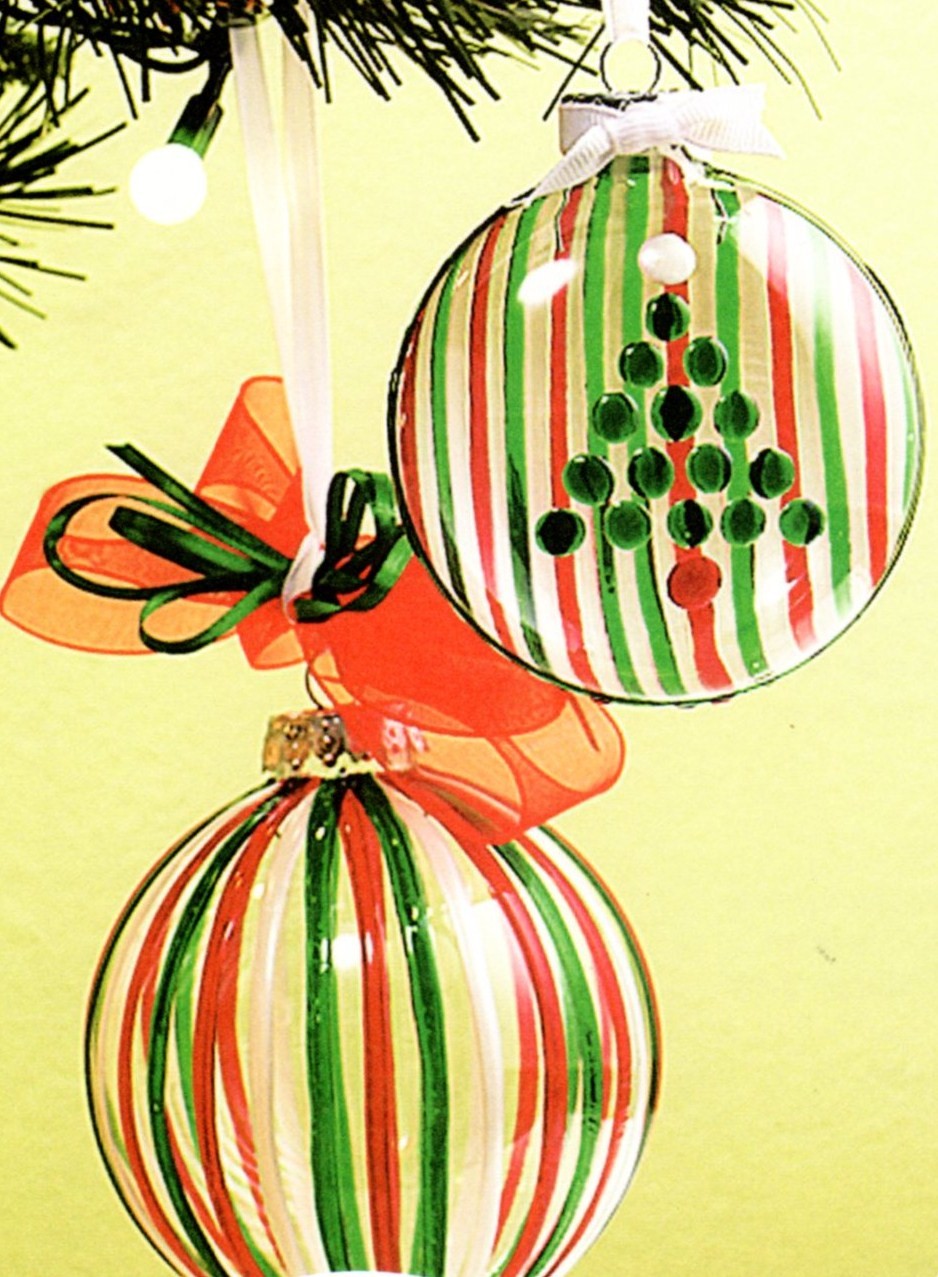
Christmas Glitter Ornaments

Supplies
Glitter – Gold, Silver, Peridot
Clear Glass Ornaments
Coordinating Ribbon
Rubbing Alcohol

Instructions
Step 1 Remove hangers from ornaments.
Step 2 Place a teaspoon of rubbing alcohol inside each ornament, swirl, and pour out. Let ornament dry completely.
Step 3 Pour a bit of glitter into an ornament. If you are making a multi-color  ornament, add a second color. Place your thumb over the ornament opening, and shake and swirl until the inside is coated completely.
Step 4 Turn ornament over and shake ball over a trash can to remove extra paint.
Step 5 Place in ornament box to let dry. Rotate the ornaments occasionally so they dry evenly.
Step 6 Replace hangers and tie with coordinating ribbons.

Christmas Tree Glass Ornament

Supplies
Gallery Glass Window Color – Snow White, Kelly Green, Ruby Red
Gallery Glass 10″ x 18″ Leading Blanks
Large Round Glass Ornaments
Notebook Paper
Craft Knife
Cellophane Tape
Ribbon

Instructions
Step 1 Place leading blank over lined paper; tape securely.
Step 2 Working one color at a time, trace multiple lines with Window Color. To keep the lines of paint from getting too wide, lightly squeeze the bottles of Window Color as you move it along the lines.
Step 3 Let dry overnight.
Step 4 Clean and dry ornaments.
Step 5 Remove the ornament hanger. Carefully peel the dry lines of Window Color from the leading blanks as you use them and apply them to the ornaments.
Step 6 Replace hangers and tie with coordinating ribbons.

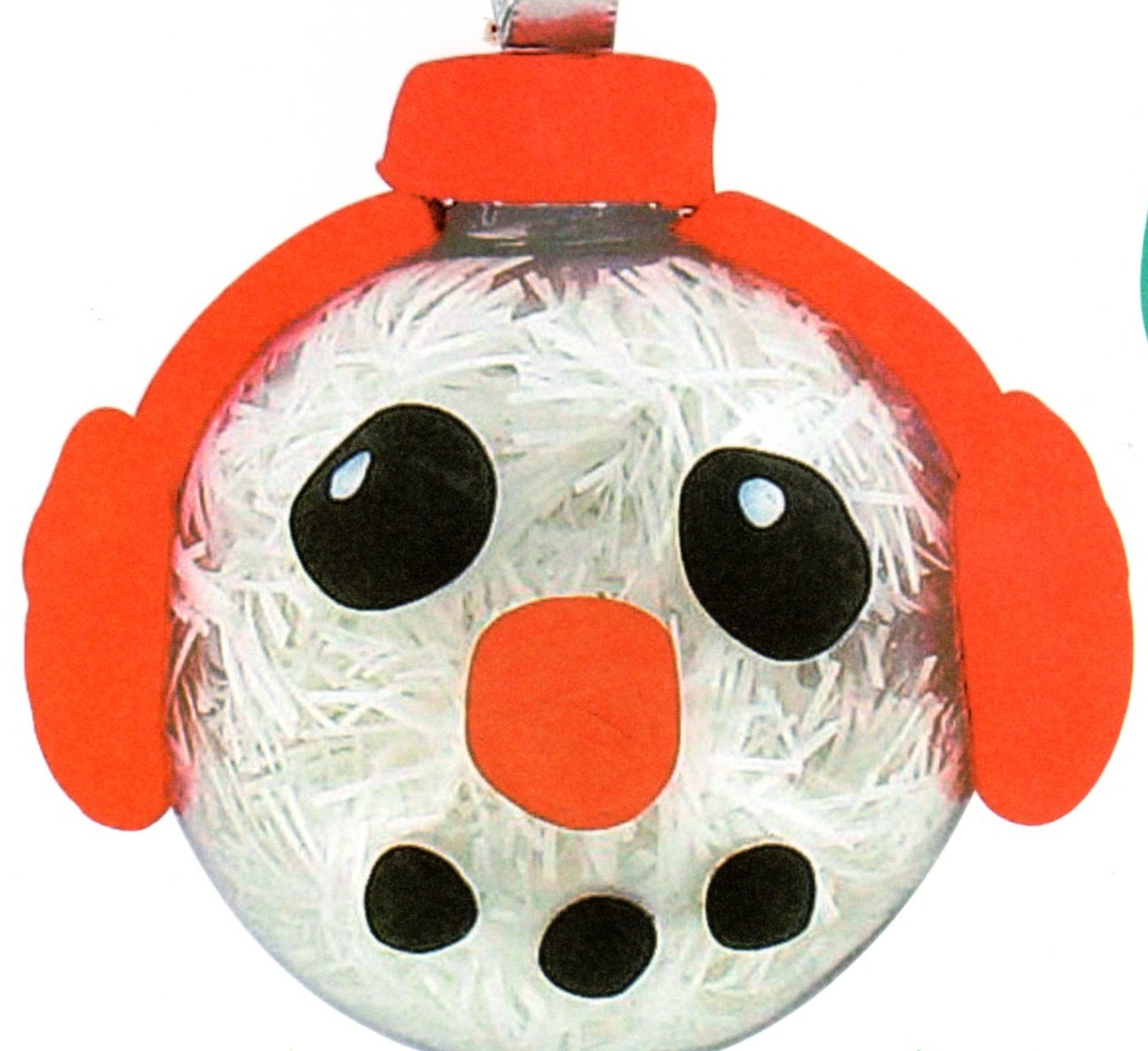
Christmas Snowman Ornament

Supplies
Fluffy-Red, Black, Orange and White
Sculpey* Clay Tool Starter Set
Glass Ornament – make sure you only
use a glass ornament; plastic ornaments
will melt in the oven D Ribbon D Acrylic Roller D Quick Drying Glue D Disposable Foil or Wax Paper D 12″ Piece of White Tree Garland

Instructions
Getting Started: Do not use unbaked clay on unprotected furniture or finished surfaces. Good working surfaces include a glass or metal surface, disposable foil or wax paper. Knead clay for 2 minutes. Bake on oven-proof glass or metal surface at 130 °C (275 °F for US customers) for 15 minutes per 6 mm CA”) of thickness. Do not use in microwave oven. Do not exceed the above temperatures or recommended baking time. All baking should be completed by an adult. Wash hands after use.

Step 1 Remove metal cap/hanger from ornament. Remove wire hanger from the cap and set aside. Make a red clay disk slightly larger than the diameter of the ornament cap.

Step 2 Wrap the red clay disk around the edges of the ornament cap. Using the 2 mm pointer tool from the Clay Tool Starter Set, poke holes through the red clay so the holes in the cap remain open to replace the hanger later.

Step 3 Make 2 wide red strips for the headband and 2 large red domes for the ear muffs. Then make 2 medium black disks for eyes and 3 little disks for mouth. Make 2 tiny white eye highlights and an orange cone shape for the nose.

Step 4 Place the face pieces firmly onto ornament, making sure each piece follows the curve of the glass. With the blunt point tool from Clay Tool Starter Set, texture the ear muffs. With the flat knife tool, texture the nose. Make sure the clay covered cap will go back on and that the ear muff headband does not interfere with the fitting of the cap. Bake as directed.

Step 5 Allow to cool then gently remove all the clay pieces. Glue them back on permanently and allow to dry. The clay cap covering will not need to be glued on. Replace the wire hanger into the holes in the cap. Fill ornament with white free garland. Replace the cap and add ribbon.

Christmas Jingle Bell Projects

Bell Wreath Supplies
Heavy gauge floral wire
Christmas theme colored bells
Chenille stems-gold, green, red
Broad width ribbon – red

Bell Wreath Instructions
Step 1 Make a circular loop with heavy gauge floral wire.
Step 2 String bells along wire and fit them closely together around the length of the loop.
Step 3 Use a pipe cleaner to wind around the bells at either end of the loop to hold the wreath shape together in a circle.
Step 4 Tie a bow around a pipe cleaner and then tie that pipe cleaner around the part of the loop that was joined together.

Bell Tree Supplies
12″ Floral cone, Styrofoam*
Christmas theme colored bells
Wrapping paper
Chenille stems – hot pink, turquoise, lime green
Craft feather boa – white
Glitter foam sheet, sticky back – hot pink
Glue
Gemstone-turquoise
Toothpick
Pattern printed from http://www.michaels.com
Pencil
Scissors

Bell Tree Instructions
Step 1 With hobby knife, cut a Styrofoam* floral cone down to desired size for tree.
Step 2 Cover cone with wrapping paper that matches the bells you will be using to decorate. Glue paper into place.
Step 3 String bells on lengths of chenille stems, keeping in mind how big your cone is.
Step 4 Join the strings of bells by twisting them together, end to end. Push one end of the joined chenille stems into the top of the cone.
Step 5 Begin circling the cone with the chenille stems and bells starting from the top and working down to the bottom in a spiral. Push in the other end of the pipe cleaner into the bottom edge of the cone.
Step 6 Wrap and glue craft boa to the base and top of the cone.
Step 7 Trace two stars and one base onto sticky foam sheet and cut out.
Step 8 Stick two stars together, sticky side to sticky side and insert a toothpick in between the stars half way in from the bottom.  Insert into the top of the tree. Glue gemstone onto front of star.
Step 9 Glue the tree onto center of base and glue craft boa around the bottom of the tree.

Rubber Stamping Terms & Techniques

Angel Company Is a term common in the rubber stamp industry.  This term identifies a company that allows the consumer to use their stamps to create products for resale.  Each company has a different policy so it is wise to contact each stamp manufacturer for information on their respective copyright policies.  Common restrictions may include: limiting the amount of hand stamped sample for resale, making sure that products are had stamped and not electronically reproduced, and restriction from using licensed properties such as Warner Bros.™, Suzy Zoo™ and Cynthia Hart™.

Dye Based Ink A quick drying water based ink.  Colors are most vibrant on white, glossy coated papers and card stock.  Not recommended for use with embossing powder.  Ink fades with time and when exposed to light.

Pigment Ink Thick, slow-drying ink.  Colors are rich and vibrant even on colored papers and cards.  The ink will not dry on glossy coated papers unless embossed.

Crafters Ink Multi-purpose, permanent ink with a longer drying time than acrylic paint.  It is highly pigmented and the colors are mixable.  It works on a variety of surfaces and is great for numerous craft applications such as fabric, wood, paper and painted surfaces.  It must be heat set on fabric.

Embossing (or Thermal Embossing) A technique using stamps with embossing or pigment ink, embossing powder and a heat source to create raised images.  Stamp image with ink and immediately sprinkle with embossing powder over stamped image.  Tap excess powder and reserve for future use.  Heat image with embossing tool until powder melts.

Embossing Ink Slow drying ink used for Thermal Embossing.  See Embossing above.

Inking a Stamp There are several ways to ink a stamp:

1.Using Felt Ink Pads – Tap stamp firmly onto ink pad until stamp is evenly inked.  Raised felt ink pads can also be picked up and patted on stamp to apply color.

2.Using Foam Ink Pads – tap stamp gently onto ink pad until stamp is evenly inked.  Raised foam ink pads can also be picked up and patted onto stamp to apply color.

3.Using Brush Markers – Use only water based brush tip markers as solvent or alcohol type inks will stain and dry rubber out.  Brush markers are used by applying the brush tip marker directly onto the stamp.  Multicolor impressions are achieved by using additional colors on various areas of the stamp.  Remoisten inks prior to stamping by breathing on the inked stamp or huffing.

4.Using Wedge Sponges – Use the flat edge of this sponge to apply inks or paints to the stamp in a patting motion.

5.Using Stamp Cleaner – Used to clean ink from stamps.  Use applicator top to apply cleaner to stamp, them pat stamp dry on paper towels.

6.Using A Stamping Mat – A durable foam mat used as a work surface for stamping.  The mat gives slightly allowing the best ink impressions.  Particularly useful for oversized stamps.

7.Using A Stamping Paint – A highly pigmented, acrylic paint specially formulated to be permanent on a variety of surfaces.  This paint has a slower drying time than acrylic paint to allow the user to apply different colors to a stamp for multi-color impressions.  Fabric must be heat set on reverse side to make permanent.

8.Using A Wedge Sponge – Used to apply paint to stamps.  Load paint or ink on flat edge of sponge.  Pat paint or ink onto surface of stamp.  Also used as a tool to sponge color onto a variety of surfaces such as paper, fabric and wood.

Masking A technique of covering a stamped image to protect it from subsequent applications of color.  A method used to create foregrounds and backgrounds.

Instructions:

1.Stamp foreground image onto surface first.
2.Re-stamp image on a second piece of paper or Post it Note™.
3.Cut the second image out.
4.Align cut out image (or mask it) over the first image or foreground image.
5.Stamp second image overlapping the mask
6.Remove the mask.
7.The second stamped image appears to be in the background.

Mirror Image Stamp A flat rubber stamp used as a tool to create a reverse or mirror image of a rubber stamp.

Instructions:

1.Ink a rubber stamp design.
2.Stamp on Mirror Image Stamp
3.The use the Mirror Image to stamp the image onto paper.
4.Image will be reversed.
5.This imprint will be light because it is a second generation print.  Image can be touched up with markers if desired.