6 Days Before Christmas

!!!!!6 Days Left….. Merry Christmas!!!!!

About Kwanzaa


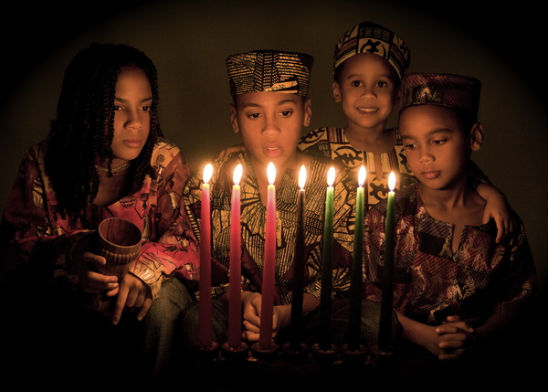
The name Kwanzaa is derived from the phrase “matunda ya kwanza” which means “first fruits” in Swahili. Each family celebrates Kwanzaa in its own way, but celebrations often include songs and dances, African drums, storytelling, poetry reading, and a large traditional meal. On each of the seven nights, the family gathers and a child lights one of the candles on the Kinara (candleholder), then one of the seven principles is discussed. The principles, called the Nguzo Saba (seven principles in Swahili) are values of African culture which contribute to building and reinforcing community among African-Americans. Kwanzaa also has seven basic symbols which represent values and concepts reflective of African culture.  An African feast, called a Karamu, is held on December 31.

The candle-lighting ceremony each evening provides the opportunity to gather and discuss the meaning of Kwanzaa. The first night, the black candle in the center is lit (and the principle of umoja/unity is discussed). One candle is lit each evening and the appropriate principle is discussed.
Seven Principles

The seven principles, or Nguzo Saba are a set of ideals created by Dr. Maulana Karenga. Each day of Kwanzaa emphasizes a different principle.

Unity: Umoja (oo–MO–jah)
To strive for and maintain unity in the family, community, nation, and race.

Self-determination: Kujichagulia (koo–gee–cha–goo–LEE–yah)
To define ourselves, name ourselves, create for ourselves, and speak for ourselves.

Collective Work and Responsibility: Ujima (oo–GEE–mah)
To build and maintain our community together and make our brother’s and sister’s problems our problems and to solve them together.

Cooperative Economics: Ujamaa (oo–JAH–mah)
To build and maintain our own stores, shops, and other businesses and to profit from them together.

Purpose: Nia (nee–YAH)
To make our collective vocation the building and developing of our community in order to restore our people to their traditional greatness.

Creativity: Kuumba (koo–OOM–bah)
To do always as much as we can, in the way we can, in order to leave our community more beautiful and beneficial than we inherited it.

Faith: Imani (ee–MAH–nee)
To believe with all our heart in our people, our parents, our teachers, our leaders, and the righteousness and victory of our struggle.

All About Hanukkah

Hanukkah, the Jewish Festival of Lights celebrates the revolt of the Maccabees in 165 BCE against the Syrian-Greek forces that had been occupying the Jewish temple in Jerusalem. After chasing the invading forces out, the victors found only enough oil in the desecrated temple to last one day, but miraculously the flame survived for eight days. This lay the foundation for the eight- day celebration of the holiday and the importance of oil in the menu planning for this period. The other important food item is dairy because, according to tradition, one of the factors contributing to the success of the Jews was that a brave woman named Judith fed salty cheese to the Syrian general, causing him to be so thirsty he drank wine until passing out. After he fell asleep she decapitated him, and his head was used to demoralize the rest of the army.

To celebrate the miracle of the oil, latkes have become a standard part of Hanukkah meals in America. In Israel, jelly donuts, or ” Sufganiyot”, is the representative food.

During this festival children look forward to playing the dreidl game, or s’vivon in Hebrew. The dreidl is a spinning top with Hebrew letters around it. It was originally used as a way to teach Hebrew to children under the guise of a game so that their captors would not realize what they were doing.

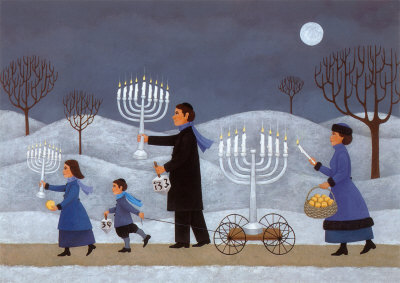
The most important symbol for the holiday is the menorah, the eight-branched candelabra. On each night of the celebration one extra candle is lit, until all eight are glowing on the last evening. Prayers and singing accompany the candle lighting.

Although Hanukkah was originally a minor holiday on the Jewish calendar, it has gained much greater prominence in America. The custom of giving presents to children during this holiday was adopted in the U.S., and generally children receive a gift for each night of the celebration. Children also receive foil wrapped chocolate coins called gelt, either as gifts or prizes for winning at the dreidl game.

But the most important part of the celebration is sharing time with family and friends, passing along the story of the Maccabee success to children, and sharing a piece of Jewish history with non-Jewish friends. With eight nights to party, Jewish families can plan a variety of activities to amuse young and old. Consider some of the following ideas to create traditions of your own:

* Make one night ” grandparent night” where the focus is on grandparents sharing the holiday with their children and grandchildren.
* Another night can be ” book night” where books are exchanged with one another, and special stories are read aloud.
* Dedicate one night to sharing the story of Hanukkah and traditions with non-Jewish friends and neighbors.
* Join in the celebration at your family’s synagogue.
* Take the family on a cultural outing another night such as a trip to the theater, symphony, or ballet.

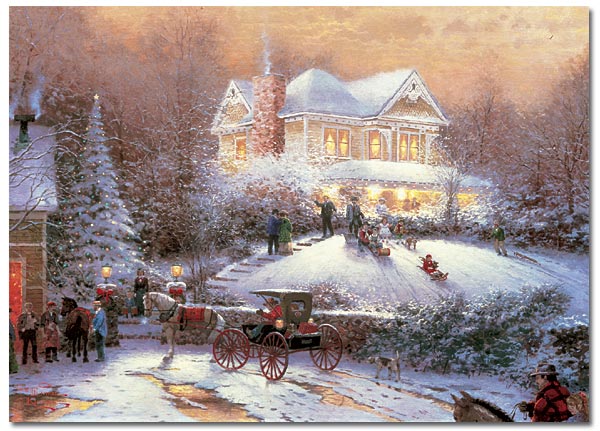
Decorating Your Own Victorian Christmas Tree

The Victorians loved their Christmas trees, and decorated them lavishly. Much time was spent in the weeks leading up to Christmas Eve making homemade ornaments to suspend on the tree branches.

Today store bought decorations have largely replaced homemade ornaments. But if you would like to have Victorian Christmas tree of your own, consider making your own authentic ornaments to hang on the branches of your tree.

Victorians lit their trees with candlelight, which isn’t practical or safe today, but you can now find some stores that carry replica electric lights that mimic candlelight and clip to your tree’s branches to get you started. From there, you can complete the look with these hand-made decorations:

* String popcorn and cranberries for garland. Do every other one or design a particular pattern of your own (three cranberries, two popcorn, five cranberries, etc.) depending on how much of each color you want.

* Dip small cookies cut like snowflakes into glue and then glitter for sparking accents on your tree. To preserve them, spray lightly with either craft preservative or hairspray.

* Paint walnuts (still in the shell) with gold or silver paint. Attach a thin ribbon bow to the top with a thumbtack and hang on the tree.

* Curl small paper doilies into cones and fill with hard candies, nuts or potpourri. Attach ribbon and tie to tree branches. You can find the doilies in a variety of pretty colors.

* Recycle old Christmas cards to decorate your Victorian Christmas tree. Cut out pictures you like and glue to cardboard, then highlight with glitter or metallic fabric paint. Attach colorful ribbons and hang.

You’ll be amazed at how your Victorian Christmas tree glitters and shines with its assortment of genuine period ornaments. Now sit back with a cup of mulled cider and enjoy!

Elves Getting Schooled

What do elves learn in school?

The Elf-abet!