Christmas Jingle Bell Projects

Bell Wreath Supplies
Heavy gauge floral wire
Christmas theme colored bells
Chenille stems-gold, green, red
Broad width ribbon – red

Bell Wreath Instructions
Step 1 Make a circular loop with heavy gauge floral wire.
Step 2 String bells along wire and fit them closely together around the length of the loop.
Step 3 Use a pipe cleaner to wind around the bells at either end of the loop to hold the wreath shape together in a circle.
Step 4 Tie a bow around a pipe cleaner and then tie that pipe cleaner around the part of the loop that was joined together.

Bell Tree Supplies
12″ Floral cone, Styrofoam*
Christmas theme colored bells
Wrapping paper
Chenille stems – hot pink, turquoise, lime green
Craft feather boa – white
Glitter foam sheet, sticky back – hot pink
Glue
Gemstone-turquoise
Toothpick
Pattern printed from http://www.michaels.com
Pencil
Scissors

Bell Tree Instructions
Step 1 With hobby knife, cut a Styrofoam* floral cone down to desired size for tree.
Step 2 Cover cone with wrapping paper that matches the bells you will be using to decorate. Glue paper into place.
Step 3 String bells on lengths of chenille stems, keeping in mind how big your cone is.
Step 4 Join the strings of bells by twisting them together, end to end. Push one end of the joined chenille stems into the top of the cone.
Step 5 Begin circling the cone with the chenille stems and bells starting from the top and working down to the bottom in a spiral. Push in the other end of the pipe cleaner into the bottom edge of the cone.
Step 6 Wrap and glue craft boa to the base and top of the cone.
Step 7 Trace two stars and one base onto sticky foam sheet and cut out.
Step 8 Stick two stars together, sticky side to sticky side and insert a toothpick in between the stars half way in from the bottom.  Insert into the top of the tree. Glue gemstone onto front of star.
Step 9 Glue the tree onto center of base and glue craft boa around the bottom of the tree.
An Interior Desgners Gingerbread House

AN INTERIOR DESIGNER’S GINGERBREAD HOUSE

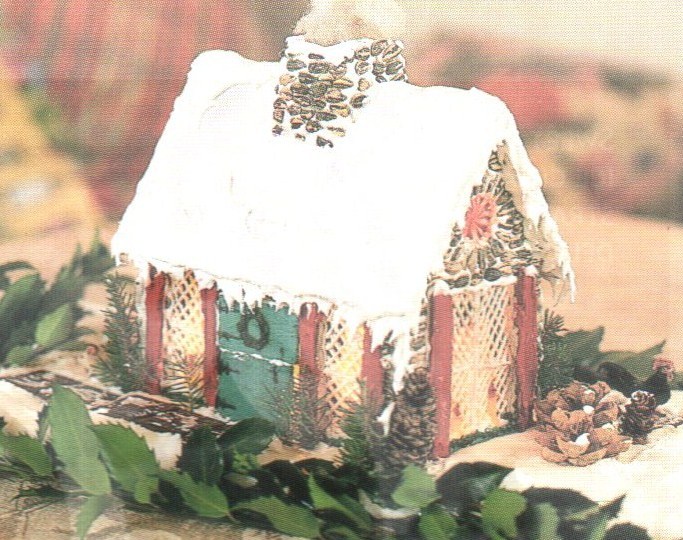
Every year James Deartron makes a ginger­bread house part of his holiday decora­tions. His professional experience gives him lots of good ideas for decorating the delicious structure, and he has become known around town for these clever cre­ations. Here are some of his tips.

Cotton batting is perfect for smoke com­ing out of the chimney.

Un-shelled sunflower seeds give the look of flagstones.

Chocolate-covered   graham   crackers pave the walkway outside the house.

White frosting makes good snow; to cre­ate the effect of rooftop icicles, allow frosting to drip down eaves.

Powdered sugar resembles the freshly fallen snow.

Pine cones provide some outdoor land­scaping (tip them with frosting for snow).

A red-and-white  peppermint drop is a good stained-glass window.

Meringue latticework is used for the doors and windows, which are glued to gingerbread pillars with royal icing (a mix­ture of egg whites and powdered sugar).

Wooden Santa & Reindeer

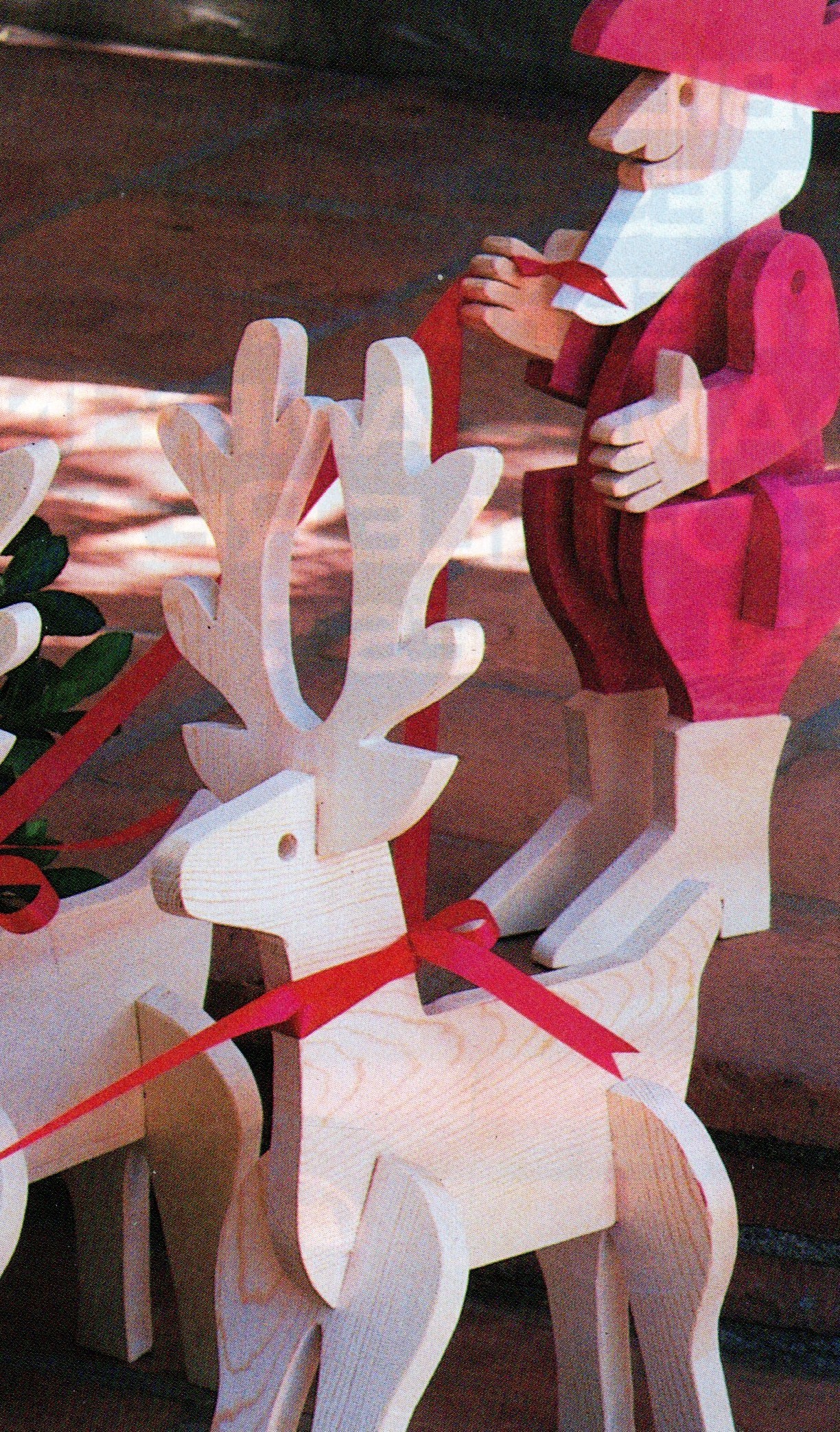
SET THE STAGE FOR SANTA’S arrival with these simple I slot-together wood figures. I Our Western Santa and his reindeer are cut from pine 1-by-12s, with notches that let you slip the fig­ures together for quick display.

To make the figures, you’ll need heavy paper; a saber, jig-, or band saw; a drill with a 1/2-inch bit; sandpa­per; and wood (about 4 feet of 1-by-12 per figure if you cut all pieces so they run with the grain, less if you cut smaller pieces across the grain). Our Santa’s arms pivot on a piece of 1/2-inch dowel, but you can glue them onto the body if you prefer.

Enlarge pattern on paper so each square equals 2 inches, then outline on wood. Make notches no wider than wood’s thickness so figures stand properly. Cut pieces, drill ‘/2-inch holes for eyes and arms, and sand. Sand as needed to widen notches.

Finish the figures with paint or stain, or leave them natural. We painted the white beard on our Santa. For his clothes and cowboy hat, we applied red paste shoe polish to let the grain show through. Use masking tape to keep lines precise.

Christmas Stocking Of Every Style

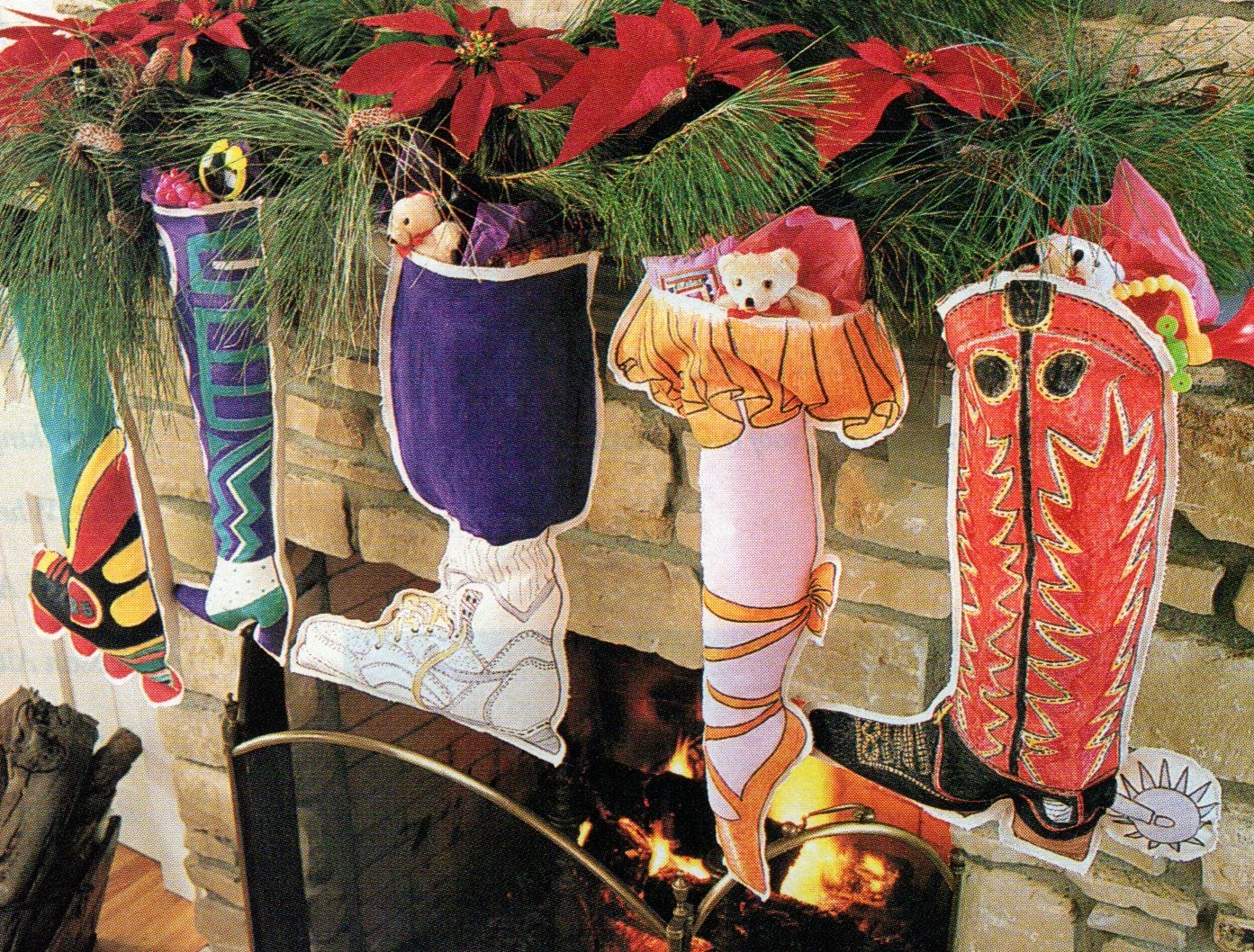
A shoe-stocking for everyone

Here’s your chance to cobble Christmas shoe-stockings that play up the interests or per­sonalities of family members. Whether you have a young ballerina, cowboy, basketball star, or other sport or hobby enthusiast, there’s a style that fits. Copy our examples, work from other shoe styles, or invent imaginary footwear. No names need go on these stockings—one look announces for whom they’re intended.

To construct each stocking, start with a piece of off-white artist’s canvas that’s been folded in half. On the top layer, draw the shoe outline and details lightly with pencil, then trace over the lines with permanent markers meant for fabric. Next, paint between the lines with fabric paint.

With the cloth still folded in half, pin through both layers of canvas. Cut around the shoe image, leaving a 1/4  to ‘/2-inch border. Stitch the halves together 1/4 inch from edge, leaving the top open. Zigzag-stitch around the border and along each top edge.

For easy hanging, stitch a loop of sturdy ribbon to the top of the back of each stocking. Finally, stuff the foot with tissue paper or a soft, space-filling gift to give the shoe a three-dimensional look.

Indoor & Outdoor Banners

Heralding the holidays, these colorful ban­ners greet visitors at the street, by the front door, or in the house. These contemporary versions of medieval gonfalons have a ban­ner-shaped backing of weatherproof fiber-glass screening ordinarily used in doors and windows. Our banners show a waving Santa, a Nutcracker rat, and a persimmon branch, but you can copy and enlarge any favorite image or printed message. Because the screening is almost transparent, the image seems to float in air.

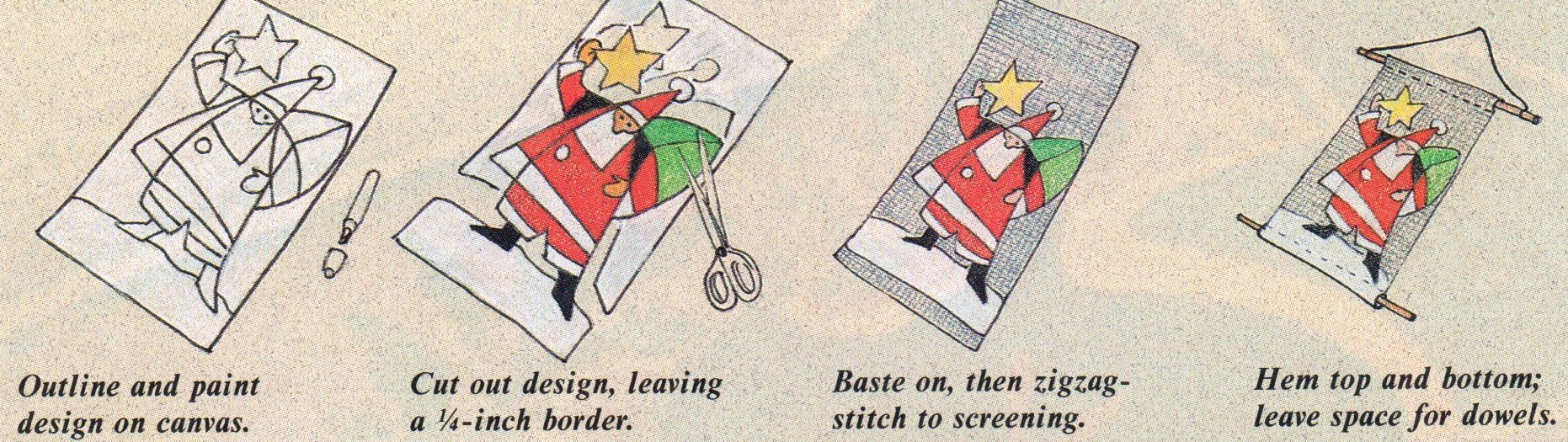
To make these banners, simply paint, cut out, and sew can­vas shapes to screening. The screening is sold by the foot in 2-, 3-, and 6-foot-wide rolls (30, 40, and 90 cents per foot) at most hardware and building supply stores.

Start by drawing a full-size paper pattern, then transfer it onto off-white artist’s canvas (available in craft and art supply stores) with fabric markers. Paint in the colors with acrylic or fabric paint. Iron the canvas flat (some fabric paints require heat to set them in any case). Follow the steps below to cut out and sew the fabric to the screen.

Finally, at the top and bottom of the screening, make a hem generous enough for a ‘/2-inch-diameter dowel. The top dowel should be wider than the banner and hang from fishing line or thread. The bottom dowel, cut to the banner’s width, unobtrusively keeps it hanging straight.