Sofa Cleaning Tips & Hints

Sofas are integral aesthetic elements in our homes. Our living rooms and bedrooms wouldn’t look half as good if it wasn’t for the inclusion of a stunning sofa – nor would they be half as comfortable! However, as sofas are often made of delicate fibres, they are susceptible to blighting from dust, dirt and stains on the surface – and grime and bacteria can become deeply entrenched in them with ease. Alas, it’s often the tarnishes we cannot see which pose the greatest threats – to you and your sofa!

Many respond to this by simply replacing their sofas when they start to show signs of wear and tear. However, with some careful preparation and the right contacts, you can ensure you have a long and prosperous relationship with your sofa, and won’t have to replace it for many years! To assist you in this regard, we have compiled a handy guide to sofa maintenance and sofa cleaning. We hope it is of some use to you!
Sofa Cleaning Tips
There are many different cleaning techniques to clean your sofa. Some will work better depending on what type of sofa you have. There really is no one size fits all solution to a dirty sofa. Remember, practice makes perfect, and there’s a lot of value in trial and error – why not try out a few techniques, and find the one that works for you the best?!

Start by vacuuming your sofa thoroughly – and do this before you even think of applying any efficient cleaning techniques! Work without an attachment – this will allow you to get up close and personal with the nooks and crannies and ensure you’re removing the worst of the dust and grime in its crevices.

Once you’ve done this, it’s time to identify any stains, or spots of filth that your hoover cannot or will not shift. We find that face wipes and baby wipes can work really well as cleaning cloths due to the chemicals contained within them – what’s more, they’ll be kind on your sofa’s fibers and material 9 times out of 10 – this is a great sofa cleaning tip! If you don’t have any of these to hand, you can fashion some makeshift substitutes using kitchen roll, warm water and vinegar.
Sofa Cleaning Tips2
Once you’ve done that, treat all surfaces to a once over with a soapy sponge or cloth. Allow the sudsy water to really soak into the sofa fabric – it’ll take on any ground in dirt head on! However, don’t use too much water – if sofas get too wet, damp can set it and they become magnets for mildew.

With any luck, your sofa should be looking fresh when you’re done. However, for major spills and stains (such as those created by ink, or food, or certain liquids, etc.), you may find that no matter how hard you try, these tips do not help! Fret not though, because professional sofa cleaning agencies are there for a reason. They will be able to complete the tasks you cannot, and make your sofa look as good as the day it did when you bought it! The best sofa cleaners will have worked on every type of sofa in their time, and every variety of stain! They will know the best way to remove the blots and blemishes which blight your prized couch. No matter how tempting it might be to take on stains yourself, sometimes you really do have to trust an expert cleaning service. Best of all, many of these companies offer cheap sofa cleaning solutions! Make sure you investigate the companies thoroughly to ensure you’re getting the best price!
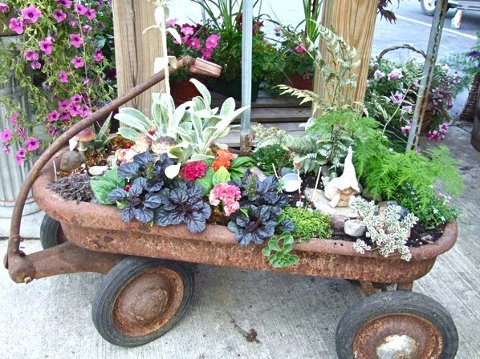
Wagon Garden

What a great use as a planter…. an old child’s wagon. It really opens up your mind to see such great usage of an old object that most would just throw away. What other type of objects…. both old and new…. that is readily thrown away can you think of that would make a great planter? Have you already up-cycled an item? Would love to see pics that I could share!

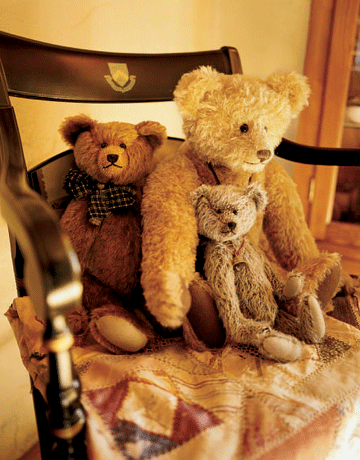
Teddy Bear History

In 1902, President Theodore Roosevelt traveled south to negotiate a border dispute between the states of Mississippi and Louisiana. During a break from the negotiations, Roosevelt accepted an invitation to join a hunting expedition in Smedes, Mississippi. After ten days of hunting, Roosevelt failed to spot a single bear. His hosts, hoping to please the President, searched the woods, found a small bear cub, tethered it to a tree outside Roosevelt’s tent, and cried “Bear!” to beckon the president. Roosevelt emerged from his tent, took one look at the frightened cub, and refused to kill such a young animal.

Newspapers reported the event. In the Washington Star, political cartoonist Clifford K. Berryman drew a caricature of Roosevelt with his hand upraised,
refusing to shoot the cud­dly bear cub. The caption read “Drawing the Line in Mississippi,” clev­erly referring to the unresolved border dispute.

Inspired, toy store owner Morris Michtom, a thirty-two-year-old Russian immigrant, made a stuffed bear cub and dis­played it alongside the political cartoon in his store window in Brooklyn to generate attention. When customers wanted to buy their own “Teddy’s Bear,” Michtom began making them, founding the Ideal Toy Company.

Meanwhile in Germany, Richard Steiff, a nephew of stuffed toy maker Margarete Steiff, similarly inspired by Berryman’s political cartoon, created his own stuffed bear toy. Launched at the 1903 Leipzig Trade Fair, Steiff’s bears also began selling quickly.

In 1906, guests at a White House wedding reception for Roosevelt’s daughter discovered tables decorated with Steiff bears dressed as hunters and fishermen as a tribute to the President’s love for the outdoors. While mulling over the possible breed of the animals, a wedding guest clev­erly labeled them “Teddy Bears.” In 1907 alone, Steiff produced more than 974,000 Teddy Bears.

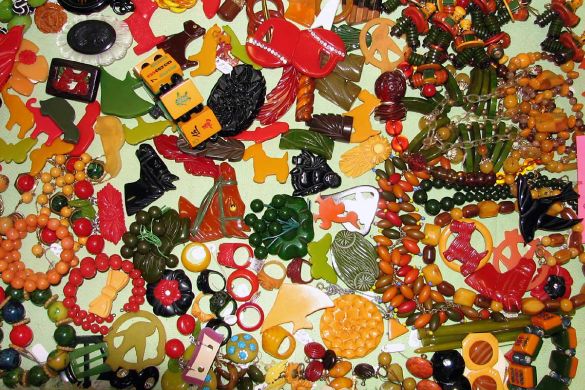
Bakelite History

In 1907, American chemist Leo Hen-drik Baekeland, a Belgian immigrant and former organic chemistry pro­fessor at the University of Ghent, began his attempts to synthesize a rubber substitute in his home labo­ratory. He combined phenol and formaldehyde to make the first synthetic resin that could be substi­tuted for hard rubber. He called his discovery Bakelite, and Baekeland became known as the “father of plastics.”

Once shaped under heat and pressure, Bakelite, tinted in a variety of colors, became rock solid, resisting heat, acids, and electric currents. Unlike rubber, which dried out and cracked, Bakelite endured, making the perfect synthetic polymer from which to mold bracelets, pot and pan handles, the heads of electrical plugs, and radio dials.

In 1927, the Catalin Corporation acquired Bakelite, selling the bracelets through upscale department stores like Saks Fifth Avenue, B. Altman, and Bonwit Teller, but also through F. W. Woolworth and Sears. During the Depression, socialites who could no longer afford to buy jewelry at Tiffa­ny’s and Cartier, embraced vibrantly colored Bakelite bracelets adorned with  rhinestones   and  costing between twenty cents and three dol­lars. In 1942, Bakelite and Catalin stopped making colorful costume jewelry and instead concentrated their efforts on manufacturing telephones, aviator goggles, and other products for use by the mili­tary. By the end of the war, manufacturers switched to newly developed injection-molded plastics, like Lucite, Fiberglass, vinyl, and acrylic, making Bakelite obsolete. Today, Bakelite is prized solely by collectors who scour flea markets, swap meets, and antique shows.

Photo credit:  [ http://gaslightshadows.com/bakelite.html  ] Please visit this great website chocked full of great information!

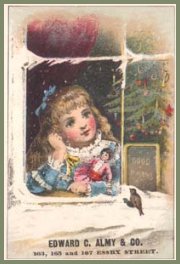
Victorian Advertising Cards

On many Victorian Parlor tables, a place of honor was reserved for the Bible, family album, post card album and a huge scrapbook. In the latter were lovely pasted advertising cards which were acquired by different members of the family. When members of the family went out to shop, they were given colorful trade cards with their purchases. At the local food store, many of these cards came packaged in tins of teas and coffees. Each member of the family would have been quite delighted to receive these free cards. The color cards were the most cherished. Lithography had just been introduced and any colorful bits of paper were treasured. As family members brought new cards home, everyone became excited. The family members began to go to many different stores to see if they had any cards and if they would look nice in their books.

Images of Santa Claus and other Holiday symbols were always welcome during the Christmas season. Advertisers during the Victorian period were no different than advertisers today. They wanted people to spend lots of money on their products for the Holidays. Cheerful images of Jolly Old St. Nick, Christmas trees, and happy children with toys were designed to promote the “giving spirit”. Christmas, followed by Easter, was the most popular holiday in which you will find trade cards

Although the commercial aspects of Christmas were greatly looked down upon from many of the church pulpits, merchants continued to promote Christmas. Toy stores, confectioners’ shops and German bakeries began to stay open late and to festoon their windows with red silk bunting and holly. Holiday shoppers could not resist the cakes, the smells of cinnamon kuchens and sweet almond paste. 1874 was the year of the first window displays with a Christmas theme at Macy’s. One window displayed an amphitheater of wax, rag, bisque and hand-painted porcelain dolls imported from Germany France, Austria, Switzerland and Bohemia. In another window, scenes from Uncle Tom’s Cabin were composed in a panorama with steam-driven movable parts. 1867 was the first year that Macy’s department store in New York City remained open until midnight on Christmas Eve. In 1880 Woolworths first sold manufactured Christmas tree ornaments, and they caught on very quickly.

Victorian Trade Cards were a popular way for advertisers to lure customers to purchase their products or to shop in their stores. Victorian Trade Cards featuring scenes of families celebrating Christmas give us a wonderful glimpse of what it must have been like in many Victorian homes during the Holiday season. If you look closely at many of the pictures, you will see Christmas trees lit by candles and covered with handmade decorations and fancy hand-blown glass balls. Some of the images show presents hanging from the tree branches. This was a common practice during the Victorian Era. Other cards show decorations inside the homes featuring fresh evergreens and berries.