Wooden Santa & Reindeer

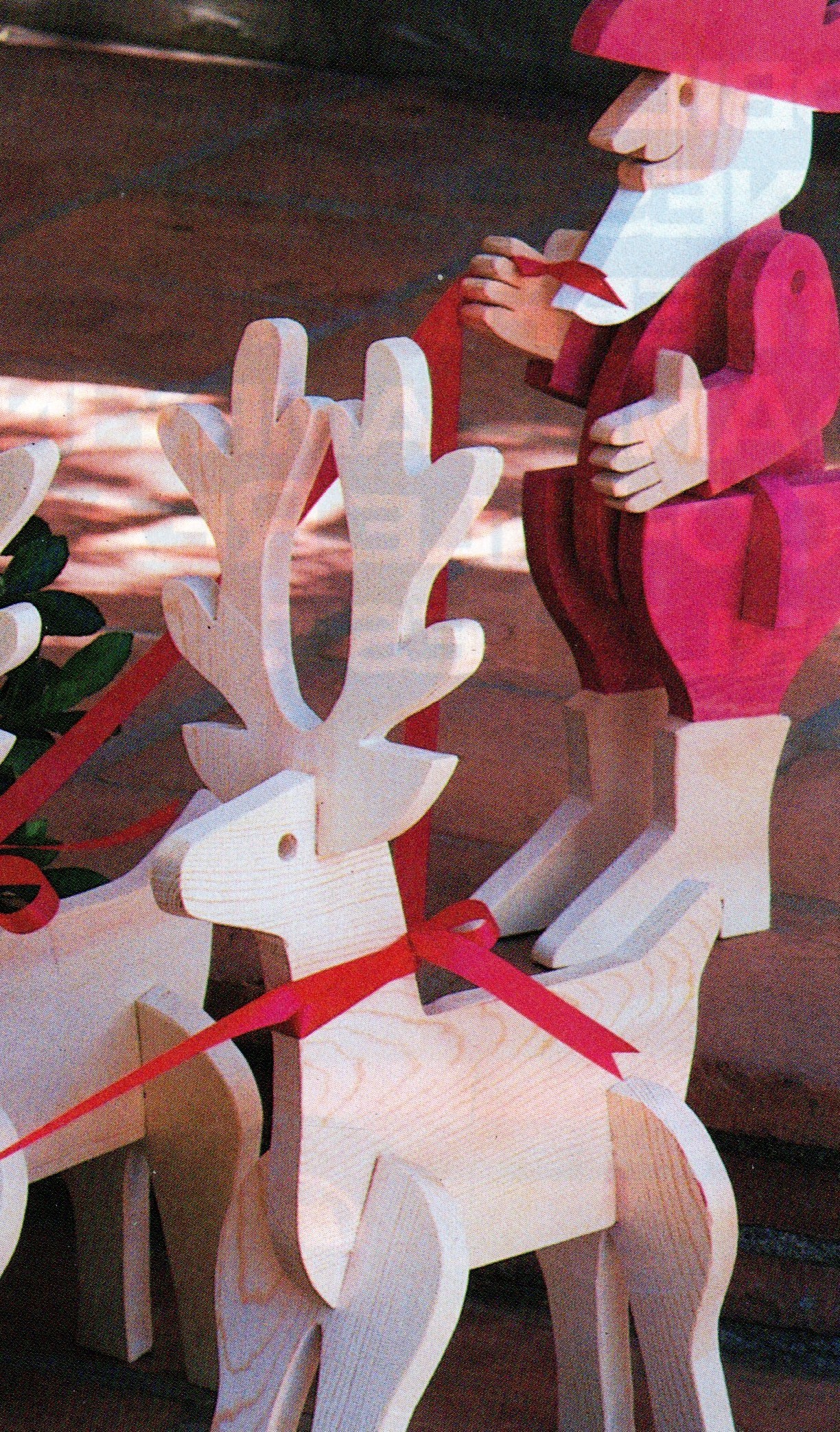
SET THE STAGE FOR SANTA’S arrival with these simple I slot-together wood figures. I Our Western Santa and his reindeer are cut from pine 1-by-12s, with notches that let you slip the fig­ures together for quick display.

To make the figures, you’ll need heavy paper; a saber, jig-, or band saw; a drill with a 1/2-inch bit; sandpa­per; and wood (about 4 feet of 1-by-12 per figure if you cut all pieces so they run with the grain, less if you cut smaller pieces across the grain). Our Santa’s arms pivot on a piece of 1/2-inch dowel, but you can glue them onto the body if you prefer.

Enlarge pattern on paper so each square equals 2 inches, then outline on wood. Make notches no wider than wood’s thickness so figures stand properly. Cut pieces, drill ‘/2-inch holes for eyes and arms, and sand. Sand as needed to widen notches.

Finish the figures with paint or stain, or leave them natural. We painted the white beard on our Santa. For his clothes and cowboy hat, we applied red paste shoe polish to let the grain show through. Use masking tape to keep lines precise.

Christmas Stocking Of Every Style

A shoe-stocking for everyone

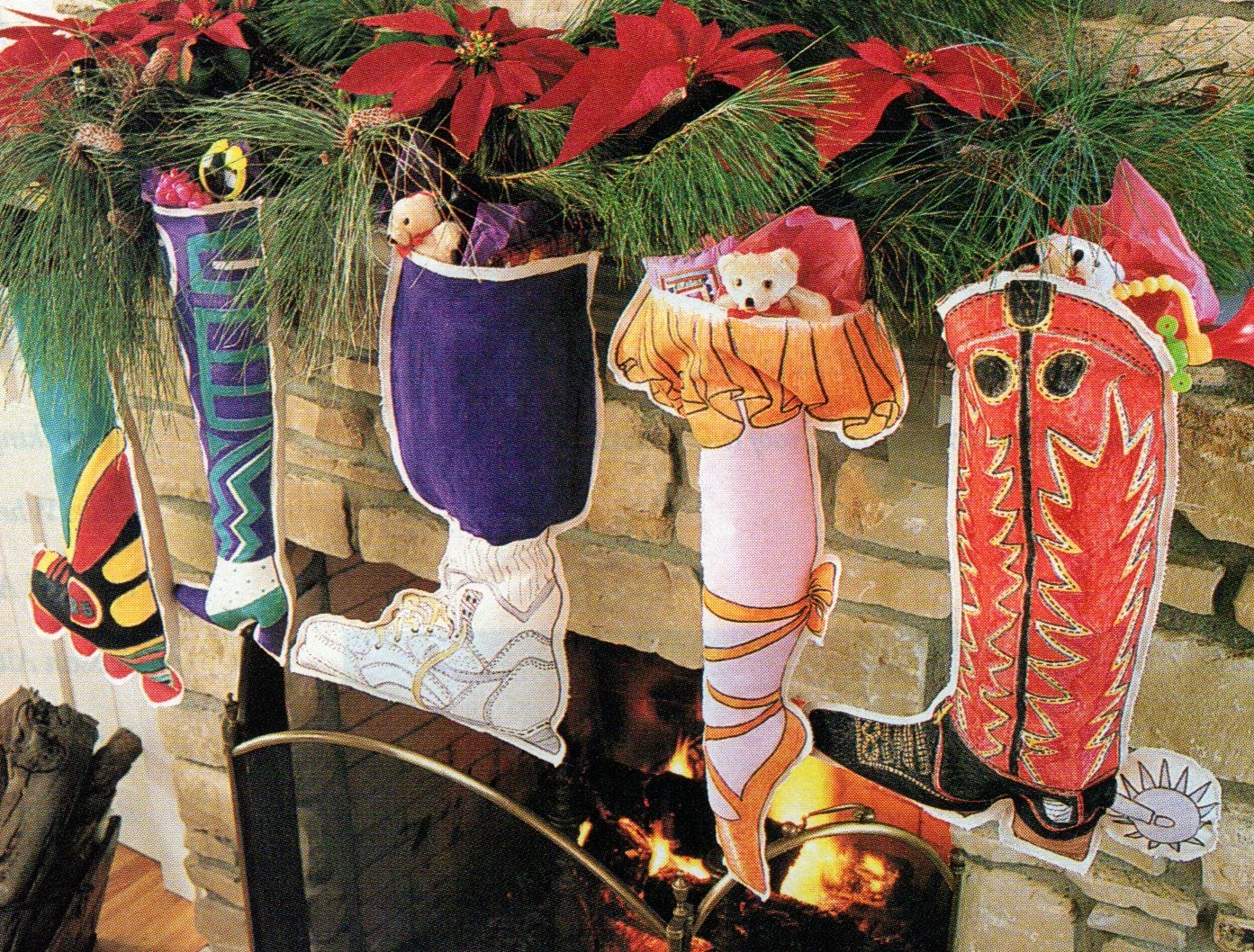
Here’s your chance to cobble Christmas shoe-stockings that play up the interests or per­sonalities of family members. Whether you have a young ballerina, cowboy, basketball star, or other sport or hobby enthusiast, there’s a style that fits. Copy our examples, work from other shoe styles, or invent imaginary footwear. No names need go on these stockings—one look announces for whom they’re intended.

To construct each stocking, start with a piece of off-white artist’s canvas that’s been folded in half. On the top layer, draw the shoe outline and details lightly with pencil, then trace over the lines with permanent markers meant for fabric. Next, paint between the lines with fabric paint.

With the cloth still folded in half, pin through both layers of canvas. Cut around the shoe image, leaving a 1/4  to ‘/2-inch border. Stitch the halves together 1/4 inch from edge, leaving the top open. Zigzag-stitch around the border and along each top edge.

For easy hanging, stitch a loop of sturdy ribbon to the top of the back of each stocking. Finally, stuff the foot with tissue paper or a soft, space-filling gift to give the shoe a three-dimensional look.

The Envelope That Is Also A Gift

The envelope is the gift
These simple, festive wraps will brighten any holiday message

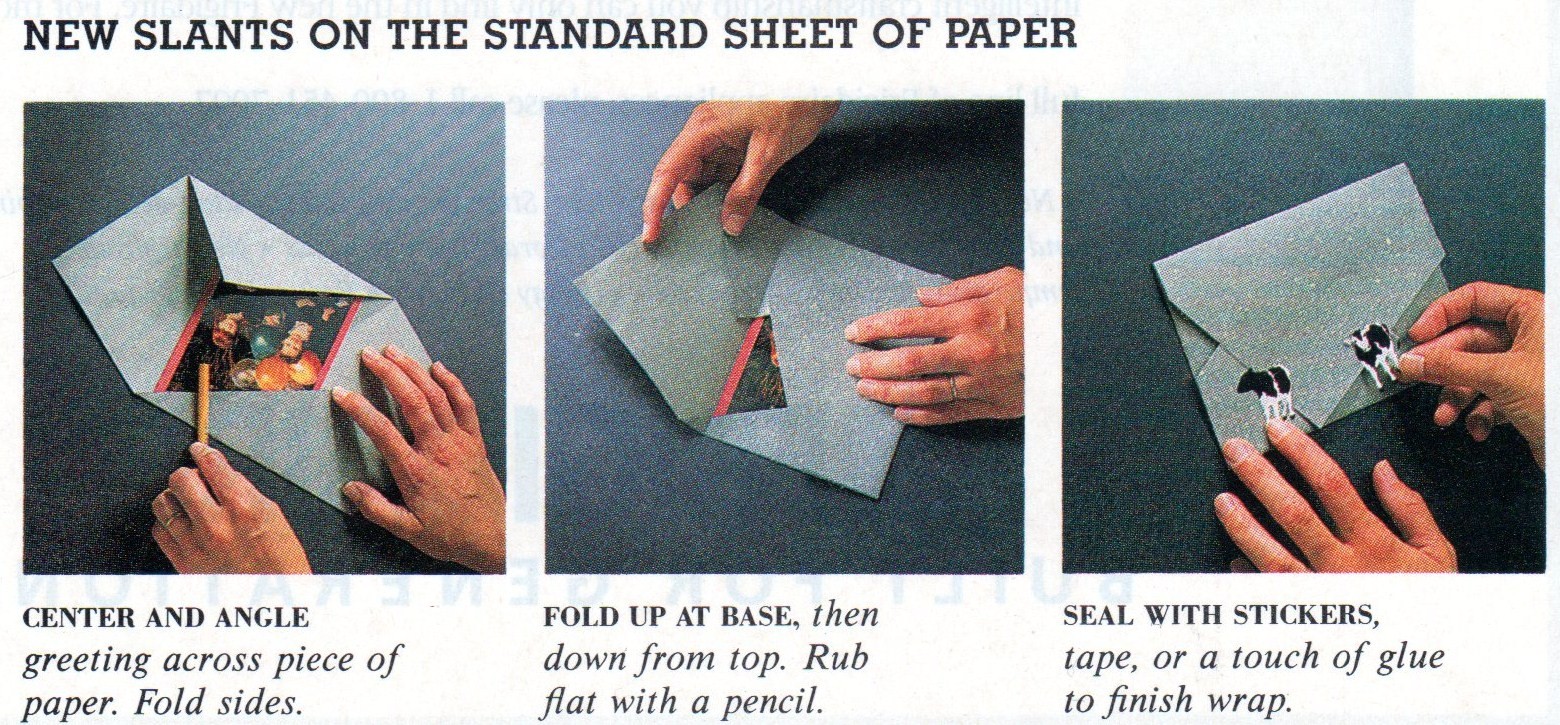
<-<-<-(INSERT)FOUR STRAIGHT FOLDS and you’re done. It’s almost that simple to make two styles of card wraps that do away with standard envelopes. In­stead, your seasonal greetings will resemble small, flat pre­sents that are wrapped in col­orful paper with curved or angled edges.

Both wraps start with pa­per from art supply or sta­tionery stores. Choose from a wide variety of paper in 20-by 30-inch sheets, tablets of construction paper, or colored 8’/2- by 11-inch writing paper. For ease of folding, use sheets no thicker than construction paper. The angle-sided card wrap below encloses a 4Vz- by 6 ‘A -inch rectangle of post­card-weight paper, upon which you can mount a pho­tograph or write a message. Make traceable patterns for the lazy X or pinwheel wrap from a large sheet of three-ply or heavy paper.

Other materials include a ‘ craft knife to cut the paper, a pencil to make crisp folds, and adhesive-backed stickers to close envelopes. You’ll also need a ruler and a compass to make the curving-edge wraps.

Indoor & Outdoor Banners

Heralding the holidays, these colorful ban­ners greet visitors at the street, by the front door, or in the house. These contemporary versions of medieval gonfalons have a ban­ner-shaped backing of weatherproof fiber-glass screening ordinarily used in doors and windows. Our banners show a waving Santa, a Nutcracker rat, and a persimmon branch, but you can copy and enlarge any favorite image or printed message. Because the screening is almost transparent, the image seems to float in air.

To make these banners, simply paint, cut out, and sew can­vas shapes to screening. The screening is sold by the foot in 2-, 3-, and 6-foot-wide rolls (30, 40, and 90 cents per foot) at most hardware and building supply stores.

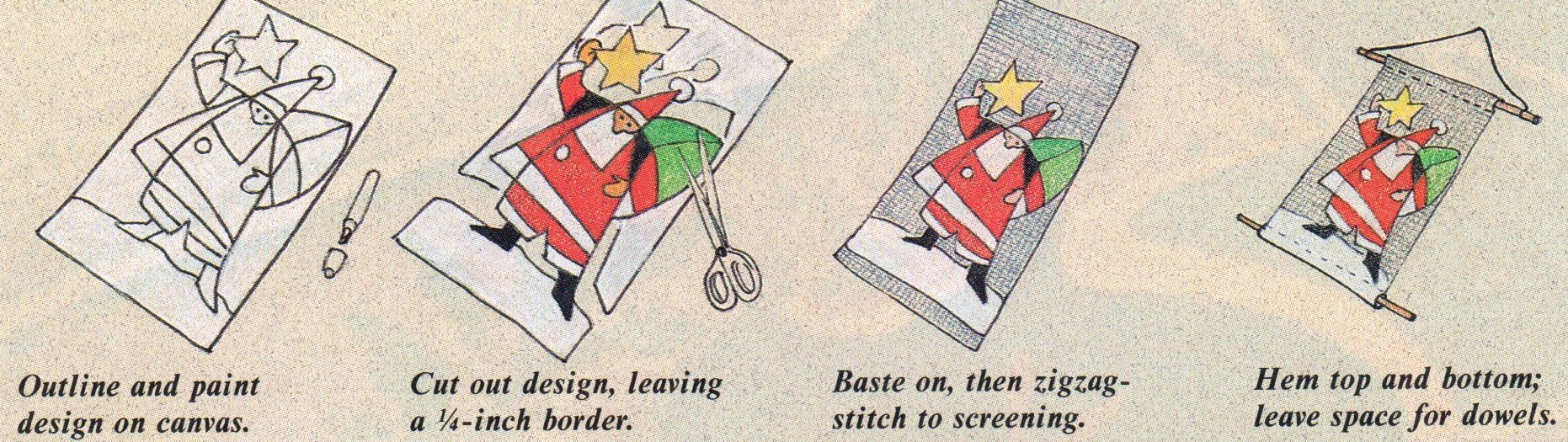
Start by drawing a full-size paper pattern, then transfer it onto off-white artist’s canvas (available in craft and art supply stores) with fabric markers. Paint in the colors with acrylic or fabric paint. Iron the canvas flat (some fabric paints require heat to set them in any case). Follow the steps below to cut out and sew the fabric to the screen.

Finally, at the top and bottom of the screening, make a hem generous enough for a ‘/2-inch-diameter dowel. The top dowel should be wider than the banner and hang from fishing line or thread. The bottom dowel, cut to the banner’s width, unobtrusively keeps it hanging straight.

Fall Leaf Bars

Fall Leaf Bars

1 3/4  cups all-purpose flour
1 1/2 cups sugar
1 1/2  teaspoons ground cinnamon
1   teaspoon baking soda
1/2  teaspoon each baking powder and ground nutmeg
r,     1
2   large eggs
1   cup canned pumpkin
6   tablespoons butter or margarine, melted
1/3   cup water

Cheese leaf rilling (recipe follows)

In a large bowl, mix flour, sugar, cin­namon, soda, baking powder, and nut­meg. Add eggs, pumpkin, butter, and
water; beat well. Spread batter in a but­tered and floured 10- by 15-inch pan. Drop cheese filling in 24 equal portions (each about 1 tablespoon) equally over surface of batter. With a knife tip, pull edges of cheese into leaf shapes.

Bake in a 350° oven until center of cake (not cheese) springs back when lightly touched, about 30 minutes; let cool. Cut pieces so cheese is in center of each. Serve warm or cool, or cover and chill up to 3 days. Makes 24.

Cheese leaf filling. Smoothly mix 1 large package (8 oz.) cream cheese, 1 large egg, and 1/4 cup sugar.

Per piece: 161 cal. (39 percent from fat); 2.6 g protein; 6.9 g tat (4.1 g sat.); 23 g carbo.; 109 mg sodium; 45 mg chol.