Collecting Salt & Pepper Shakers

Who doesn’t own a set of salt and pepper shakers? This is one collectible that everybody has on the table, whether it’s a dime-store duo, a Popeye and Olive Oyl pairing or a sterling silver set from Grandma’s trousseau.
For tabletop collectors, salt and pepper would seem to be a match made in heaven. But it hasn’t always been so. In fact, the pairing of salt and pepper in shakers dates only to the Civil War era. “That’s when two small glass cylinders fitted with metal lids were patented,” explains Dottie Avery, a member of die Antique & Art Glass Salt Shaker Collectors Society in Maitland, Florida. “At first, people were not used to shakers at all. Then the pieces became enormously pop­ular because they were easy and fun to handle.”

Early shakers were fashioned from glass and were known for their swirled patterns, hand-painted designs, pretty colors and “threads” or ridges around the tops. The threads mark them as one of the first containers with screw-on caps.

For Dottie Avery and her husband, Bill, these embellishments only add to die mystique of their two-thousand-plus shaker collection. But such details also make the designs harder to find and more expensive. “We can spend up to several hundred dollars for a single shaker,” Dottie says, “and that means just one of a pair.”
It’s not quite the same for collectors of nov­elty and figural shakers, though. Their passion is the often whimsical shape and color of each set. along with the large variety of motifs. Plus, prices for novelty shakers start as low as 50 cents a pair.

“Most serious collectors look for figural shapes from the 1940s and 1950s, because those are the most charming ones,” says Irene Thom-burg, a collector and member of die Novelty Salt & Pepper Shakers Club in Battle Creek, Michi­gan. Early shapes varied from a pair of sinking battleships commemorating Pearl Harbor, to “Campbell Kids” advertising shakers, to cup­cakes with colored sprinkles.
Other highly prized figural shakers are those created by the German manufacturer Goebel (also known for its famous Hummel figurines). “Goebel started making shakers in 1923. Since then, they’ve produced about eight hundred designs,” says collector Hubert McHugh from Stroudsburg, Pennsylvania. He and his wife, Clara, wrote the book on Goebel shakers—literal­ly. Their findings, in the Goebel Salt and Pepper Shakers Identification and Value Guide, are a must-read for collectors.

The variety of novelty shakers can be mind-boggling for even the most seasoned collector. Every year sees new designs, like the ceramic “Pencil Pusher” from the Movers & Shakers collection by Fitz and Floyd (above left), or handmade pieces such as the porcelain set with matching tray made by artist Michael Lambert for Freehand (left). Fruits, vegetables and other foods are another perennially popular style. The pewter pear and apple set by Kirk Stieff (above) is one elegant example.

What kind of shakers do serious collectors use on their own tables? There’s definitely irony at work here. “We have a set of plain glass ones from a local store,” says Irene Thornburg. “Salt is cor­rosive and can destroy your collection in no time.”
Cheese Twists

Cheese Twists

1   large egg white
1   tablespoon dry mustard
1/3  cup prepared horseradish
All-purpose flour
1   loaf (8 oz.) frozen white or whole­wheat bread dough, thawed
2   cups (1/2 Ib.) shredded sharp cheddar cheese

In a bowl, beat egg white to blend well with mustard and horseradish.

On a floured board, roll dough with a floured rolling pin into a 12- by 15-inch rectangle. (Let dough rest 5 minutes if it’s too springy to stay in place.) Spread with 1/3 cup of the egg mixture. Sprinkle half the dough lengthwise with all but 1/2 cup cheese. Fold plain dough over cheese; pinch edges to seal. Gently ex­pel air with rolling pin.

With floured knife, cut dough cross­wise into 16 to 18 equal strips. Brush with remaining egg mixture; sprinkle with remaining cheese. Lift 1 strip, make 4 twists, and lay on a greased 12- by 15-inch baking sheet; repeat with remaining strips, placing about ‘/2 inch apart. Lightly cover with plastic wrap. Let stand in a warm place until puffy, 20 to 25 minutes; remove wrap.

Bake in a 375° oven until deep gold­en, 25 to 30 minutes. Transfer to rack with a spatula.

Serve hot or cool. Cool on a rack; store airtight up to 2 days, or freeze to store longer. To reheat, place on bak­ing sheet, and bake in a 400° oven for about 5 minutes. Makes 16 to 18.

Per piece: 85 cal. (48 percent from fat); 4.5 g protein; 4.5 g fat (2.7 g sat.); 6.5 g carbo.; 159 mg sodium; 13 mg chol.

Breakfast Burritos

Breakfast Burritos

1   can (1 Ib.) refried beans
1   can (4 oz.) diced green chilies
6   large eggs
3/4 cup purchased green salsa, mild to hot
l/3   cup chopped fresh cilantro (coriander), plus cilantro sprigs
6   flour tortillas (7 to 8 in.) %  cup shredded jack cheese 1   cup unflavored nonfat yogurt Lime wedges

In a 10- to 12-inch frying pan over medium heat, stir beans and chilies of­ten until bubbling, 3 to 4 minutes.

Meanwhile, beat eggs to blend with 3
tablespoons salsa and chopped cilan­tro. Push beans to 1 side of the pan; pour egg mixture into cleared area and stir often until set, about 3 minutes.

Concurrently, wrap tortillas in a tow­el and heat in a microwave oven at full power (100 percent) until hot, about 3 minutes. (Or seal tortillas in foil; bake in a 350° oven until hot, about 10 minutes.)

For each burrito, spoon 1A of beans, eggs, and cheese in center of a tortilla; roll to enclose. Serve, seam down, on warm plates with additional salsa, yo­gurt, lime, and cilantro sprigs. Makes 6 servings.

Per serving: 312 cal. (35 percent from fat); 19 g protein; 12 g fat (1.9 g sat); 33 g carbo.; 924 mg sodium; 226 mg chol.

Italian Style Escarole

Escarole Italian-style

1 1/2  pounds (2 large heads) escarole
3   ounces thinly sliced pepperoni, cut into matchstick pieces
2   large cloves garlic, minced or pressed
1   can (about 1 Ib.) cannellini (white kidney beans), rinsed and drained
Lemon wedges Salt and pepper

Trim  and  discard  core  and  tough stems from escarole. Rinse leaves, drain well, and tear into 2-inch pieces.

In a 5- to 6-quart pan over medium-high heat, stir pepperoni until it sizzles and begins to brown, about 4 minutes. Add garlic and stir for 30 seconds. Add escarole, a portion at a time, stirring often until wilted, about 3 minutes total. Gently stir in cannellini.

Pour into a shallow bowl and offer with lemon wedges and salt and pepper to add to taste. Makes 6 servings.

Per serving: 137 cal. (45 percent from fat); 7.8 gprotein; 6.8 g fat (2.3 g sat); 12 g carbo.; 396 mg sodium; 11 mg chol.

Wooden Puzzle

Make your own wooden puzzles
The solutions to these classic brainteasers are bafflingly simple

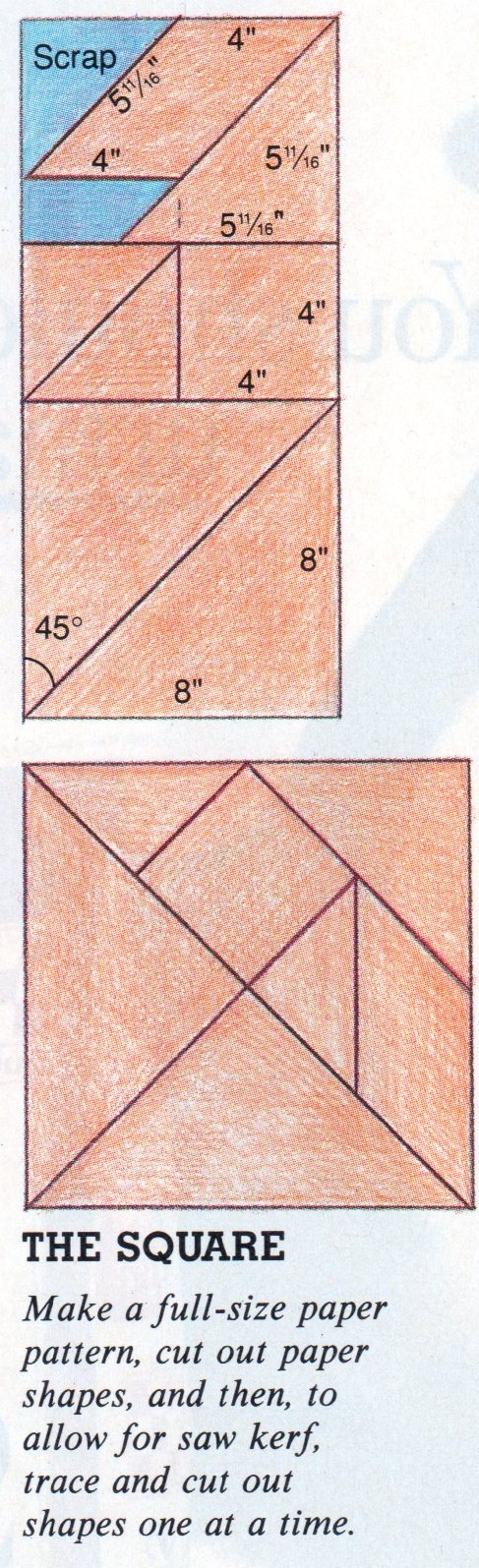
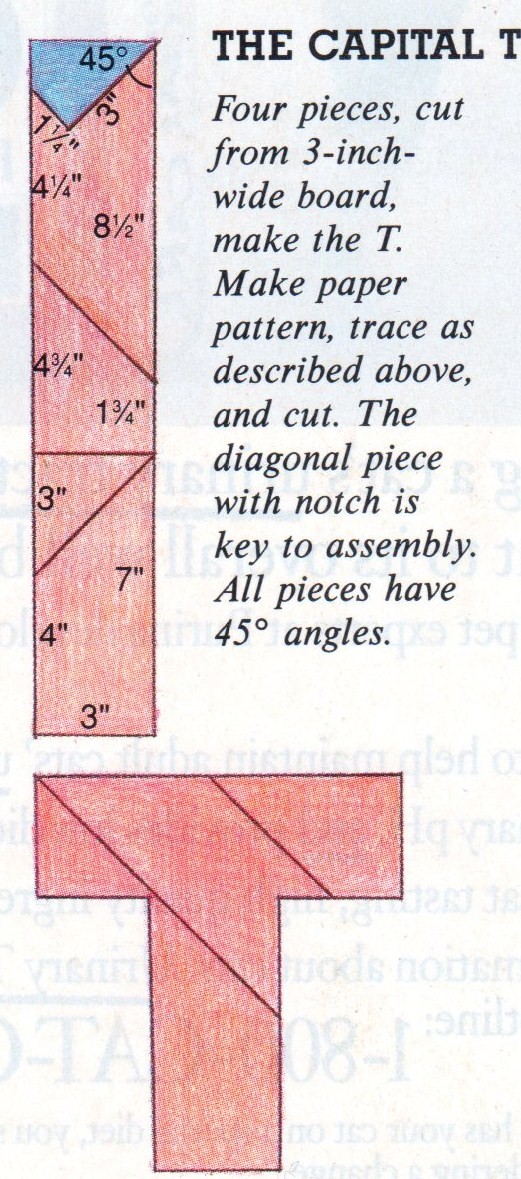
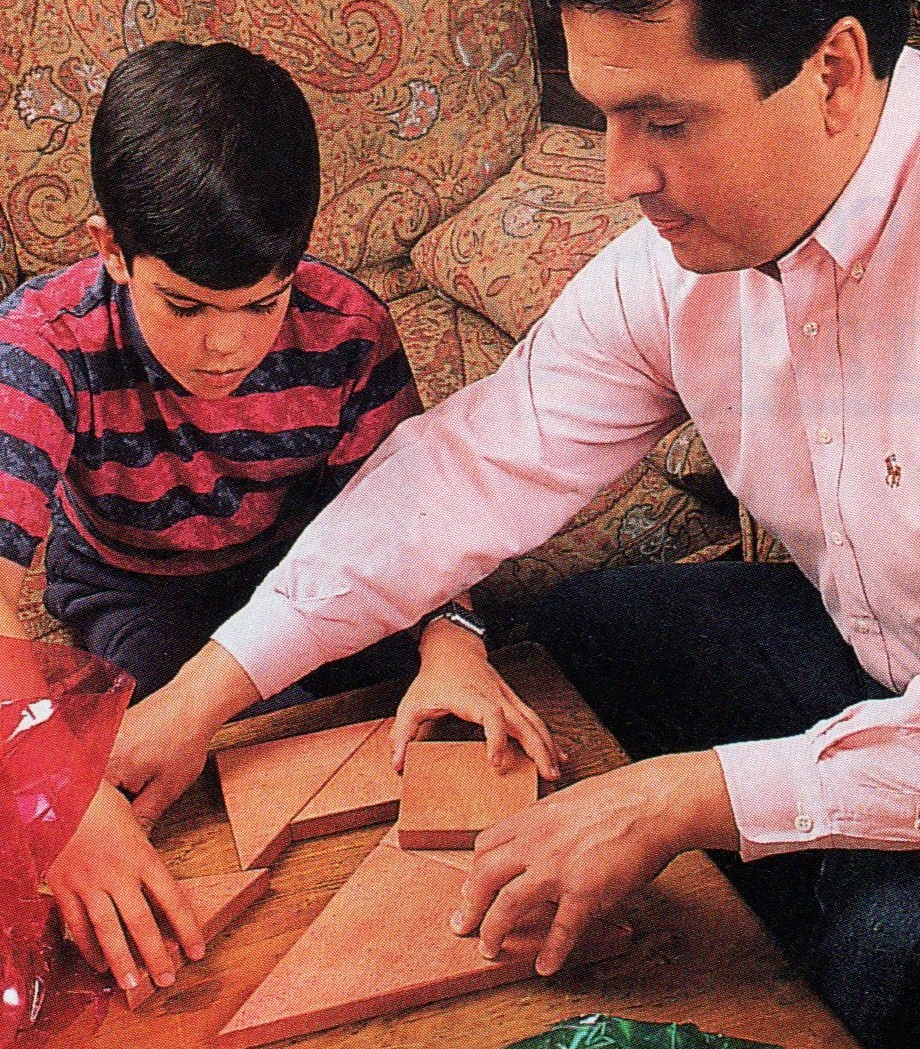
TWO CLASSIC PUZZLES challenge you to ar­range their geometric parts into a square or a capital T. They look easy to make but require careful planning and straight and accurate cuts.

Although similar puzzles are usually smaller, we made these a little oversize: the square has 11 Ma-inch sides, and the T is 10 inches tall. For durability and appear­ance, we made our puzzles from pieces of hardwood (ma­ple and cherry), but you can use any type of wood. You’ll need 2 feet of l-by-4 for the T and the same amount of 1-by-10 stock for the square.

If you don’t have a table saw, ask your lumberyard to rip the l-by-4 to 3 inches in width and the l-by-10 to 8 inches. From these, you can cut the puzzle pieces with a jigsaw or a handsaw. You’ll also need a sanding block, medium- and fine-grade sand­paper, a metal ruler, and a pencil. Sand and seal with paste wax.