
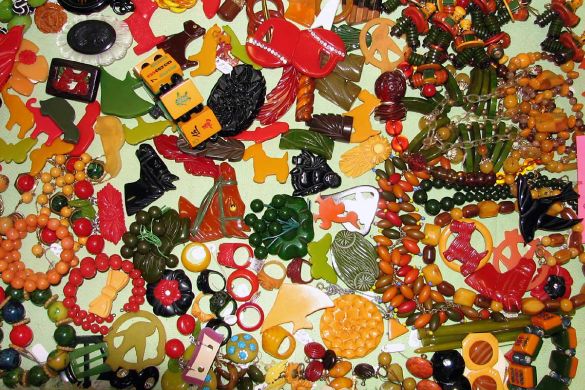
 In 1907, American chemist Leo Hen-drik Baekeland, a Belgian immigrant and former organic chemistry professor at the University of Ghent, began his attempts to synthesize a rubber substitute in his home laboratory. He combined phenol and formaldehyde to make the first synthetic resin that could be substituted for hard rubber. He called his discovery Bakelite, and Baekeland became known as the “father of plastics.”
Once shaped under heat and pressure, Bakelite, tinted in a variety of colors, became rock solid, resisting heat, acids, and electric currents. Unlike rubber, which dried out and cracked, Bakelite endured, making the perfect synthetic polymer from which to mold bracelets, pot and pan handles, the heads of electrical plugs, and radio dials.
In 1927, the Catalin Corporation acquired Bakelite, selling the bracelets through upscale department stores like Saks Fifth Avenue, B. Altman, and Bonwit Teller, but also through F. W. Woolworth and Sears. During the Depression, socialites who could no longer afford to buy jewelry at Tiffany’s and Cartier, embraced vibrantly colored Bakelite bracelets adorned with rhinestones and costing between twenty cents and three dollars. In 1942, Bakelite and Catalin stopped making colorful costume jewelry and instead concentrated their efforts on manufacturing telephones, aviator goggles, and other products for use by the military. By the end of the war, manufacturers switched to newly developed injection-molded plastics, like Lucite, Fiberglass, vinyl, and acrylic, making Bakelite obsolete. Today, Bakelite is prized solely by collectors who scour flea markets, swap meets, and antique shows.
Photo credit: [ http://gaslightshadows.com/bakelite.html ] Please visit this great website chocked full of great information!
 Country & Victorian Times