History of the White Wedding Dress

White has long been accepted as the traditional color of the wedding dress, but wedding gowns were not always white. The marriage of Queen Victoria to her cousin Albert of Saxe- Coburg in 1840 has had more influence on weddings than any other. Queen Victoria put the wheels in motion by marrying in white. Though brides continued to wed in gowns of different colors, white was now set as the color of choice for weddings and has continued ever since. In Godey’s Lady’s Book, 1849, this statement was printed: “ Custom has decided, from the earliest ages, that white is the most fitting hue, whatever may be the material. It is an emblem of the purity and innocence of girlhood, and the unsullied heart she now yields to the chosen one.”

There is an old poem about how the color of your wedding dress will influence your future: “Married in white, you will have chosen all right. Married in grey , you will go far away. Married in black, you will wish yourself back. Married in red, you’ll wish yourself dead. Married in blue, you will always be true. Married in pearl, you’ll live in a whirl. Married in green, ashamed to be seen, Married in yellow, ashamed of the fellow. Married in brown, you’ll live out of town. Married in pink, your spirits will sink.”

The Industrial Revolution also brought about change. By the 1890’s and the arrival of the department store, almost every woman could realize her dream of being married in a “new” wedding dress. The white dress was gaining popularity and in 1890, Ladies Home Journal wrote: “That from times immemorial the bride’s gown has been white”. Although this statement was not true, it shows how deeply accepted it was that a wedding gown be white. Although white was popular, some brides, especially the frontier brides, wore dresses that were more practical and could be worn after the wedding. As wedding dresses closely resembled the fashions of the time, only a little alteration was needed for the dress to be perfect to wear again.

Edwardian brides took the traditions of their Victorian ancestors to new extremes. Fashions became more extravagant as the decade progressed, but came to a screeching halt with the outbreak of WWI. Styles became simpler, and also reflected the changing role of women in society with hems getting shorter and the disposing of tightly laced corsets. Coco Chanel was a powerful force behind the change in women’s’ fashions, and was the one who officially introduced the short wedding dress in the 1920’s. It was a white knee length dress worn with a long train. This cemented white as the universal color of the wedding dress.

When the Depression hit, brides made do with their “best” dress for the wedding. My great grandmother, who was married in 1928 had a new white wedding dress, but after the wedding she dyed it navy, keeping only the collar and cuffs white—a common practice at that time. During WWII, women considered it their duty to give up the traditional wedding , although most brides might be engaged only for a few weeks or even days before the wedding took place. This did not leave enough time to find a wedding dress so the best suit had to do. If the bride was set on having a white dress, one could be borrowed or rented for the ceremony. If both the bride and groom were in the military they were married in their respective uniforms.

After the war, prosperity made it possible for the large dream weddings inspired by the Victorian era to become a reality. Grace Kelly’s marriage to Prince Monaco garnered much publicity because of its grand fairy tale wedding. She wore a white silk and lace gown. The focus of wedding dresses has shifted since the 1950”s. The emphasis now is on the individuality of the bride. So whatever color you choose to be married in, you now know a bit more behind the tradition of the white wedding dress.
Collecting Salt & Pepper Shakers

Who doesn’t own a set of salt and pepper shakers? This is one collectible that everybody has on the table, whether it’s a dime-store duo, a Popeye and Olive Oyl pairing or a sterling silver set from Grandma’s trousseau.

For tabletop collectors, salt and pepper would seem to be a match made in heaven. But it hasn’t always been so. In fact, the pairing of salt and pepper in shakers dates only to the Civil War era. “That’s when two small glass cylinders fitted with metal lids were patented,” explains Dottie Avery, a member of die Antique & Art Glass Salt Shaker Collectors Society in Maitland, Florida. “At first, people were not used to shakers at all. Then the pieces became enormously pop­ular because they were easy and fun to handle.”

Early shakers were fashioned from glass and were known for their swirled patterns, hand-painted designs, pretty colors and “threads” or ridges around the tops. The threads mark them as one of the first containers with screw-on caps.

For Dottie Avery and her husband, Bill, these embellishments only add to die mystique of their two-thousand-plus shaker collection. But such details also make the designs harder to find and more expensive. “We can spend up to several hundred dollars for a single shaker,” Dottie says, “and that means just one of a pair.”
It’s not quite the same for collectors of nov­elty and figural shakers, though. Their passion is the often whimsical shape and color of each set. along with the large variety of motifs. Plus, prices for novelty shakers start as low as 50 cents a pair.

“Most serious collectors look for figural shapes from the 1940s and 1950s, because those are the most charming ones,” says Irene Thom-burg, a collector and member of die Novelty Salt & Pepper Shakers Club in Battle Creek, Michi­gan. Early shapes varied from a pair of sinking battleships commemorating Pearl Harbor, to “Campbell Kids” advertising shakers, to cup­cakes with colored sprinkles.
Other highly prized figural shakers are those created by the German manufacturer Goebel (also known for its famous Hummel figurines). “Goebel started making shakers in 1923. Since then, they’ve produced about eight hundred designs,” says collector Hubert McHugh from Stroudsburg, Pennsylvania. He and his wife, Clara, wrote the book on Goebel shakers—literal­ly. Their findings, in the Goebel Salt and Pepper Shakers Identification and Value Guide, are a must-read for collectors.

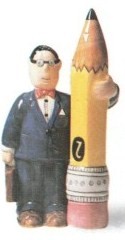
The variety of novelty shakers can be mind-boggling for even the most seasoned collector. Every year sees new designs, like the ceramic “Pencil Pusher” from the Movers & Shakers collection by Fitz and Floyd (above left), or handmade pieces such as the porcelain set with matching tray made by artist Michael Lambert for Freehand (left). Fruits, vegetables and other foods are another perennially popular style. The pewter pear and apple set by Kirk Stieff (above) is one elegant example.

What kind of shakers do serious collectors use on their own tables? There’s definitely irony at work here. “We have a set of plain glass ones from a local store,” says Irene Thornburg. “Salt is cor­rosive and can destroy your collection in no time.”

Annalee History

Annalee Davis Thorndike is an important New Hampshire businesswoman and entrepreneur who built a home craft business in Meredith into a national company. Born in Concord, NH, in 1915, Annalee Davis Thorndike pursued her interest in art by making dolls. Her first creations were marionettes, then she began making cloth dolls. Children of the era typically played with cloth dolls with changeable clothes. Thorndike was not making toys, however. From the beginning, her dolls were in set positions, with the clothes sewed onto the doll. These were dolls for display, each with a story to tell. She began selling the dolls through the New Hampshire League of Arts and Crafts, which later would become the League of New Hampshire Craftsmen. As the Great Depression progressed, she created new dolls with varied materials. During the 1930s Annalee began making her popular skier dolls.

In 1941 Annalee married Charles “Chip” Thorndike, the son of a Boston physician. Chip had become a chicken farmer in Meredith. Chip and Annalee worked on the farm through the 1940s and 1950s, until poultry farming was no longer profitable in New Hampshire. Needing another way to make a living, Annalee returned to making dolls. She started in the kitchen of her Meredith farmhouse, helped by local women. Soon every corner of the house was taken over with doll parts. Thorndike not only employed several women in her home, she took work out to be completed in other women’s homes. Her husband Chip created clever wooden components for the dolls, including skis, ski poles, and little boats. It was Chip who designed the wire frame that held the dolls in position. The doll business was incorporated in 1955 as Annalee Mobilitee Dolls.

Annalee’s dolls from the 1950s appeared in promotions in Manchester and Boston store windows. The State of New Hampshire hired Annalee to create dozens of dolls to help promote tourism. Annalee dolls that were skiing, fishing, and hunting highlighted New Hampshire attractions at the Eastern States Exposition in Springfield, Mass., and at Rockefeller Center in New York City.

The success of the promotional programs launched the popularity of Annalee Dolls. By 1960, the dolls were being sold to retail outlets in forty states, Canada, and Puerto Rico. The company was by then a major Lakes Region business. In 1964, Thorndike moved the operation out of her house and into a “factory in the woods.” It has expanded several times since then.

The individual Annalee dolls document hairstyles and dress of the times, creating a lasting statement about life in New Hampshire since World War II. The exhibition reflected Thorndike’s artistic talent, hard work, and shrewd business sense. The display chronicled her experiences building a small home-based craft industry into a manufacturer of national importance, in the process telling a remarkable Yankee success story of perseverance and creativity.

Hummel History

In 1876, Franz Goebel started a porcelain firm near the town of Oeslauby, Germany. After several years of porcelain production in the factory, Franz’s son, William expanded the Goebel product line and changed the company name to W. Goebel Porzellanfabrik. Convinced that the American market would assist sales, William developed a U.S. product line and sent his 16-year-old son, Max Louis, to America. By 1911, Max Louis Goebel returned to German to move the factory into the 20th century.

In the 1930s, Franz Goebel thought that in a world of political turmoil, customers would respond to a product that depicted the gentle innocence of childhood. The artwork of a Franciscan Sister and gifted artists trained at the Munich Academy, Maria Innocentia Hummel, was introduced to Mr. Goebel. The nun made drawings of country children that were printed as art cards which gained popularity.

Based on the artwork of Sister Hummel, Goebel wanted to produce a line of figurines. The artist was contacted at the Convent of Siessen and was shown clay models based on her drawings. Sister Hummel and the Convent of Siessen granted sole rights to Goebel to create ceramic figures based on her original artwork. Sister Hummel personally approved the sculpting and painting of each porcelain piece. It was determined that earthenware, pioneered by Goebel in the 1920s, was the proper medium for the new line.

About Sister Hummel Maria Innocentia Hummel was born in Bavaria in 1909. In 1927, she enrolled in Munich’s famed Academy of Applied Arts and befriended two Franciscan Sisters from a teaching order that emphasized the arts. She decided to enter the Convent of Siessen upon graduation from art school in 1931, and by 1934, the young nun took the name Maria Innocentia replacing the name Bertha.

The members of the convent encouraged the Sister to pursue her artwork. Soon, small German publishers began printing her artwork in the form of postcards. These charming cards came to the attention of Franz Goebel, the head of the Goebel porcelain company.

The artist worked personally with Goebel’s Master sculptors and painters to create the figurines. First introduced in 1935, the Hummel figurines were an immediate success. The relationship between Hummel and Goebel continued amicably until Sister Hummel’s untimely death at 37 in 1946. Goebel carried on her artistic legacy with new Hummel pieces.

Hummel signature and markings To determine if a figurine, plate, or bell is a genuine Hummel piece, there are definitive marks of identification that should be evident. The mark of Sister M. I. Hummel is incised on every piece. Sister Hummel requested that her personal stamp of approval would appear on every piece and under the direction of the members of the convent, approvals were made with care. All Hummels have a mold number which is a number that is incised on the bottom of each M. I. Hummel figurine at the factory. Another definitive identifier is the Goebel stamp on the underside of the figurine which is an official Goebel trademark. While the trademark has changed over the years, every authentic M. I. Hummel figurine will have a Goebel stamp on its underside. When any change in the backstamp had occurred, it has been a source of great excitement for M. I. Hummel collectors.

Values and specific figurines Hummel figurines are highly sought after by collectors with several models valued at hundreds, even thousands, of dollars per piece. Pieces such as “For Father”, “Globe Trotter”, “Little Goat Herder”, and “Going to Grandmas” are good examples of valuable collectibles. As with all collectibles, condition and rarity will affect value, but don’t let anyone tell you that your Hummel figurine is not collectible or not valuable. Remember, someone who is interested in buying your Hummels for their collection or for resale in their store will most likely not provide an accurate appraised value. Why? They don’t want to pay top dollar for a valuable Hummel!